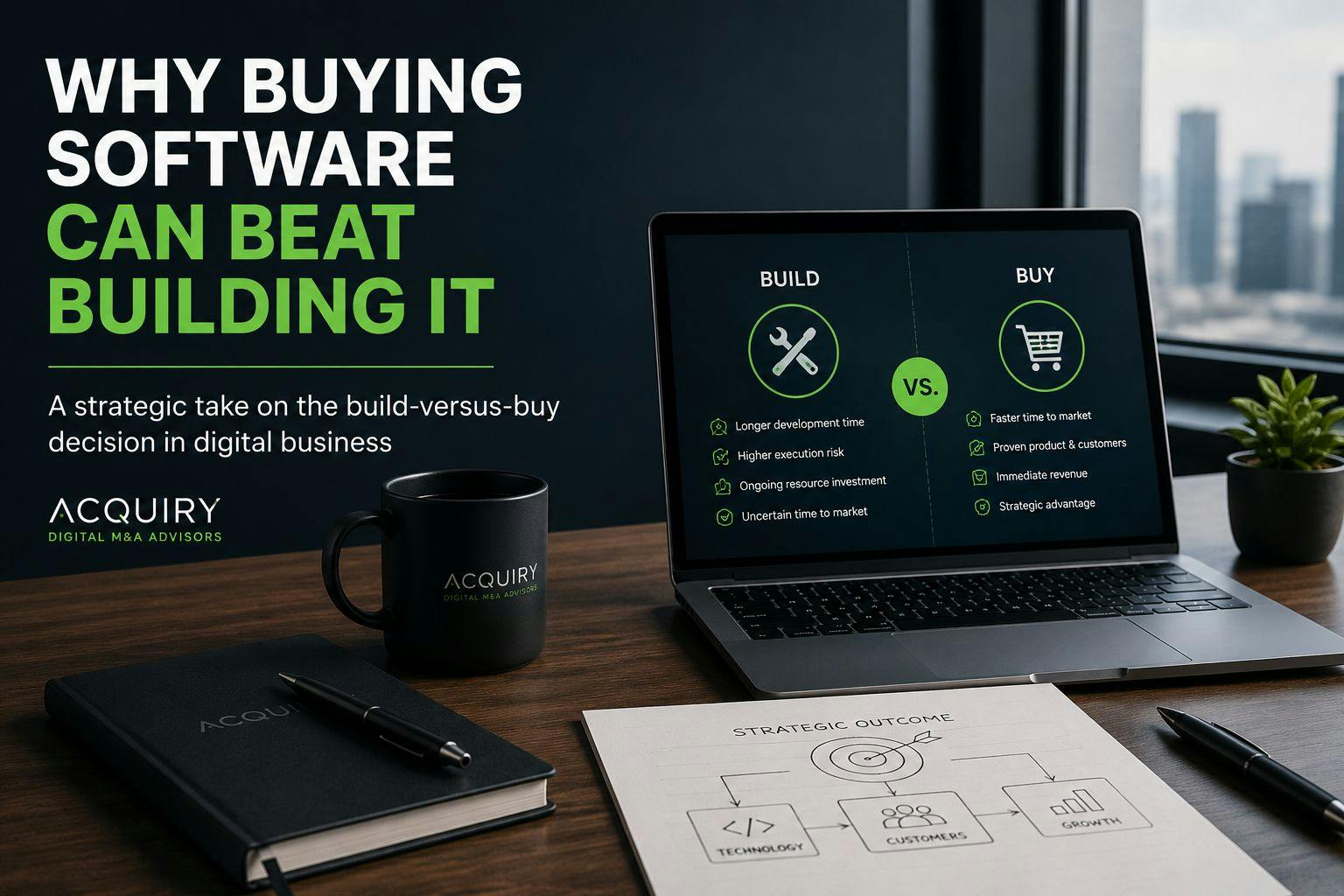
I have always thought the build-versus-buy question is framed too narrowly. A company decides it needs a new product, capability or market position, then someone asks what it would cost to build internally. That number becomes the benchmark for whether an acquisition looks expensive. The problem is that the cost of building is not just engineering salaries and infrastructure. It is also time, execution risk, customer acquisition, product mistakes, hiring, distribution and the opportunity cost of waiting while the market keeps moving. Through my work at Acquiry, I spend a lot of time looking at digital businesses from the buyer's side. The more of these situations I see, the more obvious it becomes that buying can be the cheaper option even when the purchase price is materially higher than the estimated cost of building the same thing from scratch. That is not because M&A is inherently better. It is because the asset being acquired is often much more than the code. The code is usually the easy part Software buyers often begin by looking at the product. They want to know what the platform does, how it is built, how modern the stack is and how difficult it would be to reproduce. All of that matters. But if the product has already been operating in the market for several years, the software itself may be only one part of what has been created. There may also be a customer base, a brand, usage data, integrations, recurring revenue, support processes, documentation, search visibility, partner relationships and a team that understands the edge cases no specification document will ever capture properly. A buyer that chooses to build internally has to recreate some or all of that. This is where the simple comparison between purchase price and development cost starts to break down. A capable engineering team may be able to build a competing product in twelve months. That does not mean the company has recreated the business in twelve months. Time has an economic value The most important variable in many digital acquisitions is time. If a company can acquire a working product with customers today, that can be very different from having a comparable product ready in two years. Markets change. Competitors move. Customer expectations change. Regulatory requirements evolve. Distribution gets more expensive. A delay that looks harmless on a spreadsheet can have a large commercial cost. This is particularly true when an acquisition is being used to enter an adjacent market. Imagine a company that already has distribution and customers but lacks one important product capability. Building internally might cost less in absolute terms, but the company then has to recruit the team, design the product, build it, test it, integrate it and convince customers to use it. Buying an existing business may accelerate that entire process. In that situation, the acquisition is not simply a way to buy technology. It is a way to buy time. Customers are often worth more than the product One of the things I think buyers sometimes underestimate is the value of an existing customer base. A product that has already attracted and retained paying customers has answered a question that a new internal build has not. Someone is willing to pay for it. That sounds simple, but it removes a significant amount of uncertainty. A company can build technically excellent software and still discover there is no efficient way to sell it. It can build something customers like but struggle with onboarding, pricing, retention or support. An acquired business brings evidence. The buyer can see who pays, how long they stay, what they use, where they came from and how the economics actually work. That data can be more valuable than another twelve months of internal product planning. It can also change the way the buyer values the business. A strategic acquirer may not be interested in keeping the target exactly as it is. It may be interested in introducing the product to its own customers, bundling it with another service or using the target's customer relationships to accelerate a broader strategy. That is why the value of the same company can look very different to different buyers. Distribution is hard to build and easy to underestimate A lot of digital businesses are valuable because they have distribution. That distribution may come from direct traffic, search, partnerships, a developer ecosystem, an email list, an enterprise sales team, an app marketplace or years of brand recognition. These channels can take a long time to build. They can also be difficult to reproduce deliberately. A buyer may look at a smaller company and conclude that the technology could be replicated for a fraction of the acquisition price. That may be true. The harder question is whether the buyer can replicate the route to market. If not, the acquisition economics look different. This is one reason I think some of the best digital acquisitions are not necessarily the businesses with the most impressive technology. They are businesses where product and distribution have already been proven together. Integration risk is where the logic can fall apart There is a danger in taking the build-versus-buy argument too far. Buying does not automatically save time. A badly integrated acquisition can consume more management attention and engineering capacity than an internal build. Technology can be incompatible. Teams can leave. Customers can react badly. The buyer can impose processes that slow the acquired business down. A product that worked well independently can become difficult to operate inside a much larger organisation. This is why I think integration needs to be considered before the acquisition is agreed, not after it closes. If the buyer is acquiring a company for its technology, who needs to remain? If it is acquiring the customer base, what changes are likely to affect retention? If the value is in distribution, will integration damage the channel that made the business attractive in the first place? The acquisition thesis should survive contact with the integration plan. If it does not, the buyer may be paying for value that disappears during the handover. Sometimes building is clearly the better decision There are plenty of situations where I would rather build. If the capability is not differentiated, the buyer already has the right team, time is not critical and there is no meaningful customer or distribution advantage in the available targets, an acquisition may be unnecessary. The same is true when the available businesses are burdened with technical debt, weak economics or dependencies the buyer does not want. Buying something simply because it is faster can be a mistake. The right comparison is not build cost versus purchase price. It is the total cost, time and risk of reaching the desired position through each route. That is a much more useful framework. The strategic value has to be specific When I look at an acquisition, I want to understand what becomes possible for the buyer after completion that was not possible before. That answer needs to be specific. "We get a software company" is not enough. "We enter a new market with an established product and paying customers" is much clearer. "We acquire a capability that would delay our roadmap by two years if built internally" is clearer again. The more specific the strategic value, the easier it becomes to understand what the buyer should be willing to pay and what needs to be protected during the transaction. This is also where digital M&A becomes interesting. The purchase price is only one part of the economics. The real value may come from what the buyer can do with the asset after it owns it. The better question I do not think companies should ask whether buying is better than building in general. They should ask which route gets them to the strategic outcome they want with the best combination of speed, cost and execution risk. Sometimes that will be an internal build. Sometimes it will be an acquisition. And sometimes the right answer will be a combination of both, where the buyer acquires a product, team or customer base and then invests heavily after completion. For me, the important thing is to stop treating the acquisition price as the cost of buying and the development budget as the cost of building. Neither number tells the full story. The real comparison is between two paths to the same strategic outcome. Once you look at it that way, a purchase that initially appears expensive can sometimes be the more rational option. This article was published under HackerNoon's Business Blogging program.
Joash Boyton of Acquiry on Why Buying Software Can Beat Building It
Full Article
Original Source
Read the full article at Hackernoon →KhanList aggregates and links to publicly available news content. We do not host full articles from third-party sources. Always verify important information with original sources.