
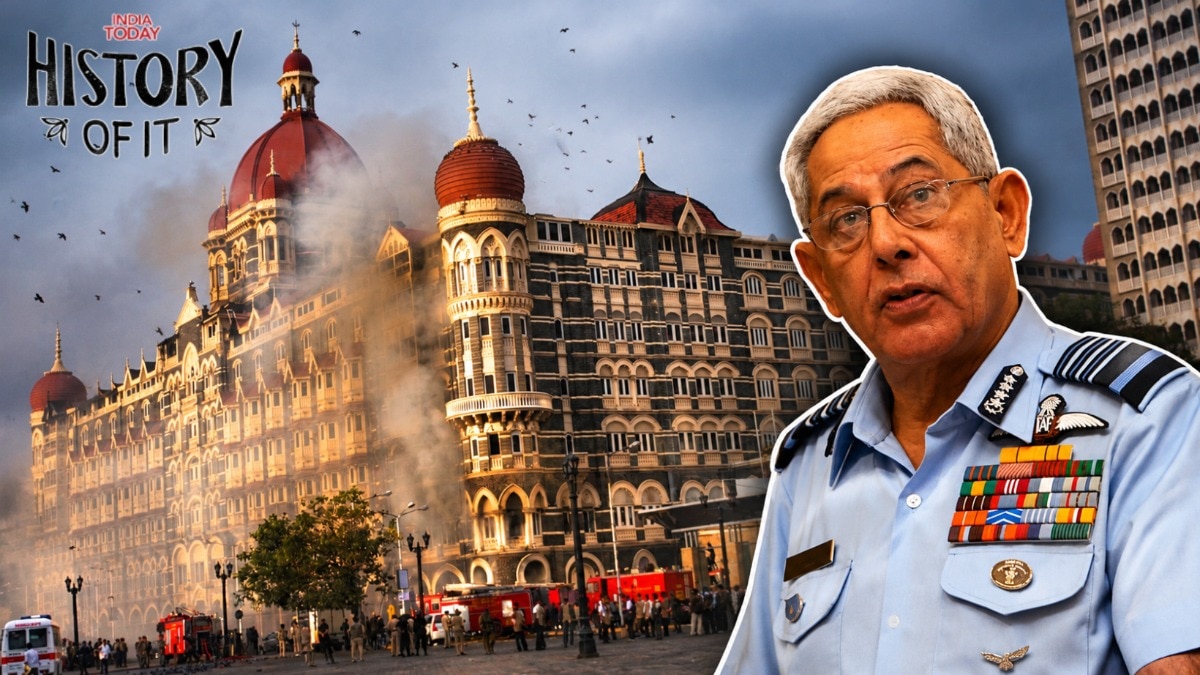
"I personally was looking forward to a strike back to avenge that dastardly act of the terrorists in Mumbai."This is what former Indian Air Force (IAF) chief, Air Chief Marshal Fali Homi Major (retd), recounted while talking about the retaliation plan that the IAF had presented to the Prime Minister's Office after the November 26, 2008, terror attacks in Mumbai. Ten Pakistani terrorists carried out carnage that resulted in the death of 166 people, in what is referred to as the 26/11 Mumbai terror attacks.The attack unfolded over three days, and the IAF had told the government on November 28 that it could launch air strikes on terrorist camps in Pakistan and Pakistan-occupied Kashmir (POK) within 16 hours if given the go-ahead. The plan was readied even as the terrorists were still active, and a definite Pakistani role had been established.In an interview with India Today TV in 2021, Fali Homi Major, who was the IAF chief at the time of the 26/11 attacks, revealed that the plan was presented to the then Prime Minister, Manmohan Singh, when the three service chiefs were summoned to brief the political leadership on India's military options. "We had already discussed amongst our operational staff, and we had a plan ready, which was given to the Prime Minister during this briefing," Major recalled, while speaking to India Today TV.According to a 2015 India Today Magazine report, IAF chief Major told the government that the IAF could carry out air strikes against terrorist camps in POK within 16 hours. Whether the IAF then had the capability to strike terrorist camps in Pakistan and POK, Major's response was unambiguous. "Absolutely. That's what I'm saying. Our aim was for air strikes across, wherever the government intelligence gave us the information about these terrorist camps," said Major.But the expected order from the political establishment never arrived."There was no response. They said that they'll let us know, and that is that. We'll let you know," he said.For a country watching its people and foreigners being held hostage and killed on live television, the prospect of fighter jets crossing the border to hit the infrastructure behind the carnage was a powerful one. India had the evidence of a Pakistani role, the military was examining its options, and the Air Force chief wanted to strike back. But, the government chose restraint. There were several reasons behind it.India observed the 18th anniversary of the 26/11 Mumbai terror attacks on Thursday.What happened inside the Prime Minister's Office in those days? Was India genuinely close to launching air strikes against Pakistan? And why did a government that had military options before it eventually decide against using them?Eighteen years after 26/11, these questions are still relevant, and the answer lies in a series of high-level meetings, a set of military options that went well beyond air strikes, and the difficult calculations of fighting a nuclear-armed neighbour. Former Prime Minister Manmohan Singh, along with then Defence Minister AK Antony, former chiefs of the IAF, Navy and Army, Air Chief Marshal Fali Homi Major(Left), Admiral Sureesh Mehta, General Deepak Kapoor (right) respectively pose for a photo. (India Today Group) MILITARY OPTION WAS ON PM'S TABLE WHEN 26/11 TERROR ATTACK WAS STILL ONOn November 26, 2008, 10 heavily armed Lashkar-e-Taiba (LeT) terrorists from Pakistan arrived by sea in Mumbai and launched coordinated attacks on some of the city's busiest and most prominent locations. The Taj Mahal Palace Hotel, Oberoi-Trident, Leopold Cafe, Chhatrapati Shivaji Terminus and Nariman House became scenes of unprecedented terror killings.The siege lasted nearly three days. By the time security forces neutralised the last terrorists at the Taj on November 29, 166 people had been killed and more than 300 injured.The 26/11 episode was not just another terrorist attack with a Pakistan link. This was different because one terrorist out of the 10, Ajmal Amir Kasab, had been captured alive. Intercepts of conversations between the terrorists and their handlers in Pakistan provided further evidence of the operation's origins. The handlers were directing the attackers from a control room in Karachi, watching the Indian response on live TV.The Congress-led UPA government had then faced enormous public pressure to respond hard. A message against the 26/11 terror attack was painted on a tetrapod opposite the Trident hotel suggesting that the Mumbai spirit is alive and kicking on November 27, 2008 in Mumbai. (Getty Images) According to Sandeep Unnithan's 2015 India Today Magazine report, the first meeting of India's security establishment took place on November 28, even as the final terrorists were still inside the Taj Hotel.PM Manmohan Singh chaired the meeting at the PMO in South Block. National Security Adviser MK Narayanan, Defence Minister AK Antony, the chiefs of the Intelligence Bureau (IB) and Research and Analysis Wing (R&AW), and the chiefs of the Navy and Air Force were present. Army Chief General Deepak Kapoor was away on a visit to South Africa and was represented by Vice Chief of Army Staff Lieutenant General Milan Naidu."The prime minister sought the assessment of intelligence agencies and the military's options for dealing with Pakistan. A military response was very much under consideration," the India Today Magazine report said, citing officials who had attended the meeting.The first option that came out in the meeting was to use the Army's Cold Start doctrine."The Indian Army's plan for swift and shallow thrusts across the International Border without waiting for a full-scale mobilisation. It was developed after it had taken the Army more than a month to fully mobilise along the Pakistani border after the attack on India's Parliament in December 2001. But the option of using Cold Start was discarded," the India Today Magazine report revealed.A cross-border military strike, particularly against the LeT headquarters at Muridke in Pakistan's Punjab province, was also on the table, but it risked turning the Mumbai terror attack into a full-fledged India-Pakistan confrontation."Lt General Naidu also said he would rather wait for the Army chief to return from South Africa. The Navy did not have a swift retaliatory option either. Navy chief Admiral Sureesh Mehta said his forces were not ready yet and did not have a 'Cold Start' doctrine," according to India Today Magazine.The Air Force offered a more immediate and planned possibility.According to Unnithan, Air Chief Marshal Major told the government that the IAF could carry out air strikes against terrorist camps in Pakistan and POK within 16 hours. But there was a catch. The Air Force needed precise coordinates of the camps to ensure that the strikes hit their intended targets without causing civilian casualties."The intelligence agencies did not have such precise information. The military option was postponed," according to the report.At a meeting on December 2, National Security Advisor MK Narayanan presented five options, ranging from covert operations against the LeT leadership to air strikes on its camps in POK and a limited war. But each came with serious complications.The then Foreign Secretary Shivshankar Menon, in his book Choices: Inside the Making of India's Foreign Policy, offered another reason why a military strike might not have achieved much. "A limited strike on selected terrorist targets — say, the LeT headquarters in Muridke or the LeT camps in Pakistan-occupied Kashmir — would have had limited practical utility and hardly any effect on the organisation," he wrote.He pointed out that the camps were often "tin sheds and huts, which could be rebuilt easily". "Collateral civilian damage was almost certain," Menon added in his book. The Mumbai terror attack of 2008 was the first terror attack in India to be captured live on television screens. (India Today Group) THE AIR CHIEF WANTED RETALIATION. THE FOREIGN SECRETARY DID TOOMenon, who was the Foreign Secretary during the attacks and later became the NSA, provided a particularly candid account in his 2016 book. He wrote that he himself pressed for immediate and visible retaliation against the LeT's headquarters in Muridke, its camps in POK or the ISI, which he believed was complicit in the attack.He wanted India to respond not just to deter future attacks but also to "restore" its international credibility after the security failures exposed during the three-day siege."I am often asked, 'Why did India not attack Pakistan after the 26/11 attack on Mumbai?' Why did India not use overt force against Pakistan for its support of terrorism?" Menon wrote.He then adds an admission. "I myself pressed at that time for immediate visible retaliation of some sort, either against the LeT in Muridke, in Pakistan's Punjab province, or against their camps in Pakistan-occupied Kashmir, or against the ISI, which was clearly complicit."He also revealed that he urged both the External Affairs Minister Pranab Mukherjee and PM Singh to retaliate. Mukherjee, according to Menon's account, appeared to agree and publicly maintained that all options were open.But the Foreign Secretary's position changed after the government examined the consequences. During the 26/11 Mumbai terror attacks, 15 Mumbai Police personnel, one Home Guard, one Railway Protection Force constable and one State Reserve Police Force constable were killed in the line of duty. Two National Security Guard (NSG) commandos also lost their lives, taking the total number of security personnel killed to 20. (Getty Images) "On sober reflection and in hindsight, I now believe that the decision not to retaliate militarily and to concentrate on diplomatic, covert, and other means was the right one for that time and place," wrote Menon.His argument rested on a crucial distinction that attacking Pakistan could have shifted the international focus from the perpetrators of 26/11 to the confrontation between two nuclear-armed neighbours.Instead of the world discussing Pakistan-based terror networks and their links to the establishment, the crisis could have become another India-Pakistan dispute, with both sides being asked to exercise restraint.Menon believed this was precisely what Pakistan's Army wanted.At the time, Pakistan's civilian government under President Asif Ali Zardari was relatively more interested in improving relations with India than the powerful military establishment."An Indian attack would have united Pakistan behind the Pakistan Army, which was in increasing domestic disrepute, disagreed on India policy with the civilian-elected government under President Asif Zardari, and was half-heartedly acting against only those terrorist groups in Pakistan that attacked it," he wrote.There was also a political opportunity that India could have lost. Pakistan's Foreign Minister Shah Mehmood Qureshi was visiting New Delhi when the attacks began. The government under Zardari was already facing pressure from the military. An armed conflict could have strengthened the Army's position at the expense of the elected government.Then, there was tremendous international pressure on India not to attack Pakistan.THEN US PRESIDENT BUSH, SECY OF STATE CONDOLEEZZA SOUGHT RESTRAINT FROM INDIAPakistan moved quickly to internationalise the crisis even as the 26/11 attacks. Menon in his book revealed that Pakistan's first reaction was to approach the United States and the United Kingdom, seeking their intervention to restrain India from launching a war between two nuclear-armed neighbours. Islamabad appeared to anticipate an Indian military response and wanted major powers to step in before the situation escalated.Condoleezza Rice, then US Secretary of State, was among the key American officials involved in the diplomatic effort to prevent the crisis from escalating. According to the Brookings Institution's analysis "Avoiding Armageddon", Rice and then President George W Bush spoke directly to both Pakistani President Asif Ali Zardari and PM Manmohan Singh, cautioning them against allowing the situation to spiral out of control.Washington's message was two-fold. It urged India to exercise restraint, while Pakistan was asked to cooperate with the investigation into the attacks.The pressure on New Delhi was not limited to Pakistan's diplomatic outreach.Washington's concerns went beyond preventing another India-Pakistan conflict. "More than 80% of Nato's supplies for its war in Afghanistan passed through Pakistan, making the routes vulnerable if the two countries went to war," the Brookings analysis detailed adding that the global economy was also in the middle of a severe crisis in late 2008, and a military confrontation could have worsened the situation. Above all, the possibility of escalation between two nuclear-armed countries carried catastrophic consequences.India faced immense international pressure after the 26/11 attacks. People demanding death by hanging punishment for terrorist Ajmal Kasab. He was executed by hanging on November 21, 2012. (Getty Images) THE NO-STRIKE DECISION STILL HAUNTS THE CONGRESS POLITICALLYThe decision not to strike did not end the debate. If anything, Pakistan's failure to bring the masterminds of 26/11 to justice ensured that the question would return whenever India faced another major terror attack.In October 2025, after India's Operation Sindoor in May, Prime Minister Narendra Modi questioned who had stopped the armed forces from attacking Pakistan after the 26/11 Mumbai carnage. An India Today interview from 2021 with former Air Marshal Major went viral, bringing renewed attention to his account of the operational plan and the government's failure to give the go-ahead.India's subsequent responses suggest that its approach has evolved considerably.Following the Uri terror attack in September 2016, the Indian Army announced surgical strikes against terrorist launch pads across the Line of Control. In February 2019, after the Pulwama suicide bombing, the IAF carried out air strikes against a Jaish-e-Mohammed (JeM) facility in Balakot. And in May 2025, India attacked terrorist camps in Pakistan after the Pahalgam terror attack. National Security Guard (NSG) commandos in action near Taj Mahal hotel in Mumbai. (India Today Group) The political and strategic circumstances of these operations were different from those of 2008.Menon himself had anticipated that the restraint exercised after 26/11 might not be repeated.He detailed that another attack of similar magnitude originating from Pakistan would make it virtually impossible for the Indian government to make the same choice again.The story of 26/11 is therefore not simply one of a government refusing to retaliate despite its military being ready. It is a story of a country confronting an extraordinary provocation, the military examining ways to strike back, and the political leadership weighing the possibility that a limited operation could spiral into a war neither side could control.The eventual decision was to hold fire. Eighteen years later, the jets never having taken off remains one of the most consequential military decisions of the Manmohan Singh government. Whether it was strategic restraint or a missed opportunity to establish deterrence is a question that India continues to debate.- Ends
Jets ready, attack plan on PM's table: Why India didn't strike Pak after 26/11
Full Article
Original Source
Read the full article at Indiatoday →KhanList aggregates and links to publicly available news content. We do not host full articles from third-party sources. Always verify important information with original sources.