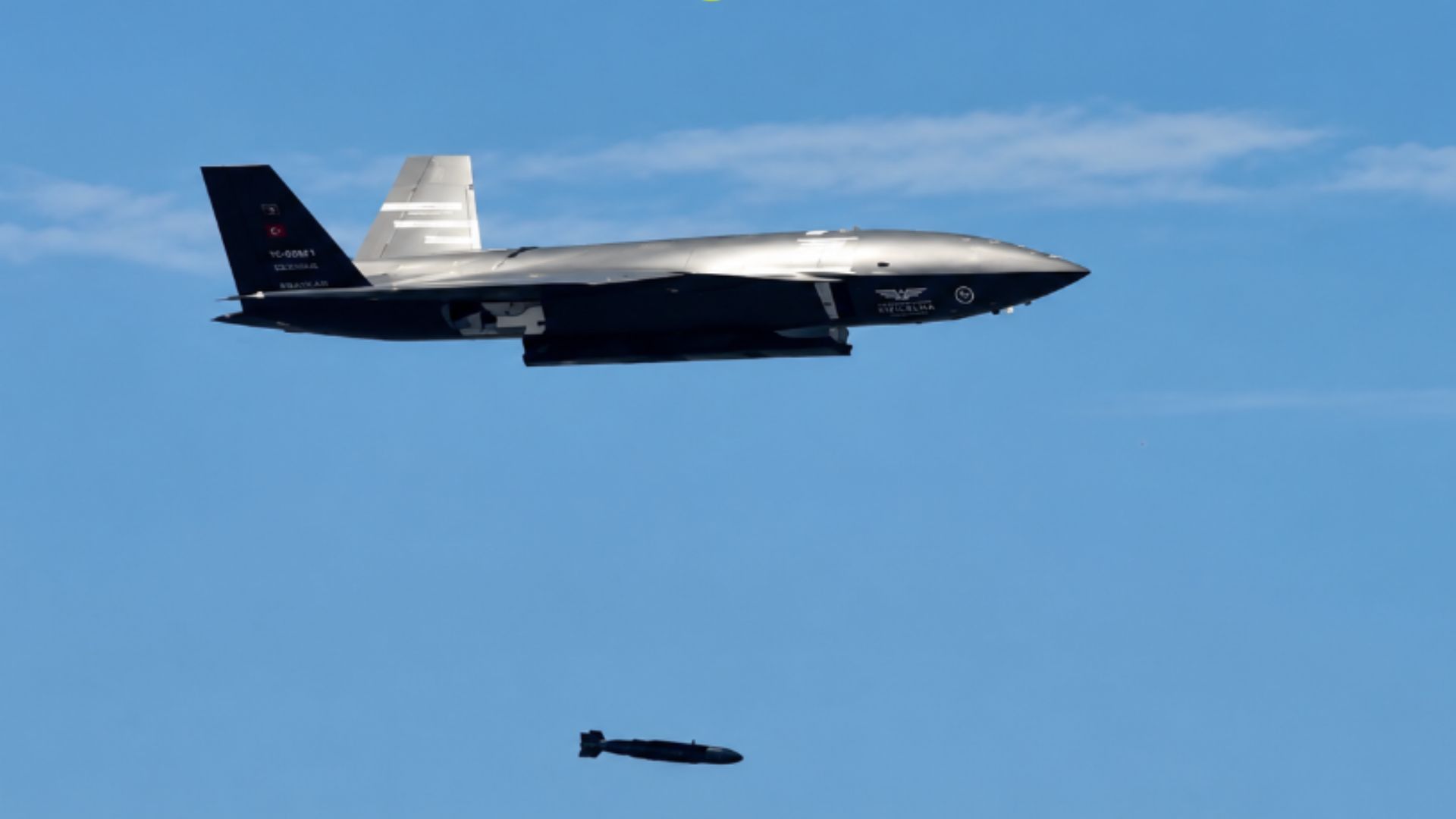
Türkiye’s Bayraktar KIZILELMA unmanned fighter aircraft has reached another important development milestone after completing its first live-fire tests using munitions carried inside its internal weapons bay. The achievement marks a significant step toward the aircraft’s goal of combining precision strike capabilities with the reduced radar signature typically associated with stealth aircraft. The tests were carried out at Baykar’s Flight Training and Test Center in Çorlu, where the serial-production S2 aircraft successfully released two different precision-guided munitions from its internal bay, scoring direct hits on designated ground targets. According to the company, the aircraft first employed ROKETSAN’s TEBER-82 guided bomb on July 25, followed by ASELSAN’s TOLUN precision-guided munition during a second test on 28 July. Both weapons successfully struck their intended targets after being released from inside the aircraft’s fuselage. Why the internal weapons bay matters While precision-guided bomb releases are routinely demonstrated by many combat aircraft, the real significance of these tests lies in how the weapons were carried. Unlike conventional external hardpoints mounted beneath the wings, an internal weapons bay allows an aircraft to carry its weapons entirely inside the fuselage. According to Baykar, this configuration enables KIZILELMA to preserve its low radar signature while maintaining aerodynamic efficiency and high-speed performance during combat missions. Carrying weapons internally reduces the aircraft’s radar cross-section because external stores often create additional radar reflections. It also minimizes aerodynamic drag, allowing the aircraft to maintain better performance while operating in heavily defended airspace. For modern combat aircraft, internal weapon carriage has become one of the defining characteristics of low-observable designs, helping improve survivability without sacrificing offensive capability. Expanding an increasingly diverse weapons portfolio The successful release of TEBER-82 and TOLUN also represents another step in KIZILELMA’s growing weapons integration program. According to Baykar, the aircraft has already completed firing tests with several domestically developed munitions, including the GÖKDOĞAN beyond-visual-range air-to-air missile, JET-230 supersonic missile, KGK, LGK-82, and previous versions of the TEBER and TOLUN precision-guided weapons. The latest milestone demonstrates that those capabilities are now being extended to internally carried munitions rather than relying solely on external weapon stations. The company says expanding compatibility with indigenous Turkish weapons remains one of the key objectives of the aircraft’s ongoing flight-test campaign. A different kind of combat drone Unlike many unmanned aerial vehicles that are primarily designed for reconnaissance or ground attack, KIZILELMA is being developed as a jet-powered unmanned fighter aircraft capable of undertaking missions traditionally assigned to crewed fighter jets. The platform is intended to conduct precision strike missions, air-to-air engagements, and operations in contested environments where survivability is critical. Previous milestones highlighted by Baykar include autonomous close-formation flights between two KIZILELMA aircraft and successful testing of the GÖKDOĞAN beyond-visual-range air-to-air missile, which the company described as the first time an unmanned fighter aircraft destroyed a jet-powered aerial target using a BVR missile. These demonstrations illustrate the program’s broader objective of developing an unmanned platform capable of performing increasingly complex combat missions rather than serving solely as a conventional strike drone. Another milestone on the road to operational service Although KIZILELMA is still undergoing development and flight testing, the successful internal weapons bay firings represent an important engineering milestone. Integrating precision-guided munitions while preserving the aircraft’s low-observable characteristics is a capability shared by only a small number of modern combat aircraft. As Baykar continues integrating additional indigenous sensors and weapons, the latest tests suggest the aircraft is steadily progressing toward its intended role as a multi-mission unmanned combat platform capable of conducting precision strikes while operating in increasingly challenging air defense environments.Recommended ArticlesGet the latest in engineering, tech, space & science - delivered daily to your inbox.Kaif Shaikh is a journalist and writer passionate about turning complex information into clear, impactful stories. His writing covers technology, sustainability, geopolitics, and occasionally fiction. A graduate in Journalism and Mass Communication, his work has appeared in the Times of India and beyond. After a near-fatal experience, Kaif began seeing both stories and silences differently. Outside work, he juggles far too many projects and passions, but always makes time to read, reflect, and hold onto the thread of wonder.
Jet-powered combat drone aces live-fire tests using hidden internal weapons bay
Full Article
Original Source
Read the full article at Interestingengineering →KhanList aggregates and links to publicly available news content. We do not host full articles from third-party sources. Always verify important information with original sources.