
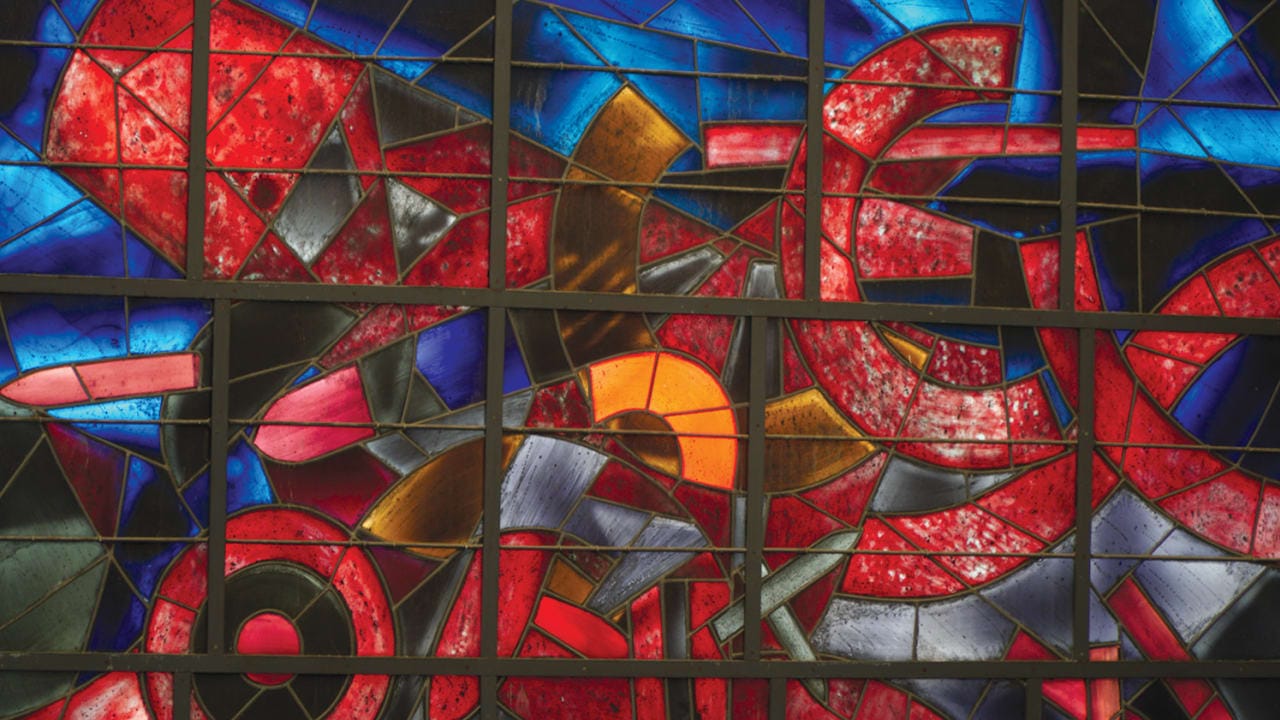
OCTOBER 3, 2026 20:22As the offspring of a Holocaust survivor, I try to stay clear of comparisons between the most cataclysmic chapter in Jewish history and any of the – sadly, all too many – other disasters that have befallen us right through our timeline.But it must be said that Oct. 7 comes close, and has left deep scar tissue and open emotional wounds that may never fully heal.That is where art can come in and lend a recuperative or, at the very least, soothing hand.There are historical, corporeal facts on the ground that support that supposition in the form, for example, of the astoundingly rich cultural life Jews led when incarcerated behind forbidding walls in the Warsaw Ghetto. Despite the desperate existential plight in which the inmates found themselves, they defiantly clung to a spiritually enriched way of life, and maintained their humanity for as long as they possibly could, engaging in theatrical and musical entertainment for fearful people starved of physical sustenance.These days Israel finds itself largely politically-culturally incarcerated by members of the global political arena who impose and promote boycotts of anything that smacks of Israeli content. That strays far beyond political and military parameters and affects our artists, who simply want to keep creating and spread their rich expressive word as far and as wide as they can.Sigalit Landau’s video slot in the Or Chozer exhibition infers a dystopian view of our future. (credit: SIGALIT LANDAU)But while the number of foreign artists and institutions, across all areas of cultural endeavor, willing to come over here or even collaborate with their Israeli counterparts elsewhere continues to be depressingly negligible, our own homegrown artists maintain the good fight, keeping tabs on their muses and producing the quality, inspiring, heartwarming, spiritually uplifting goods time and time again.That much is clear from the rollout of the current Jerusalem Biennale, which opened for business last week – postponed from May due to Iranian-Israeli shenanigans – and is due to run at all manner of museum, gallery, and ad hoc display spaces across the city through to mid-November. The breadth of styles, chromatic presentations, ideas, viewpoints and emotional undercurrents is mightily impressive.Feeding off the bad vibesBiennale founder Rami Ozeri believes that is part and parcel of the quotidian artistic condition, as well as a direct result of our ongoing predicament.“The situation actually generates two contrasting things,” he posits.“First, it detaches us from a lot of connections and friendships and institutions around the world. Those connections are enriching. When they exist, they help creativity. It is not good to be disconnected.”Clearly, but Ozeri also sees the benefits of the sizable challenges faced by the Israeli artistic community.American-Israeli artist Caron Tabb’s ‘On the Face Of It’ explores poignant themes of memory, loss, identity, compassion, and spirituality. (credit: Julia Featheringill)“The intensity of our reality, and the pain we feel every single day, and the very significant things that have been happening here in the past few years, provide a very fertile platform for art.”That sounds suspiciously similar to the age-old cliché of artists having to suffer for their art.Setting hackneyed adages aside, Ozeri says the fruits of paying one’s dues, whether by choice or imposition, are being unfurled for our viewing and sensorial pleasure in the multi-exhibition program.That, he notes, is reflected in the choice of the titular banner for the biennale’s seventh edition. There is a clear spiritual element to the logistical mix.Pamela Silver’s ‘Sunrise Over Jerusalem’ is an explosion of vibrant colors. (credit: MICHAEL AMAR)“I think that is what the title, ‘Mima’amakim’ [from the depths or, as the official non-Hebrew moniker has it, De Profundis], is trying to encapsulate. It starts from prayer. They say that when prayer comes from a low, deep place, it is more powerful and meaningful.”The same, he argues, goes for the creative process. “When art comes from a sense of being satiated, from quietness, it is very limited. When art is spawned by trauma, by a wound, by struggle and pain, that is art which has a lot of power.”Unfortunately, we have plenty of all those elements to draw on.That, Ozeri feels, more than makes up for almost blanket worldwide exclusion.“Despite the disconnection from international ties, we manage to create excellent art. Israeli artists are rising to new heights, de profundis, from the depths. Their works are very charged with meaning. They have a lot of strength that comes from our reality.”Drawing from the depthsThe event header comes from the opening verse of Psalm 130: “Out of the depths I cry to you, Lord; Lord, hear my voice.”That plaintive heavenward appeal is, naturally, a close fit for our present state of affairs. There is no escaping the trauma of Oct. 7, or our continuing unresolved security issues.Yehudit Sasportas premieres a video and sound installation at the Tower of David Jerusalem Museum. (credit: Yehudit Sasportas)Ozeri is as painfully aware of all that as the rest of us, and it was clear to him, from the outset, that it would filter through the logistical and artistic choices made in the lead-up to the biennale.“When we chose the theme, we still had hostages in Gaza; there were people being killed there. There was a lot of pain and trauma.”The current edition of the biennale addresses that and tries to offer some light and hope amid the darkness and sorrow.“De profundis is designed to try to generate some movement, to recognize the fact that we are down there in the depths. But this is about ‘out of the depths,’ to set us in motion towards healing and improvement of our quality of life.”Hanita Ilan’s large painting at Hamiffal takes a contemplative look at Jerusalem’s history. (credit: JERUSALEM FINE ART PRINTS)Light is generally not in ready supply the deeper you dig into solid substances or through emotional strata. There is, however, an abundance of illumination in the program centerpiece – “Or Chozer: An Active Vision.” Or Chozer translates as “Reflected Light” and references a Kabbalistic concept whereby humankind returns divine light to its celestial origin, after having shared its benefits.The exhibition opened last week at the former home of the National Library of Israel, on the Givat Ram campus of the Hebrew University, specifically on the first floor of the celebrated cavernous, currently disused edifice.US-born Jerusalemite multidisciplinary artist Andi Arnovitz’s ‘Isaiah Is Waiting’ sketches set features snapshots of highly emotive events from Oct. 7 and the ensuing war. (credit: JERUSALEM FINE ART PRINTS)The hall in question houses the monumental stained-glass window triptych created by Mordechai Ardon over 40 years ago. The three-parter’s official title is “Isaiah’s Vision of Eternal Peace,” otherwise known simply as the Ardon Windows.As the biblical reference infers, there is so much to the substantial creation that was once frequently passed and, no doubt, intermittently observed and admired by then library users. And there is much to draw on, aesthetically, stylistically, and culturally.The windows sport sumptuous colors – predominantly red, blue, and white – with a whole host of surreal and symbolic shapes and forms that suggest manifold lines of thought and inspiration. Jewish mysticism is well and truly in there, and the hues Ardon used almost knock you off your feet.Harmony in art“Or Chozer” is curated by Dr. David Sperber and artist Porat Salomon. The pairing of a reform rabbi – Sperber – and a settler, as Sperber put it, is in itself quite a declaration of harmonious intent.“Putting us together goes against the standard grain of a religious man and a secular one,” Salomon notes. “We are, as it were, at different ends of the religious spectrum. But we haven’t spent even one moment discussing that.”And they haven’t come to blows? I jokingly interjected. “We came close to it,” Salomon shot back in a witty touché.That seamless flow, says Sperber, is at the core of the whole event.“That is important in the context of the Jerusalem Biennale. There are people who think it is a biennale of Jewish art and, therefore, a religious project. I have been a part of the biennale since the beginning, and I can say that is not true. This is a biennale which brings everything together and somewhat challenges the divisions [between religiously observant and secular Jews].”The coalescence of seemingly contrasting philosophies and lifestyles is central to the Ardon triptych, and the contemporary items Salomon and Sperber have physically and conceptually wedded with the veteran work address that, as well as, inevitably, that fateful day almost three years ago now, when our faith in the safety of our homeland was brutally shattered.“Oct. 7 is undeniably at the core of this exhibition,” says Sperber. That, and violent altercations in general.“The triptych talks about the [utopian] vision of Isaiah: ‘and they shall beat their swords into plowshares, nation shall not lift up sword against nation, neither shall they learn war anymore.’ That is in the Ardon Windows. I don’t know if, at this time, we can even consider a situation like that.”Still, one can dream. “Perhaps we should think about that,” Sperber continues. “That is what the [contemporary] works express vis-à-vis the windows.”One current-day contribution to that intriguing philosophical and conceptual dialogue is the “Isaiah Is Waiting” set of sketches by US-born Jerusalemite multidisciplinary artist Andi Arnovitz.It is a highly emotive series that evokes all sorts of heightened feelings and sensations, offering a string of snapshots from a storyboard of the tortuously interminable captivity of our hostages, and the war, in Gaza.There is an image of pianist Alon Ohel returning to Israel after over two years in a Hamas tunnel, one of a decimated Gazan neighborhood, and another of a house on Kibbutz Be’eri reduced to rubble.Perhaps the most recognizable and painful of the 11 sketches shows the parents of hostage Hersh Goldberg-Polin, Jon and Rachel, after their son was murdered almost a year after his abduction.Visitors to the former National Library building will be drawn – corporeally – into the thick of the emotional mix evoked by the method of making visual contact with the Arnovitz works.“There is a View-Master close to the windows, and people will be able to see the pictures by looking through the viewfinder,” Salomon explains.The interface of a toy used by kids worldwide to get a 3D look at Disney characters and other similarly entertaining content, and the aftermath of the horrors of the violence that erupted down South three years ago, he says, spawns an oxymoronic fusion designed to grab us by the heartstrings.“The sketches capture difficult moments of trauma and memories from that time,” says Salomon.“Isaiah Is Waiting” also feeds off the Ardon centerpiece in a direct, elemental way.“The light that illuminates the sketches in the View-Master comes from the windows,” he adds.Glimmers of better thingsto comeAriane Littman’s installation also gets its visual and ideational nutrition from the triptych.Over the past three-and-a-half decades, the Swiss-born Jerusalemite multidisciplinary artist has gained a reputation for her no-punches-pulled output, particularly since Oct. 7.Her layout at the former National Library building takes the feral line to expressing her thoughts and feelings about where we are at these days, comprising receptacles of various shapes and substances and a maze of bandage-like material, all suffused with a sanguine-tinted liquid. No prizes for guessing the inference there.“The cloth drips blood, and all juxtaposed with the very red section of the windows,” Sperber explains.That sounds highly dramatic and dystopian, but there is hope of better things to come in there, too.“It is very red at that spot in the Ardon work, but there is also the prophetic vision of Isaiah, with the healing element.”Sperber says Littman gained some spiritual encouragement from her project. “It was her way to cope with reality here, to accommodate her own pain.”That sounds like the quintessential site-specific effort, fueled by both the spirit and aesthetics of the host windows.There is more soul-seeking in a video creation by internationally renowned artist Sigalit Landau, who has drawn on the Dead Sea for inspiration for many years now.“She has been engaging with the Dead Sea for so long,” Salomon notes. “That is her ‘excavation site’ from which she gleans all the power of her art.”The footage she shot at the lowest point on the face of the Earth shows a static figure standing on a revolving islet in the briny body of water. It is a Sisyphean scene, with the character not making any progress toward some unknown destination.“I see Sigalit’s oeuvre in the context of the fate of the Israelis and the Jewish people. In the past she called that the ‘infinite solution.’”That automatically and intentionally triggers thoughts of the Nazis’ “Final Solution.”Belu-Simion Fainaru, whose global profile continues to rocket and is currently representing Israel at the Venice Biennale, has a somewhat cryptic item in “Or Chozer,” in the form of an alternative neon exit sign.“It shows the words ‘yihyeh tov’ (things will be OK). That may mean things really will work out. But we all know the Israeli expression ‘yihyeh tov’ and what it may imply,” Salomon says with more than a touch of dark humor. “We say that, often, when we don’t actually know things will turn out in our favor.”As ever, time will tell.Other items in the expansive “Or Chozer” spread include a video work by French-born Israeli artist Yosef-Joseph Dadoune, shot in the Louvre, and a very large oil painting by Hanita Ilan, winner of last year’s prestigious Rappaport Prize, which approaches historical material about Jerusalem through a contemplative look at a particular moment in the city’s development, comprising snippets of information, photographs, archival documents, and testimonies.Arab-Israeli artist Asad Azi bridges the ethnic-religious divide with a pair of paintings with a leitmotif of an Arab riding a donkey, which many visitors will, no doubt, associate with the coming of the Jewish Messiah.Israeli-Arab artist and actress Raida Adon also features in the biennale hub.“We are showing a simple and beautiful video work she created when she was still a student at Bezalel,” says Salomon. “I think she was the first Palestinian artist to have a large exhibition at the Israel Museum. She is seen walking through the Via Dolorosa, in the Old City of Jerusalem, with a cutout of a house on her head. That is, of course, a house with no foundations, and is similar to the wall in the Ardon Windows.”That makes for a neat seamless fit.“That work is another example of asking questions vis-à-vis the [prophetic] vision. It raises thoughts about home, and where that exists.”An abundance of questions and issues is on display across no fewer than 42 exhibitions, at 21 venues, in the largest biennale to date.Other shows to watch out for include Ilan’s collection at Hamiffal, and South African-born Pamela Silver’s rich “Undercurrents” rollout at the Mormon University, with a retrospective of watercolors and monotypes created over the past 25 years.Over at the Tower of David Jerusalem Museum, Yehudit Sasportas premieres a video-and-sound installation, and there are contributions from some 80 artists from abroad dotted around town.Our security and political issues may be a tough burden to bear, and we may be getting a resounding cold shoulder from many cultural bodies and personalities around the globe, but it doesn’t look like anyone or anything is going to stop our talented artists from having their say, come what may.For more information, click here.Follow us on Google
Jerusalem Biennale turns trauma and pain into art, healing, and hope
Full Article
Original Source
Read the full article at Jpost →KhanList aggregates and links to publicly available news content. We do not host full articles from third-party sources. Always verify important information with original sources.