
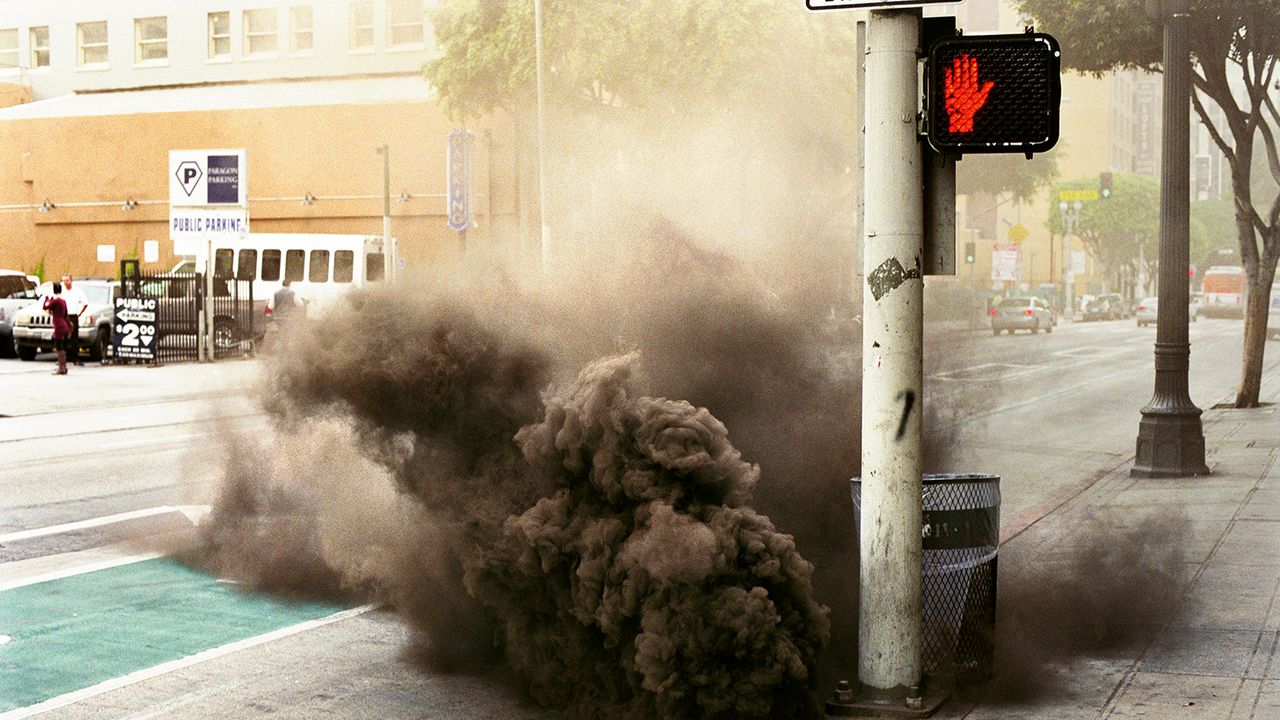
Jerry Hsu became a professional skater at 16, which is to say he’s spent the majority of his life looking at the world differently than most. Skating is a pursuit that requires you to see the potential in things everyone else has agreed to ignore. A jagged brick wall becomes something to glide on. A dirty gravel pit becomes something to clear. The outside world starts to look like a playground of possibilities. Once you learn to pay attention, there is the potential for magic around every corner. It turns out this is pretty good training for becoming a photographer.Hsu, now 44, has carried a camera for much of his adult life, developing a wide-ranging photographic practice alongside his 20-plus-year career in skateboarding. In 2017, he “fake retired,” as he puts it, walking away from both professional skating and his sponsors. Around the same time, he started the skate brand Sci-Fi Fantasy, an art project that gradually became something resembling a real business. “There was something about skateboarding that really wouldn’t let me go,” he tells me.All the while, Hsu kept taking pictures. “I cannot be in the world without a camera,” he explains. His pictures have an eye for the strange, funny, and melancholy things hiding in plain sight: a misspelled sign, an accidental visual joke, some small bit of human weirdness. Then there are the considerably less subtle subjects—a dramatic plume of smoke, a Bank of America ablaze, a blood-soaked mattress abandoned in a grassy field. Hsu’s camera is democratic that way. One of Hsu’s early influences was the prolific American multidisciplinary artist Robert Rauschenberg, who once said, “One gets as much information as a witness of activity from a fleeting glance, like a quick look, sometimes in motion, as one does staring at the subject.” That ethos crackles throughout Hsu’s photography.His latest body of work, How About Never, turns that eye toward Los Angeles, where he has lived since 2011. The photographs span years of wandering the oft-misunderstood city. Still, it wasn’t until Hsu began editing them—a process he describes as “very long and confusing”—into a book that their interiority revealed itself. The period covered by the photographs coincided with his marriage and its eventual end. Suddenly, all the images of barriers, destruction, and transformation began to take on meanings he hadn’t consciously intended when he shot them. Photography, he came to realize, had been a way of communicating with his own subconscious.GQ spoke with Hsu about photographing the darker corners of Los Angeles, finding meaning in images after the fact, and why sometimes the most important step in making art is simply getting out the door.GQ: When you’re out in the world, what catches your eye and makes you reach for your camera?Jerry Hsu: Some events are so grand that it’s just sort of like, “Okay, obviously I will try to capture this.” But I’m more interested in the smaller moments. There’s this one photo where someone left a note on a door that said “close for the time being,” but they meant “closed for the time being.” I really like things like that because they accidentally trigger an emotional memory or feeling.There’s another one of a tent that belonged to someone who lived on the street, and they spray-painted “there is no peace,” but they wrote “know” instead of “no.” I love seeing things like that. Small romantic moments are always very important to me.Even the more disaster-motif-related photos have a bit of romance to me, because a major theme in the book is transformation. In order to grow or transform, sometimes we have to go through a lot of pain. That’s sort of an allusion to that.You’ve lived in Los Angeles since 2011. How would you describe the city you’ve been photographing all these years?Los Angeles is a strange place because it’s not really a city. It’s a region that has many smaller regions within it. When I’m in New York, I’m like, “Okay, this is a city.” Paris, “I’m in a city.” Tokyo, “I’m in a fucking city.” But LA is so vast and disconnected.What’s cool about it is you can drive 15 minutes and be in a completely different environment. People complain about how spread out and unwalkable it is, but that helps me explore what secrets might be hiding in other parts of the city. There’s also this weird noir darkness to LA that’s difficult to see, but once you get used to a way of seeing, it’s everywhere.It’s hard to explain my relationship with this city, but I love it. It keeps giving me what I want, and that’s why I stay here. I’ve only really scratched the surface.There’s this melancholy to LA that’s the antithesis of the stereotype, which I really like to explore. People think of glamour, Hollywood, and beauty in a superficial way. I like to go beneath that and be like, “What else is going on here?”Jerry Hsu, from How About Never (MACK, 2026). Courtesy of the artist and MACK.Jerry Hsu, from How About Never (MACK, 2026). Courtesy of the artist and MACK.Your iPhone photos in Lonely City had this distinct undercurrent of humor. There’s still some of that in moments across the new book, but I sensed more somberness than in your previous work.The phone stuff deals more with humor because that practice is more snapshot-y. It’s about these very small, absurd, humorous moments in my daily life. This work is my film work, which is a little deeper and more private to me. Obviously, my sensibilities will come across, so there will always be something that I enjoy about humor.I went through a lot of processes editing this book. There were a lot of iterations, but once I set certain parameters for myself, the edit and my message became much clearer. I didn’t shoot these photos with much understanding of what it would eventually be. Then I realized, okay, I’m going to assemble a body of work that reflects the time I lived in Los Angeles.The book also chronologically coincides with my relationship with my ex-wife. Our relationship ended last year, and late in the editing process, I realized this story is about my emotional state as I went through the ups and downs of a marriage. A relationship beginning and ending. A lot of the themes in the book—transformation, destruction, rebirth—are representative of what it’s like to try to be with someone.Another theme is barriers. I’m shooting through fences a lot. Los Angeles is built in this way where there are fences around everything. There’s always something between you and the environment. To me, that represented how I felt in a relationship: you can see someone, but sometimes you can’t get to them, like a flower behind a gate or something, which is a little bit on the nose. The editing process was very long and confusing, but eventually it just presented itself to me.Was it difficult working on the book while the relationship itself was ending? Or did the project help you process it?To be honest, I didn’t really understand that my relationship was going to be a character in this book until almost the very end. I kept asking myself, “What is this edit? What is this sequence? What is this story?” I felt like it was slowly presenting itself to me.I’m always alone and in this very solitary state when I’m making this stuff. It might sound kind of corny, but it really is a practice where you’re speaking to your subconscious. When you have a dream, a part of you is trying to speak to you, but you don’t really speak the same language. It’s up to you to try to understand what your subconscious is trying to tell you. I feel like that’s what the work was doing for me. Something about being a photographer in this city and what I was photographing was trying to tell me something. At the end, I realized, “Oh, this is what I’m trying to say to myself.”Coming off a two-decade career as a pro skater, how did you develop your style and learn the more technical aspects of analog photography?I’m actually not very technically proficient at all. I learned through trial and error, and I did a lot of research. I think that’s very important in any craft: look at tons of stuff and study all the people who came before you.People ask me all the time, “How do you find your voice?” I don’t really know how to answer that, but one cool thing you can do is figure out who you like and admire, then copy them for a while. In that process, you’ll discover your voice. You can’t just start from zero and be like, “What’s my voice?” By researching and copying people you really look up to, eventually your voice will emerge. It’s a boots-on-the-ground way of learning.There’s a growing school of artists and photographers who came up through skating. What do you think skateboarding gives people creatively?Being around skateboarders is really cool because they’re not only creative, but they also have this innate ability to not immediately accept the available forms of life. The things offered to you, you’re sort of like, “Okay, that’s cool, but is there another way?”That really helped my photography. I was able to take that disobedient, rebellious attitude toward creation, and it gave me the freedom to do what I wanted. Skateboarding really teaches you that. There are no rules. There’s no one telling you what’s right or wrong. I think that’s why so many skateboarders go on to become musicians and artists. They have this perspective on how to utilize the environment and situation. I’m very fortunate to have found skateboarding because it taught me how to live my life.Jerry Hsu, from How About Never (MACK, 2026). Courtesy of the artist and MACK.Jerry Hsu, from How About Never (MACK, 2026). Courtesy of the artist and MACK.You were a professional skateboarder from such a young age, while photography started as a hobby. As photography has become a bigger part of your life, has your sense of identity shifted?I’ve gone through a few identity crises because I was a professional skateboarder since I was 16. It’s really difficult to separate your identity and balance multiple identities. In 2017, I fake-retired as a pro skateboarder. I thought, “Oh, I’ll just become a photographer after that.” But I couldn’t do it. There was something about skateboarding that wouldn’t let me go, and I had to submit to that and be like, “Okay, I guess I’m not done yet.” Eventually, I just want to be a photographer because being a skateboarder… I’m 44. I can’t be a skateboarder forever.I’m also really protective of photography. It’s nice that it hasn’t become the only thing I do. I fantasize about it—just being a photographer—but I think my protectiveness of it has helped me be better at it. With skateboarding, I started to resent it after a while. It was my love, my passion, and my dream, but it was also my job.It’s kind of cool, if you have the opportunity as an artist, to wear a couple of hats. But just to be contradictory, sometimes I’m like, “I wish all my time were for photography.” But I’m also kind of afraid of that.You founded Sci-Fi Fantasy when you moved on from your other sponsors. Now that you skate without sponsors and those professional obligations, does it feel different? Or is the experience of being a pro skater still in your bones anytime you’re on the board?Both. It’s still in my bones to think like a professional skateboarder and have the standards of a professional skateboarder. But having no sponsors is amazing because it was like being reborn as a skateboarder.Part of why I started to resent being a professional skateboarder was that I felt like I had to do things I didn’t want to do. Having no sponsors and skating for myself, especially around 2017, ’18, ’19, when I was going out with my friends and skating, it really was so fun. It made skateboarding feel like it did when I was a kid.Nobody wants to hear a pro skateboarder complain about being a pro skateboarder. It is such a dream and a privilege. But you’re still human, and eventually it can take away the essence of why you began. I think any creative person can relate to that conflict when their job is their passion. You have to learn to deal with it and be honest with yourself if it’s becoming too much.You’ve been running Sci-Fi Fantasy for eight years now. What place does it hold in your day-to-day life these days?It’s my day job. I have an office. I go there and mainly art-direct the company, but I do a lot of fucking shit there. Having a small business is so fucking crazy. I’m the art director, the marketing manager, the owner. It’s funny because it started as just an art project and now it’s a business. It does feel oppressive at times, but it opened up an area of creativity that I didn’t know existed before. Once I realized what I wanted it to be, it opened up this design side of my mind that I’d never really worked that hard on.Jerry Hsu, from How About Never (MACK, 2026). Courtesy of the artist and MACK.How do you balance that with making photographs?I actually don’t spend that much time photographing stuff. Sometimes I fantasize, “What if I spent 100% of my time doing this? What would I have?” I have to work very hard to make Sci-Fi run, and I spend every other moment on photography. I always have cameras on me. I cannot be in the world without one.The type of photography I do is an exercise in hope every single day. I don’t have control over what happens around me. I only have control over whether I’m there. The most important thing is to get out the door. You really need to pursue curiosity and have a lot of faith in what the day might give you. There’s no secret. It’s just try, try, try, and hope for the best. My practice is based on hope.It’s a lot like skating because you have to tolerate an immense amount of failure. I can shoot hundreds of photos in a month, and there could literally be nothing. You could come home with nothing after three weeks. But that’s a way skateboarding has helped me: you have to show up.A lot of skateboarding is spontaneous. You’re out with someone, and you’re like, “Maybe I’ll try this,” and then you get one of the best things you’ve ever done. I’ve always respected that spontaneity and tried to use it. You just have to put a lot of trust into the world.
Jerry Hsu on Skating in His 40s, Running Sci-Fi Fantasy, and His New Photo Book How About Never
Full Article
Original Source
Read the full article at Gq →KhanList aggregates and links to publicly available news content. We do not host full articles from third-party sources. Always verify important information with original sources.