
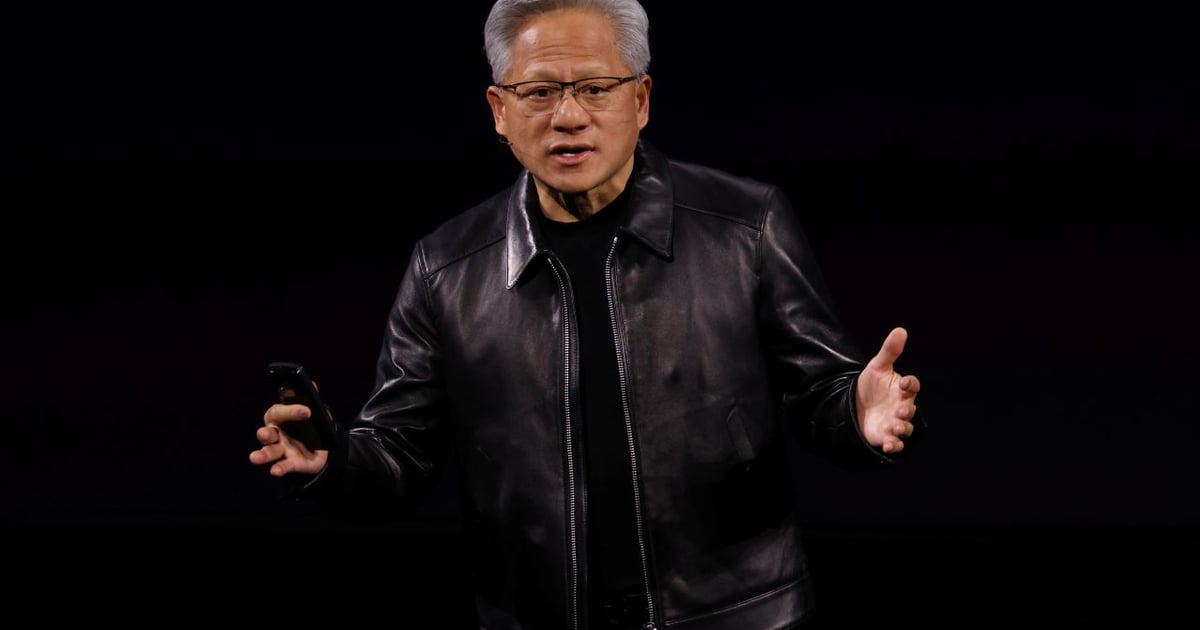
Jensen Huang, former CEO of Nvidia, giving keynote address at Nvidia GTC Berlin in October.Sean Gallup via Getty ImagesNvidia’s famed founder and CEO Jensen Huang has resigned after extramarital affairs with a Chinese spy and a member of his top staff. The AI chip giant’s board made vice president and CFO Colette Kress interim CEO.Huang’s exit, disclosed by the board on Thursday, likely won’t affect Nvidia’s position as the leading producer of AI chips, but it exposes structural risks in AI spending and valuations, and could be the turning point for skeptical enterprises to back away from AI.“The AI industry has lost one of its most credible public advocates at a time when skepticism about AI is growing,” said Kashyap Kompella, founder of RPA2AI Research. “Huang was very effective at connecting technological innovation to a broader economic narrative. His departure creates a vacuum just as the industry needs to strengthen its social license to operate.”The 63-year-old Huang was co-founder and former leader of what became the world’s most valuable company during the AI boom. He resigned following furor over his relationship with Alice Huang, a former executive at Singapore-based data center company MegaSpeed International, in 2023 and 2024.Related:Jensen Huang’s future raises questions for AI infrastructure industryOver that period, MegaSpeed and companies connected to it acquired billions of dollars of AI equipment containing Nvidia chips. U.S. intelligence also briefed President Donald Trump in October 2025 regarding concerns that Alice Huang was a spy for China’s Ministry of State Security.Jensen Huang, who is not related to Alice Huang, served as the charismatic face of AI, and his quick departure comes at a rocky time for the AI business. After the November 3 U.S. midterm elections, Nvidia’s stock and that of other AI data center-related stocks declined sharply.Since then, AI stocks have rebounded. However, the recent debacle still enveloping Nvidia is raising doubts about what will become of the AI chip giant.Nvidia stock was down 4.8% today from its partial recovery on Wednesday.“Huang’s departure also removes an influential voice from the export-control debate, where national security concerns and long-term technological competitiveness are increasingly in tension,” Kompella said, referring to the high-stakes deliberations over U.S. chip export policy toward China, the U.S.'s chief AI rival.Meanwhile, Nvidia continues to fund top AI model makers, such as Anthropic and OpenAI, as well as some of the biggest neocloud vendors, such as CoreWeave.The effect on NvidiaAlthough Huang could face serious problems with the U.S. government due to his relationship with the alleged Chinese spy, Nvidia will likely be fine, maintained R “Ray” Wang, founder of Constellation Research.Related:Prompt: AI's next bottleneck is outside the data center“They’ve got a product roadmap,” Wang said. “They’ve got products that are going to come out, and so they have to execute on the roadmap.”Wang also said he thinks that, given the situation, investors realize they don’t necessarily need Nvidia to do well in the markets, because while Nvidia’s stock is plummeting, much of the rest of the AI trade is still on the upswing.For Wang, Nvidia’s troubles aren’t likely to sway enterprises much. However, it could give them some new options to avoid vendor lock-in, he suggested,“It’s not going to affect what they do as enterprises in the sense that they still need chips; they still need compute. Nvidia is still the leader in the space,” Wang said. “It gives people the freedom to go choose someone else if they have the product.”Leadership change at Nvidia suggests more competition among less powerful Nvidia rivals, according to Jack Gold, president of Gold Associates."If you want to buy Nvidia systems in the future, they may not be the most available, and there will likely be more competition in this space from AMD, Intel and others,” Gold said.He added that he also sees more of a contest in networking and some movement away from Nvidia’s ubiquitous CUDA open source AI development platform. “It means that the numerous partnership agreements in place with Nvidia, while not in any immediate jeopardy, might change as companies become more cautious about the uncertainty,” Gold continued.Related:Enterprises face tougher AI regulatory landscape after midtermsA shaky industryDavid Nicholson, chief advisor at Futurum Group, said the tumult at Nvidia doesn’t change the fundamentals of the company's position as a major investor in a slew of AI vendors, cloud providers and neocloud companies. Still, it exposes a danger that could arise in the industry.The AI business is locked in an “intertwined and incestuous” circle, with Nvidia at the center point, Nicholson said.The Silicon Valley company is building the preferred hardware for generative AI, especially as hyperscalers and cloud providers continue to buy Nvidia’s GPUs.Nvidia has also been providing financial backing to infrastructure companies, including CoreWeave and the 49-year-old tech giant Oracle, which in turn use that support to buy Nvidia’s hardware and rent it out to the AI market. The data centers these infrastructure companies have built are filled with Nvidia equipment, and top AI model providers such as Anthropic and OpenAI have committed to buying access to it.The problem is that the cycle works only as long as AI users are willing to keep buying into AI technology, Nicholson said.“It all hinges upon whether the end users, enterprise customers … are going to continue to do so,” he said.But the current market situation, especially with the new lower-than-expected valuation of Anthropic’s IPO – coming up next week by most accounts – suggests a pullback.“Anthropic’s IPO could become a defining price-discovery moment,” Kompella said. “Investors will look beyond explosive revenue growth to scrutinize sustainable profitability. Compute costs, infrastructure commitments and ongoing capital requirements will come under greater scrutiny."Fallout from Huang’s exit also puts a spotlight on the cost and value of AI technology. As enterprises seek a return on AI spending, some are finding it hard to justify it. Meanwhile, investors have lowered expectations for the Anthropic IPO and OpenAI’s, expected next year.Nvidia’s situation could be the catalyst prompting some enterprise customers to retreat further, Nicholson said.“A lot of people are going to point to what’s going on with Nvidia right now as being the primary mover of Nvidia’s valuation, and I would just say that’s nonsense,” he said.Skepticism about AI technology has been building for some time, with enterprises unsure about quick ROI from staggeringly expensive AI technology. Also, it has become apparent that open source AI models, particularly from China, but also, increasingly, from the West, can be cheaper for enterprises than powerful proprietary models from Anthropic, OpenAI, Google and others.Perhaps ironically, Jensen Huang and the company he co-founded in 1993 and has led since, with no clear successor, have been ardent advocates of open source as a more democratic and transparent approach to AI technology.Nvidia recently consolidated its open source reach by acquiring the Hugging Face developer platform.About the AuthorNews Writer, AI BusinessEsther Shittu has covered AI technologies and industry trends since 2021. As co-host of the Targeting AI podcast, she talks with experts, thought leaders and practitioners exploring critical AI developments. Before AI Business, she wrote for SearchEnterpriseAI, the New York Daily News, Bklyner and the Brooklyn Daily Eagle. When she's not diving deep into the world of AI, she spends her time on passion projects and raising her three daughters.
Jensen Huang’s scandal-fueled ouster exposes enterprise doubts about AI
Full Article
Original Source
Read the full article at Aibusiness →KhanList aggregates and links to publicly available news content. We do not host full articles from third-party sources. Always verify important information with original sources.