
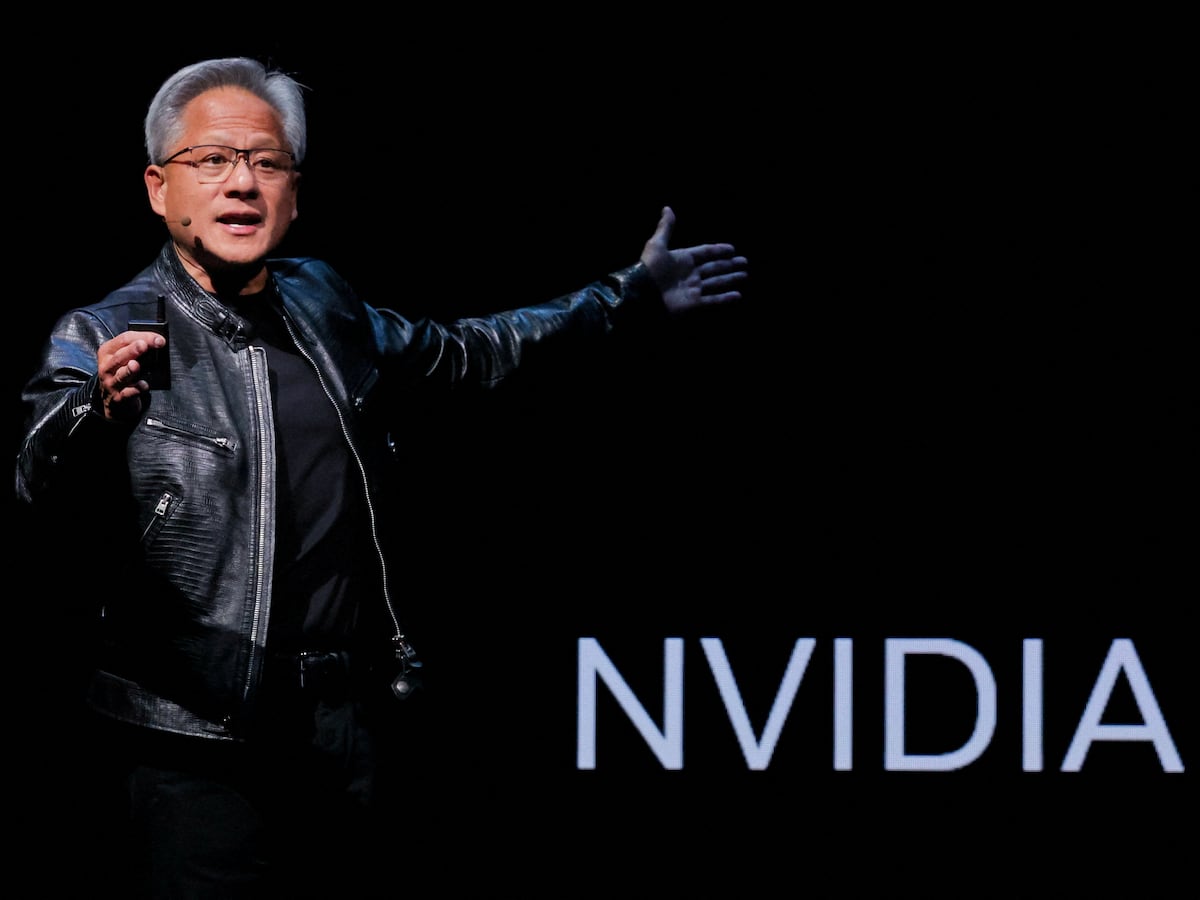
It took Jensen Huang just 11 days to return to the helm of Nvidia. His departure sent shockwaves through Wall Street, and his return was like a shot of the most potent drug for investors. During that short period, Huang went from wanting to atone for his sins to fighting to reclaim the throne of the company he founded 33 years ago and that he propelled to the very top of Wall Street.Huang’s surprise return to the company was orchestrated over the weekend. U.S. President Donald Trump played a decisive role, as he himself admitted. “I convinced them. I made the deal,” he said Monday in a lengthy interview on CNBC.The U.S. president admitted that he orchestrated an unprecedented political intervention to convince Nvidia’s board. “I’ve been talking to the board, both directly and indirectly, and I had a very strong opinion on the matter,” Trump revealed. “I watched the screen and I said, boy, that thing’s like a rocket ship going in the wrong direction... Now it’s a rocket ship going in the right direction,” he added. The president spoke with several board members, called Huang, and listened to Elon Musk, who led the push for Huang’s return. Last Friday’s stock market crash finally convinced the board.Huang returned to Nvidia’s offices amid cheers and applause. The 11 days since his departure from Nvidia began on November 12 in a seven-act drama, featuring his resignation, redemption, revelation, support from Silicon Valley, the stock market’s reaction, and Trump’s backing.ResignationThe day before his resignation, The New York Times reported that the 63-year-old founder of Nvidia had been involved in a third extramarital affair with another employee under his supervision. It was the last straw for the board. Huang had denied any extramarital affairs for months, and within a few days, as many as three had come to light. The board’s confidence in its leader had been shattered. Beyond that was the fear of the legal consequences of keeping the CEO in his position under these circumstances. Nvidia’s stock had plummeted nearly 30% since rumors broke about his infidelities and his relationship with an alleged Chinese spy.The board of directors called an emergency meeting, which lasted past midnight. The next day, November 12, the company announced Huang’s resignation a quarter of an hour before Nvidia’s stock resumed trading. A resignation forced by pressure — or rather, a dismissal. “Nvidia announces CEO transition,” the company headed a brief press release that barely mentioned its founder. Huang had transformed a small manufacturer of video game graphics cards into the largest corporate giant on the planet. And the statement announcing his departure was barely two lines long: “Jensen’s contributions to NVIDIA are profound. NVIDIA is one of the most consequential technology companies in the world,” the board noted.RedemptionTrump said he had unsuccessfully called Huang to urge him to hold his ground at the helm of Nvidia. He told him he had the support of the federal government. But Huang was devastated. He watched as the company he had built was plummeting on the stock market, and his marriage to Lori Huang — which had lasted nearly 40 years — was in jeopardy. “I’m a piece of shit,” he told one of his associates on Wednesday night after he had decided to step down. Following his resignation, he kept saying that he “didn’t care” about anything. And when asked about company matters, he would say, “I don’t care,” according to Bloomberg. Huang is Nvidia’s largest private shareholder, and during those turbulent days, he lost a fortune.By then, Trump was publicly calling for Nvidia to hire Tim Cook, Apple’s CEO, to replace Huang. “A Legend replaces a Legend,” he wrote on Truth. In a coordinated move, Treasury Secretary Scott Bessent called for a radical change at the company following Huang’s departure. “This makes me think that as the board conducts a search for a new leader that they need to go outside the company, that just [with] what was going on inside the company, they need a dramatic shakeup” he said, ruling out the return of Nvidia’s founder.RevelationHuang began to reevaluate his situation over the weekend following his departure. Despite his controversial behavior, he has always been a fighter. As a child, he traveled from Taiwan to the United States to live with his aunt and uncle near Oregon. While his parents were sorting out the paperwork to legalize his status, his uncle mistakenly enrolled him in a boarding school in Kentucky. But it turned out to be a school for troubled youth. There, he was bullied. Years later, he confessed that it was one of the worst experiences of his life. “Greatness,” he proclaimed a few years ago at a conference at Stanford University, “is not intelligence. Greatness comes from character. And character isn’t formed out of smart people, it’s formed out of people who suffered. I don’t know how to teach it to you except for I hope suffering happens to you,” he told the assembled students. During that cathartic weekend, he began planning his return and started rallying support.He had the backing of his family — primarily his two children, Madison and Spencer, who hold prominent executive positions at Nvidia; and his son-in-law Nico Caprez, one of the vice presidents. “Above all, I am grateful for the love and support of my family,” Huang wrote.Support from Silicon ValleySpurred by the support he received from some of Nvidia’s most influential employees and executives — and with the backing of prominent figures in Silicon Valley — he began planning his return to the helm of the world’s largest chipmaker. A group of tech executives and entrepreneurs, led by Elon Musk, published a letter calling for his return. “Thirty-three years deserve an answer. We demand the NVIDIA Board bring Jensen back,” stated the manifesto signed by more than 200,000 current and former employees, partners, shareholders, and supporters of Nvidia.On Tuesday, the day of Nvidia’s quarterly financial results presentation, Huang stepped forward. He posted a message on the social media platform X to acknowledge his mistakes: “I did not live up to the standards expected of everyone at NVIDIA, and I have made serious mistakes in my personal life. I created problems for the Board that I deeply regret. I own my mistakes completely, and I am committed to cooperating with the Board’s independent investigation.” He used the message to leave the door open for his return: “If the Board of Directors decides that my return is in the best interest of our shareholders, our employees, the company, and America, I would be honored to answer these calls and return as CEO,” he wrote. At that point, the company’s new chairman, Harvey Jones, shut the door by stating that they were not considering the return of the man who, until a week ago, had been their CEO.Trump also began to change his tone. He went from calling for Huang’s removal to saying he “would not mind” him returning. “I think he learned a big lesson,” he said. The U.S. president never stopped defending his friend. During those days, he traveled to China to meet with Chinese leader Xi Jinping, with whom he discussed the matter of Huang’s dismissal, as the occupant of the Oval Office revealed in an interview on CNBC.Stock market meltdownThe situation came to a head last Friday. Wall Street experienced its worst week in a year and a half, with a 5.6% drop driven by concerns over artificial intelligence. Beyond the problems at Nvidia — the cornerstone of the AI ecosystem, given its near-monopoly on the chips needed to develop new intelligent agents — investors began to fear a shift in the political cycle in the United States, with a Congress more reluctant to turn a blind eye to the tech sector and more likely to put up barriers to the construction of data centers. The SEC announced the opening of an investigation into Nvidia’s financial statements. The White House grew nervous about the stock market’s “black week,” and Trump began pulling the strings.Trump’s supportThe markets are among the few things capable of making Donald Trump back down. Black Friday prompted the president to pick up the phone. He called Elon Musk to gauge the level of support Huang had at Nvidia and in the tech sector. He phoned members of the company’s board to try to convince them. “I spoke with them, so to speak,” Trump said, referring to the board of directors during the CNBC interview. “I convinced them,” the president said. “I made the deal.”Board members wanted assurances that Huang’s relationship with the alleged Chinese spy, Alice Huang, posed no risk to national security. “And we gave them assurances, at least with everything we know,” the president said.Finally, on Sunday night, after getting the company’s approval, Trump contacted Huang to outline the steps he would need to take for the board to accept his return. “I called him up and I said, ‘I ask you to do one thing, Jensen, work hard,’” the president said, emphasizing that, after all, “he hasn’t done anything wrong.”Trump is more concerned with maintaining the lead in the AI race than with other issues. As such, he wanted to prevent Huang from falling into the hands of the Chinese government at all costs. “If we hadn’t done this, China could come and say to Jensen, ‘Hey, would you like to come to China?,” Trump explained to justify his intervention in a private company. “People say, is it a threat to have him? No, it’s a threat to lose him.”Sign up for our weekly newsletter to get more English-language news coverage from EL PAÍS USA Edition
Jensen Huang’s return to Nvidia in seven acts: From Trump’s pressure to family support
Full Article
Original Source
Read the full article at English →KhanList aggregates and links to publicly available news content. We do not host full articles from third-party sources. Always verify important information with original sources.