
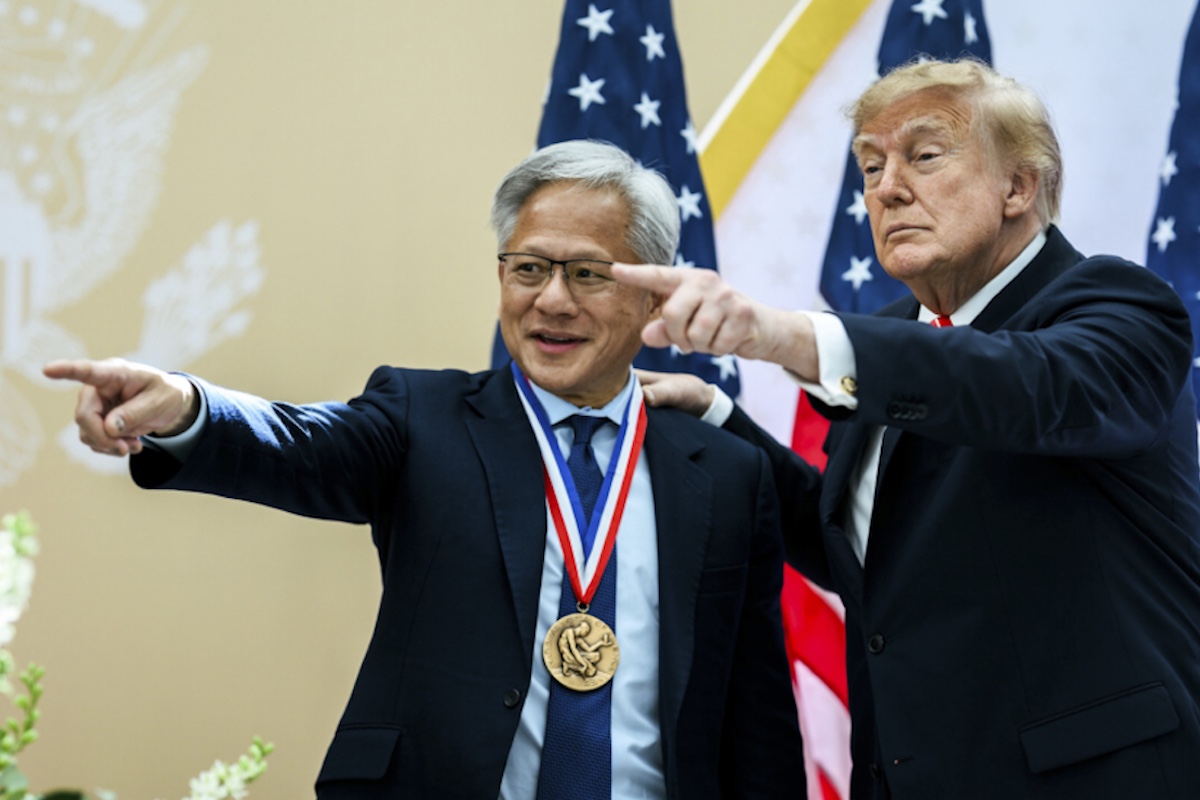
When Nvidia’s board voted unanimously on Monday to reinstate Jensen Huang as chief executive less than two weeks after his resignation, equity markets treated the reversal as an immediate restoration of the status quo. Shares in the world’s most valuable chipmaker surged roughly 30% in New York trading as investors priced in product roadmap continuity and direct political backing from US President Donald Trump. Across Asia’s semiconductor and data-center corridors, however, Huang’s comeback marks a more decisive break from the past stemming from a perplexing structural shift. Far from reviving the commercial autonomy that once allowed Nvidia’s hardware to circulate freely across Pacific Rim supply chains, a White House-brokered reinstatement binds the company squarely to Washington’s national-security perimeter. That constraint is embedded in the political bargain behind Monday’s abrupt reversal. Nvidia’s board had ruled out rehiring Huang only days earlier, after disclosures of his extramarital relationship with Alice Huang, a former executive at Singapore-based Megaspeed whom US authorities suspect of helping to channel restricted compute capacity to Chinese clients, along with other reported affairs. Reversing such a decision required Trump’s public intervention, paired with formal assurances from senior US officials that Huang posed no national-security risk. Yet political rehabilitation has not lifted Nvidia’s legal or regulatory overhang. Even as Trump praised the board’s move as vital for American competitiveness, he urged the company to continue investigating its export-control compliance. Meanwhile, Securities and Exchange Commission and Justice Department inquiries into alleged chip smuggling and accounting practices remain active, alongside shareholder lawsuits targeting both Nvidia and Alibaba over offshore compute arrangements. Wall Street is trading on executive continuity and White House cover. Asian policymakers and infrastructure operators must price in an enterprise operating under explicit compliance conditions. That duality reflects a deep-seated contradiction in Washington’s China strategy that surfaced during Trump’s Asia tour last week. Even as the president met Chinese President Xi Jinping in Shenzhen on the sidelines of the APEC summit and touted US$17 billion in commercial deals, his Commerce Department issued sweeping new restrictions on remote cloud access to advanced US chips. From easing H200 licensing conditions late last year to publicly campaigning for Huang’s return, Trump has repeatedly treated technology files as tools of personal leverage and bilateral dealmaking. Over the coming months, however, presidential patronage will narrow, rather than expand, Nvidia’s room to maneuver. Ahead of next month’s G20 summit and the seating of a Democratic-majority Congress in January following the US midterm elections, lawmakers on both parties are pressing for statutory mandates on chip-location verification and cloud access. Having staked his own credibility on clearing Huang of security concerns, Trump cannot afford fresh disclosures of Nvidia compute reaching Chinese developers, leaving the chief executive far less latitude to lobby for relaxed China export terms than he enjoyed a year ago. For Southeast Asian governments and cloud builders, this shift carries three immediate operational consequences. First, Huang’s return dispels any expectation that a restored chief executive will quietly persuade Washington to soften its November 19 Bureau of Industry and Security (BIS) rule restricting remote cloud access to advanced AI chips across Singapore, Malaysia, Thailand and Indonesia. Before this month’s governance crisis, Nvidia’s partner program functioned as a critical allocation channel for regional data-center developers demonstrating committed compute demand. After the Megaspeed disclosures and congressional scrutiny of nearly 880,000 previously approved chip licenses, neither Huang nor Nvidia’s board can afford to absorb another partner-program compliance failure. Second, tighter compliance enforcement sharpens the regulatory collision awaiting Southeast Asia on December 1, when the China-ASEAN Free Trade Area (CAFTA) 3.0 upgrade protocol enters into force. As banks, logistical platforms and enterprises in the region prepare to plug into CAFTA 3.0’s cross-border digital trade, smart customs and AI standards plumbing, some observers have interpreted Trump’s Asia trip and his intervention on Huang’s behalf as evidence of a broader transactional easing in US-China technology friction. That reading misjudges the political incentives now governing Santa Clara. Precisely because Huang’s reinstatement rested on explicit White House political cover, Nvidia faces intense pressure to prove airtight export-control adherence across ASEAN. Rather than acting as a commercial bridge between US hardware restrictions and Beijing’s regional digital ecosystem, a reinstated Huang will be compelled to enforce rigorous end-user verification across overseas clusters running Blackwell and Rubin processors. Third, the sector will capitalize on Huang’s return along sharply asymmetrical lines. Cash-rich US hyperscalers, which are exempted as US-headquartered end users under the November 19 BIS rule, can leverage Nvidia’s restored leadership continuity to lock in multi-year chip allocations and priority grid capacity across Malaysia, Singapore and Thailand. Independent regional neocloud operators face a far harsher calculus. Stripped of informal allocation channels or unvetted cross-border tenants, debt-financed data-center builders must carry premium hardware costs while competing for a narrower pool of BIS-compliant customers. At the same time, Chinese hardware challengers, from Huawei’s Ascend processors to domestic memory makers Yangtze Memory Technologies and ChangXin Memory Technologies, gain a clearer commercial opening to supply non-restricted storage and sovereign-cloud infrastructure to ASEAN enterprises seeking insulation from US compliance audits. Prevailing commentary has largely framed Monday’s boardroom reversal primarily as a test of Silicon Valley corporate governance and founder power. Across the Indo-Pacific, however, the more consequential shift is institutional: Nvidia has crossed from a commercial chip supplier into an instrument of American industrial and security statecraft. Jensen Huang is back at the helm in Santa Clara, and Nvidia’s engineering lead remains intact. For Southeast Asian’s policymakers, cloud builders and investors planning into 2027, nonetheless, the space in which the company could operate above the fault lines of US-China rivalry has narrowed sharply. Albert Cleisthenes Wong is a Hong Kong-based geopolitical and policy analyst covering technology policy and digital infrastructure.
Jensen Huang’s return locks Nvidia deeper into US statecraft
Full Article
Original Source
Read the full article at Asiatimes →KhanList aggregates and links to publicly available news content. We do not host full articles from third-party sources. Always verify important information with original sources.