
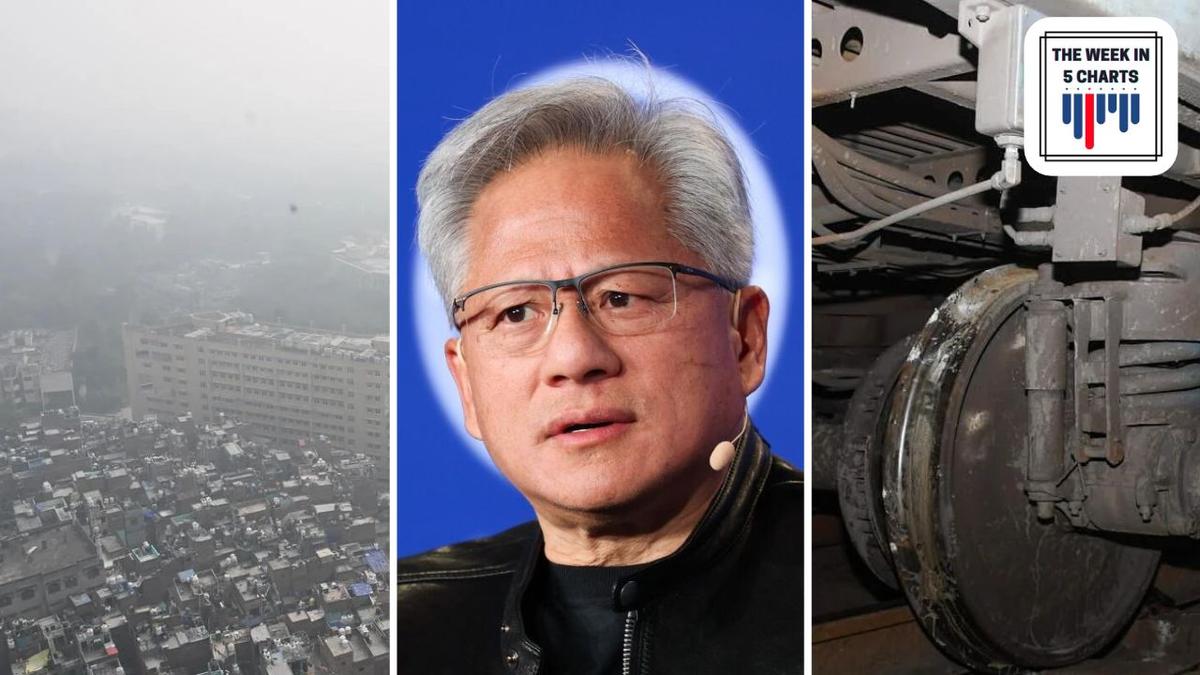
(1) Nvidia CEO Jensen Huang resigns amid spy scandalJensen Huang resigned as chief executive of Nvidia on Thursday (November 12, 2026), ending his 33-year run at the helm of the AI giant he co-founded after revelations he had two extramarital affairs, including with a woman accused of spying for China.The company’s board said Mr. Huang had stepped down as president, chief executive and board member, effective immediately. Chief financial officer Colette Kress will serve as interim CEO while keeping her finance role, and the board will consider internal and external candidates for a permanent replacement.Mr. Huang faced growing calls to resign after his affair with an alleged Chinese spy. Late Wednesday (November 11, 2026), media reports said Mr. Huang had another extramarital affair with an Nvidia employee who reports to him.Mr. Huang, who co-founded Nvidia and is its fourth-largest investor with a stake of about 3.61%, will not remain on the board.(2) Two train derailments renew concerns over rail safetyThe Gorakhpur-bound Chauri Chaura Express derailed on November 11, 2026, shortly after leaving Kanpur Central railway station in Uttar Pradesh. Four coaches of the train derailed. No casualties were reported, senior police and railway officials said.On the same day, the Kolkata-Sairang Express derailed at Digaru railway station in Assam, with several coaches going off the tracks after the loco pilot failed to control the train’s speed while giving precedence to another train. The Northeast Frontier Railway said that all passengers were safe and no injuries had been reported.The incidents have brought renewed attention to rail safety and the safeguards in place to prevent major mishaps.In July 2026, the Ministry of Railways issued a press release stating that the country had witnessed ‘only two consequential train accidents’ up to that month. A consequential train accident refers to an accident resulting in loss of human life, injuries, damage to railway property or disruption to rail traffic beyond prescribed threshold levels.Indian Railways has reduced consequential train accidents by 88% over the past 12 years, according to an ANI report published in July 2026, which cited an official statement.(3) AQI slips to ‘severe’ in Delhi; Mumbai, Chennai wake up to a smoggy morning after DeepavaliDelhi’s Air Quality Index (AQI) slipped into the ‘severe’ category as a thick layer of toxic haze engulfed the national capital on Monday (November 9, 2026). Despite stringent restrictions on fireworks imposed by the Supreme Court, people defied the deadline, bursting firecrackers well past 10 p.m. on Deepavali night.According to the Central Pollution Control Board’s (CPCB) live dashboard, Delhi’s AQI rose to 404 at 4 a.m. on Monday, before subsequently easing.Burari Crossing recorded the highest AQI at 441, followed by Vivek Vihar (437), Delhi Technological University (DTU) (434), North Campus of Delhi University (433), Jahangirpuri (433) and Rohini (430).Northern and western cities bore the brunt of the pollution, with Lucknow (246), Amritsar (242), Jodhpur (234), Ahmedabad (230), Dehradun (228), Jaipur (223), Udaipur (223) and Surat (207) recording ‘poor’ air quality. Central and industrial cities also witnessed a spike in pollution levels, with Nagpur recording an AQI of 239, Pune 221, Bhopal 205, Mumbai 171 and Kolkata 167, amid emissions from Deepavali celebrations.Southern cities recorded relatively better air quality, with Chennai registering an AQI of 208 (‘poor’), while Bengaluru (127), Hyderabad (120) and Thiruvananthapuram (67) recorded ‘moderate’ to ‘satisfactory’ air quality.Meanwhile, air quality data from several government monitoring stations in Delhi went missing for hours during the pollution spike following Deepavali on Sunday (November 8, 2026). Experts warned that these gaps could have led to an underestimation of pollution levels and a lower official AQI.According to Dr D. Saha, former head of the CPCB’s air quality laboratory, AQI values are calculated using a moving or running average of hourly concentrations of eight parameters, including PM2.5 and PM10, over the preceding 24 hours.On Monday (November 9, 2026), PM2.5 data were missing for several hours at multiple monitoring stations across the city, including Anand Vihar, Patparganj and Bawana, on the CPCB website. PM2.5 refers to fine inhalable particles measuring 2.5 micrometres or less in diameter. These particles can penetrate deep into the lungs and enter the bloodstream, potentially causing respiratory and other health problems. Similar data gaps were reported at several monitoring stations during Deepavali last year as well.(4)COP31 begins amidst quickening global warmingThe UN’s annual climate talks kicked off last Monday (November 9) in Turkiye as rising temperatures heighten the urgency of action, with financial constraints and geopolitical tensions complicating efforts to secure global cooperation.The Paris Agreement, drawn in 2015, gave countries the goal of keeping average increase in global temperature below 1.5°C from pre-Industrial Revolution levels. This threshold might be breached as soon as 2029, if current trends continue, as per data from Copernicus. Some observers warn that an ‘overshoot narrative’ might unfairly impact the Global South’s resources for absorbing emissions from other parts of the world.The partners have branded the summit as the “implementation COP”, focusing on turning commitments into concrete action after years of pledges and ambitious announcements. But observers say few major breakthroughs are expected from the two-week long summit as countries grapple with an oil price shock and geopolitical tensions fuelled by the U.S. war with Iran and Russia’s conflict in Ukraine.Negotiators from 200 countries will meet. However, climate diplomacy is still missing a major player as President Donald Trump pulled the United States out of the Paris Agreement and has not sent officials to COP31.(5)AIMIM and ASPKR announce alliance ahead of polls in Uttar PradeshAll India Majlis-e-Ittehadul Muslimeen (AIMIM) president Asaduddin Owaisi and Azad Samaj Party (Kanshi Ram) chief Chandrashekhar Azad on Thursday announced a new political alliance, the Samajik Parivartan Morcha, for the 2027 Uttar Pradesh Assembly elections.This alliance was pitched as an alternative to the opposition alliance, with Mr. Azad from the ASP saying the main opposition alliance failed to defeat the BJP in previous elections. Here’s how the State voted in 2022.AIMIM and ASP contested in 95 and 110 seats respectively. This is among the top number of seats contested by unrecognised and other State parties. However, their vote share remains marginal.What stands out is that compared to other State parties (from other States), AIMIM’s contested vote share is the highest, along with contesting in the second highest number of seats. Among the unrecognised parties thart participated in 2022 elections, most parties contested in fewer seats and won a smaller vote share in these seats. Again, ASP stands out for the number of seats it contests in comparison.(With inputs from AFP)
Jensen Huang’s Nvidia exit, Delhi reels under air pollution post Deepavali, COP31, and more: The week in 5 charts
Full Article
Original Source
Read the full article at Thehindu →KhanList aggregates and links to publicly available news content. We do not host full articles from third-party sources. Always verify important information with original sources.