
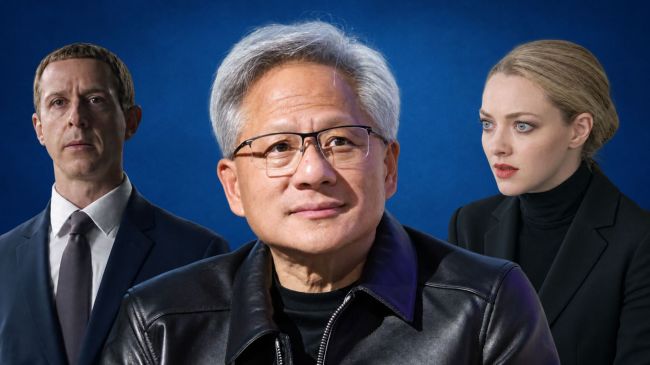
Hollywood loves a visionary, especially one whose biggest gamble eventually made him a billionaire. But the trouble with making a biopic about a tech mogul actively shaping the future? That kind of story often refuses to sit still long enough to be told before ending in calamity. When it comes to Nvidia co-founder Jensen Huang, any filmmaker hoping to get ahead of the microchip company’s uncertain next chapter may already be too late. Or is it still… too early? On Thursday, Nvidia announced that Huang had resigned as CEO and board member, effective immediately. And no reason was given for the departure: a rather extraordinary development for someone who helped build the company into one of the most powerful and lucrative forces in artificial intelligence. For Hollywood, it’s the kind of twist that practically demands a screenplay. Huang’s rise from teenage Denny’s employee to the face of the AI boom always had the makings of a prestige drama. Now there’s a corporate disaster — involving an alleged Chinese espionage operation and reports of multiple extramarital affairs — at the end of it. Hot dog! Still, it’s anyone’s guess whether that fiery conclusion can seem genuinely relevant by the time film and TV creatives get around to adapting it. The entertainment industry has spent much of 2026 demonstrating how difficult it is to dramatize Silicon Valley while the real people involved keep making headlines. Aaron Sorkin’s “The Social Reckoning,” for example, opened to just $5.5 million in North America. That’s a disappointing debut for the follow-up to David Fincher’s “The Social Network,” which won three Oscars including best adapted screenplay. Revisiting Facebook through the perspectives of whistleblower Frances Haugen (Mikey Madison) and Wall Street Journal reporter Jeff Horwitz (Jeremy Allen White), Sorkin attempted to turn Mark Zuckerberg (Jeremy Strong) and his social media platform’s disastrous effects on politics and public discourse into a satisfying sequel. Jeremy Strong and director Aaron Sorkin on-set for “The Social Reckoning”©Columbia Pictures/Courtesy Everett Collection Of course, audiences had already spent years living with the very real consequences of Zuckerberg’s company’s actions. And in his “D+” review for IndieWire, Ryan Lattanzio described Sorkin’s approach as “less old-fashioned than completely out of date,” criticizing a falsely triumphant finale that failed to reconcile how little had actually changed in the world after the investigation’s revelations came to light. While Sorkin was late to the party, Luca Guadagnino’s “Artificial” has had the good fortune of arriving right as things have been starting to get worse. Dramatizing OpenAI’s chaotic 2023 firing and rehiring of Sam Altman (Andrew Garfield), the dark comedy finds absurdity in the gap between Big Tech’s grandiose promises and the frequently clownish folks making them. In his “B-” review for IndieWire, David Ehrlich praised the coming film for recognizing how “deeply fucking stupid the road to superintelligence has turned out to be.” He also questioned its tendency to simplify an ongoing story into something more resolved than it is. (Suffice to say, any film that tries to predict the cultural conversation also risks declaring history finished too soon.) Andrew Garfield and Cooper Hoffman in “Artificial”Courtesy Everett Collection “Artificial” has benefited from some remarkable timing, too. Amazon MGM dropped the project after entering into a partnership with OpenAI — with sources telling the Los Angeles Times that the script’s critical perspective on artificial intelligence specifically contributed to the decision. Neon eventually acquired it, and a well-received New York Film Festival premiere helped build some serious awards-season momentum for routine Oscar contender Guadagnino. Then came the U.S. midterms, during which voters across the country backed restrictions on data-center development. That makes the questions about who controls AI and who actually pays for its consequences feel spectacularly urgent, effectively turning a simple boardroom fight into a existential consideration of society with significantly heavier stakes. Of course, tech biopics don’t necessarily have to predict the future to be powerful. Consider Hulu’s “The Dropout,” which won Amanda Seyfried an Emmy for playing Theranos founder Elizabeth Holmes. Four years later, Nathan Fielder and Lance Oppenheim’s boundary-breaking documentary “You Can See Everything” once again made Holmes a viral sensation — even bringing Seyfried into contact with the woman she portrayed. Amanda Seyfried in Hulu’s “The Dropout”©Hulu/Courtesy Everett Collection As IndieWire TV critic Ben Travers recently argued, “The Dropout” remains effective precisely because it didn’t pretend to know everything about Holmes in 2022. Fielder and Oppenheim’s contribution often gets so close to its subject that Holmes’ motives become difficult to pin down, while the series maintains enough separation to keep her actions and victims in focus. “Sometimes a healthy distance provides greater clarity,” Travers wrote. That’s a useful lesson for anyone hoping to next adapt the life of a Silicon Valley billionaire before history has finished passing judgment on them. And in Huang’s case, there’s already plenty of material to work with — before pretending to know how his former employer’s whole saga ends. Having cofounded Nvidia in 1993, Huang nearly lost the company after betting on a method of rendering video-game graphics that Microsoft effectively rendered obsolete. With Nvidia running out of money, he then scrapped its original technology and made a last-ditch gamble on a new chip that ultimately helped save the business. Huang eventually helped develop the graphics-processing infrastructure that would make his company’s hardware essential to the AI boom. Fast-forward to a public apology to his wife and throw in a leather jacket? Hollywood could probably have a trailer ready by Christmas. U.S. President Donald Trump and Jensen Huang on September 29, 2026 in Washington, DCGetty Images But that would also be the easiest, and potentially least interesting, version of Huang’s story, right? Nvidia’s success was built on the backs of countless engineers, researchers, and developers aside from Huang. The fallout within the AI giant will impact everyone. A truly great movie about Huang and Nvidia would need to understand the company’s founding and survival, follow the enormous risks Huang took with that future, and then seriously interrogate what happens when a single corporation becomes indispensable to the technology rapidly reshaping nearly all of modern life. Those are three(!) very different artistic ambitions. Considering the entertainment industry’s own increasingly lucrative partnerships with AI companies, and Amazon’s offloading of “Artificial,” there’s reason to wonder just how much scrutiny Hollywood would be willing to apply to the innovators they are in business with. Which brings us back to the question of when to make a Jensen Huang biopic. The tech industry is moving faster than filmmakers can reasonably hope to keep up with, but the bigger problem may be that news around the Silicon Valley story most worth telling is changing just as quickly. A film about the man who helped build the future we’re facing might have been an easy sell a few years ago. These days, the more pressing issue is what kind of world Huang actually put in motion — and whether Hollywood can afford to doubt it in public.
Jensen Huang’s Biopic Feels Inevitable — The Right One Might Be Impossible
Full Article
Original Source
Read the full article at Indiewire →KhanList aggregates and links to publicly available news content. We do not host full articles from third-party sources. Always verify important information with original sources.