
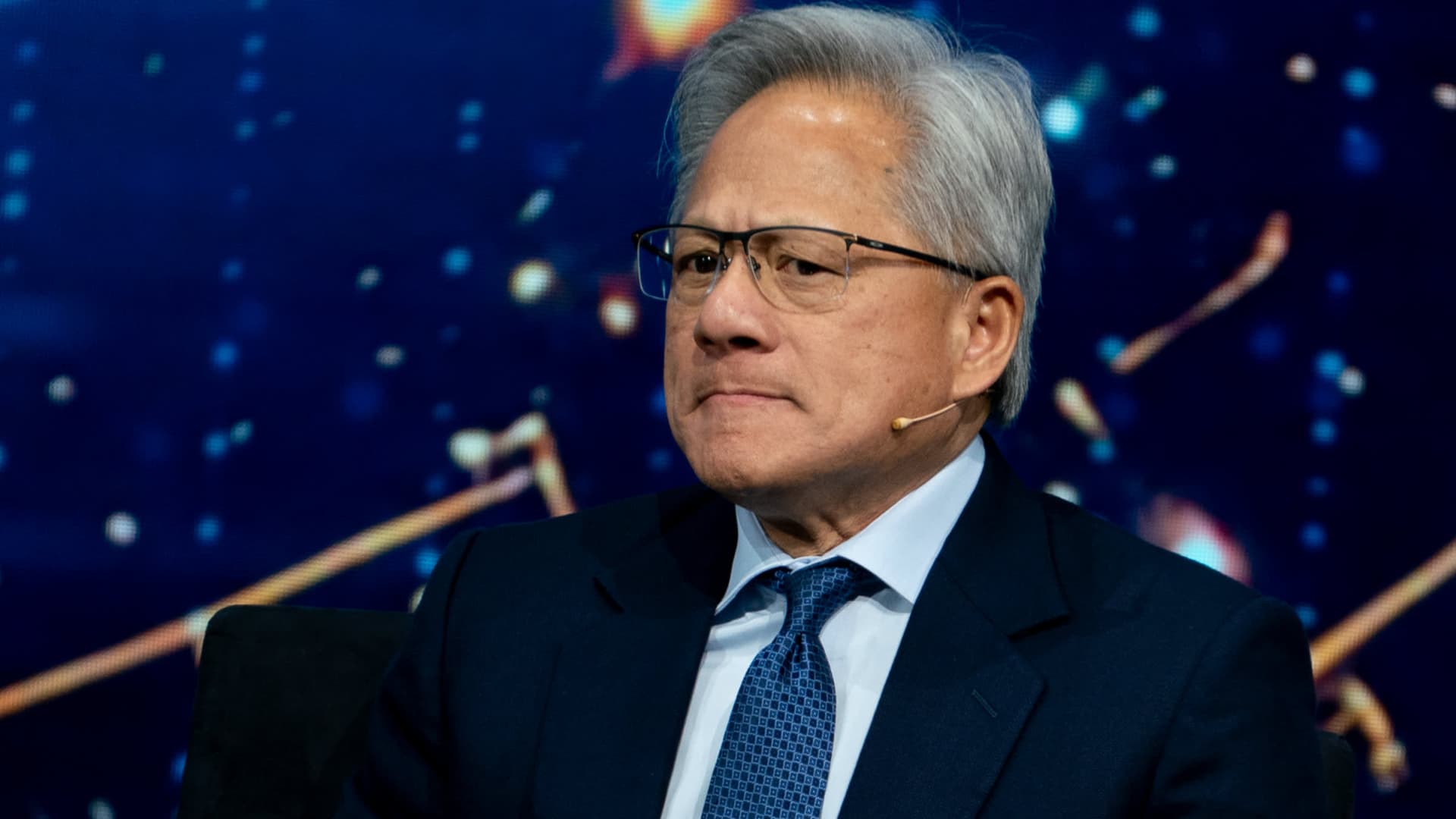
FILE: Jensen Huang, chief executive officer of Nvidia Corp., during the US-Saudi Investment Forum at the Kennedy Center in Washington, D.C., on Nov. 19, 2025.Stefani Reynolds | Bloomberg | Getty ImagesThe still-unraveling scandal of former Nvidia CEO Jensen Huang's extramarital affairs and the tech giant's potential role in its advanced semiconductor chips ending up in China present a legal minefield for Huang and Nvidia.Federal and state prosecutors and Nvidia employees may target Huang and the company in court, where some shareholders have already taken action.That's on top of a rapidly growing pile of probes by Republicans who control Congress now and Democrats who will have majorities in both the House and Senate in January."It's not going to get any better for Jensen Huang; it's going to get far worse," said Salvatore Graziano, a New York securities litigation attorney at Bernstein, Litowitz, Berger & Grossmann. His firm is looking at shareholder lawsuit opportunities against Nvidia and Huang.[Huang] "faces the Department of Justice, the Securities and Exchange Commission and private litigation," Graziano said. "The criminal exposure is very serious. The SEC could bar him from being an officer. And the potential liability [from shareholder] lawsuits can be very large."Huang's and Nvidia's legal exposure stems from three issues that led up to his shock resignation Nov. 12.There's his alleged affair with suspected Chinese spy Alice Huang, who worked for Megaspeed, a Singapore-based company under investigation for diverting advanced Nvidia semiconductor chips to China in violation of U.S. export rules. That, in turn, has raised questions about whether Huang and Nvidia were aware of any diversions.There are Huang's two other alleged affairs with Nvidia employees.And there is the sharp drop in the company's stock price in the wake of the scandal. Nvidia's share price has fallen 19% since Nov. 8 when Huang sent a company-wide apology acknowledging extramarital affairs.Stock Chart IconStock chart iconNvidia share priceHuang last week retained the law firm Paul, Weiss and its attorneys Melinda Haag and Walter Brown to represent him. Haag is a former U.S. attorney in San Francisco, and Brown is also a former federal prosecutor.Huang's spokesman at Trident, a crisis communications firm, declined to comment when asked if Haag and Brown are representing him in any potential criminal case and other questions about his legal exposure.Nvidia did not respond to a request for comment. Last week, Nvidia retained the law firm Wachtell, Lipton, Rosen & Katz to conduct an independent investigation into Huang allegedly being targeted by a spy, as U.S. intelligence reportedly has concluded.Read more CNBC news on NvidiaNvidia's staff split over Jensen Huang return as Kress takes overPRO: Here's what every major Wall Street analyst is saying about Nvidia after its earnings reportKress tells Jim Cramer that 'customers continue to be with us'Nvidia warns chip buyers of legal risks tied to China access: SourcesExclusive: How Trump traded Nvidia stock as he championed the chipmakerThe civil liability Huang and Nvidia could face is underscored by a hearing Graziano, the securities attorney, attended Tuesday in U.S. District Court in San Francisco. A judge at the hearing approved a $175 million settlement from Seagate Technology Holdings to resolve a shareholder lawsuit alleging it concealed sales of hard disk drives to Huawei in China in violation of export bans. The Seagate settlement came three years after the Commerce Department's Bureau of Industry and Security — which is investigating Megaspeed's business with Nvidia — imposed a $300 million penalty on Seagate for its sales to Huawei.Graziano said his law firm is "actively looking at securities law liability for Nvidia, Jensen Huang and other senior executives in the company given all the recent developments regarding their [potential] knowledge and facilitation of illegal chip sales to Chinese entities." One shareholder suit has been filedThere is already a pending class-action shareholder lawsuit in San Francisco federal court against Nvidia and Huang by the Rosen Law Firm, for allegedly misleading and false statements related to Megaspeed and Alice Huang. "Several hundreds of investors have contacted us and expressed an interest to join the case — investors of all walks of life, from mom and pops to investors with very large losses," Rosen attorney Phil Kim told CNBC in an email. Katie Sweeten, a former federal prosecutor in the DOJ's National Security Division, said the question of "who knew what and when, and what was [Huang's] role" is potentially the biggest risk for Nvidia and him."Now DOJ can leverage their criminal authorities," Sweeten, a partner at Scale LLP, told CNBC's Kelly Evans on "The Exchange.""They can bring grand jury subpoenas, search warrants for emails, bank accounts, personal devices, computers, things like that," Sweeten said.While it is "not illegal to, you know, sleep with a spy ... it is illegal to pass certain types of information to a counterintelligence officer," she said.Sweeten also pointed to potential export control violations, which "could be very serious."She noted the DOJ can indict a company as well as its officials if there is evidence of criminality. Export control violations carry a maximum possible criminal sentence of 20 years in prison and "really large fines," she said."You can't send the company to prison, but they can face fines, civil penalties, debarment — where you can't export items down the line," she said.One example of that came in July 2025, when the DOJ obtained a guilty plea and an agreement to pay more than $140 million from Cadence Design Systems for violating the Export Control Reform Act by unlawfully exporting semiconductor design tools to China's National University of Defense Technology, a school led by China's Central Military Commission.Congressional hearings present riskAnother potential legal risk for Huang comes from his planned appearances before Congress.Huang is scheduled to give a closed-door interview Dec. 1 to three House committees. Senate banking committee Chair Tim Scott, R-S.C., wants Huang's testimony before that panel to be public, and told CNBC Tuesday he hopes to have that happen "before Christmas."Sweeten said Huang "has to be very careful" about what he says there because of the risk of being criminally charged with lying to Congress, and of saying something "that absolutely can become part of a criminal or civil investigation.""I expect Huang to take the Fifth on most questions" from Congress, Jonathan Kanter, a former assistant attorney general in the DOJ's Antitrust Division, told CNBC, meaning Huang will likely use his constitutional right against giving testimony that could be used against him in a criminal case."With a Justice Department criminal investigation into Megaspeed already underway and more investigations possible, anything he tells Congress could be used against him," Kanter said. "His lawyers are likely to advise him against taking that risk."Ben Heineman Jr., a former senior vice president and general counsel of General Electric, and a senior fellow at Harvard University, told CNBC that Nvidia's board will be scrutinized over its actions before it pushed Huang to resign.Heineman cited the board's apparent lack of succession planning and what looks like weak oversight of Huang, including relating to personal conduct such as the two alleged affairs with Nvidia employees and with an executive of an Nvidia customer."When there is a sort of reasonable suspicion, they need to investigate it, and they don't appear to have done that," Heineman said.State attorneys general may circleNvidia and Huang could face investigation from state attorneys general, including in California, where the company is headquartered.On Tuesday, California Attorney General Rob Bonta told Bloomberg Television that the situation at Nvidia with Huang is "something that we're interested in." Bonta's office later told CNBC, "We are monitoring the situation."Huang's alleged affairs with Nvidia employees also open the possibility of workplace litigation.Ari Wilkenfeld, a Washington-area employment lawyer, said a consensual relationship between a chief executive and a subordinate "is not in and of itself illegal.""The liability never comes from the existence of the relationship alone. It comes from whether it was genuinely welcome, what job benefits flowed from it, and what it did to everyone else in the building," Wilkenfeld said. "California law recognizes that so-called sexual favoritism can create a hostile environment for an entire workforce.""The affair is Huang's problem," Wilkenfeld said. "What, if anything, Nvidia did once it knew is the company's problem."
Jensen Huang's — and Nvidia's — legal exposure balloons
Full Article
Original Source
Read the full article at Cnbc →KhanList aggregates and links to publicly available news content. We do not host full articles from third-party sources. Always verify important information with original sources.