
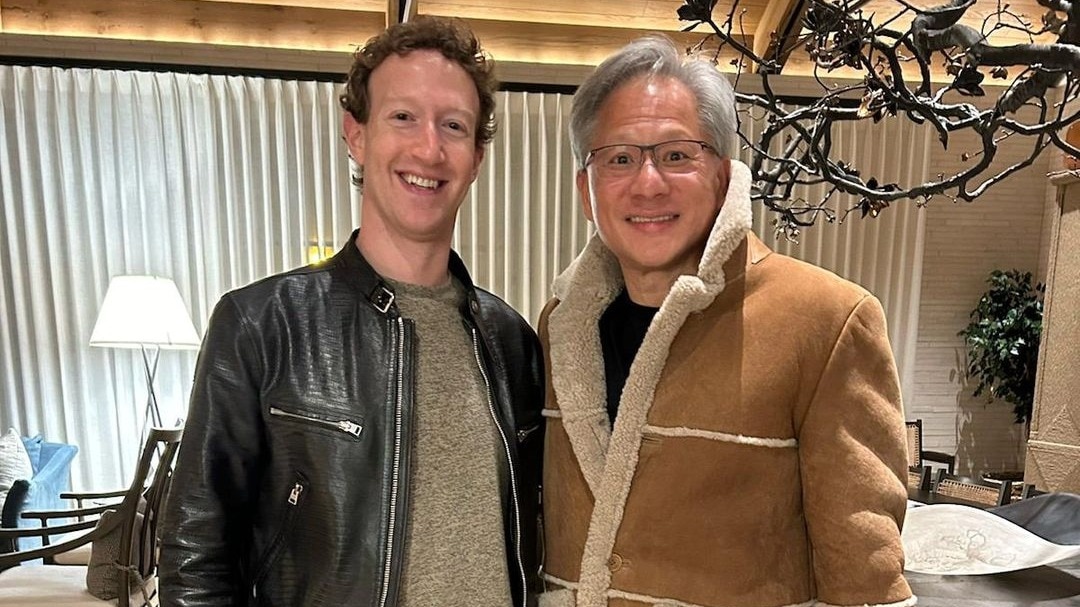
For all his billions, Jensen Huang cannot decide who runs Nvidia. Mark Zuckerberg, meanwhile, can effectively decide who gets to sit on Meta's board, thanks to a shareholding structure that gives him control over most of the company's voting power.The difference became particularly stark on November 17. Huang, who ran the chipmaker he co-founded for 33 years, said on X that he would be honoured to return as chief executive if Nvidia's board wanted him back. Even Elon Musk backed his return, and more than 180,000 people had signed a petition calling for it. But Nvidia chairman Harvey Jones had a different message. Opening the company's earnings call hours later, he told investors that the board would not rehire Huang.And there lies the irony. Nvidia's 2026 proxy filing listed 870.6 million shares under Huang's name. At the November 17 closing price of $155.46 apiece, that holding would have been worth about $135.3 billion. Yet those shares accounted for just about 3.58% of the company's voting power.So, how can someone with a stake worth $135 billion have so little say in who runs the company? The answer lies in how Nvidia's shares are structured. Every share carries one vote. Shareholders elect the board, and the board appoints the chief executive. This means that even if Huang wanted to bring in directors who supported his return, he would need other shareholders to vote alongside him. Now consider Meta. Zuckerberg does not have that problem. Most of his shares carry 10 votes apiece, while investors who buy Meta shares on the stock market generally get just one vote per share. As of October 20, Zuckerberg controlled 60.6% of the company's voting power. Even if every other shareholder voted against him, he could still determine the outcome of director elections.The difference, therefore, is not simply how much these two billionaires own. It is how much voting power their shares give them. Huang gave up his board seat when he resigned as Nvidia's president and chief executive. Days earlier, he had acknowledged an extramarital affair. Reports linked him to Alice Huang, a Chinese businesswoman whom US officials believed had been recruited by China’s main intelligence agency. Nvidia said it had no reason to believe national security or company secrets had been compromised.The board opened an investigation, while finance chief Colette Kress took over as interim CEO. Jones said Nvidia had hired executive search firm Heidrick & Struggles to help find a permanent successor.HOW ZUCKERBERG KEEPS CONTROL AT METASo, how does Zuckerberg manage to control Meta's board when ordinary investors can also buy shares in the company? The answer lies in the different classes of shares Meta has issued.The shares most investors buy on the stock market are Meta's Class A shares. Zuckerberg held about 1.2 million of these as of October 20. But these are not what give him control. That comes from his holding of about 341.2 million Class B shares.Here's the catch. Each Class B share carries 10 votes, compared with just one vote for a Class A share. In other words, one Class B share held by Zuckerberg carries the same voting power as 10 Class A shares held by an ordinary investor. This is how he controls 60.6% of Meta's votes.And Meta plans to take this arrangement a step further. In January 2027, the company intends to introduce a third class of shares. Existing Class A and Class B shareholders are set to receive one Class C share for every share they hold. These new shares will carry no voting rights.What does that mean for Zuckerberg? He could sell the Class C shares he receives without giving up the 10 votes attached to each Class B share he retains. In effect, he could monetise part of his holding without losing the voting power that keeps him in control.Now compare that with Nvidia. The chipmaker has only one class of common stock. Every share carries one vote. If Huang sells his shares, he gives up the voting rights attached to them as well. There is no separate class of shares that allows him to sell part of his economic interest while retaining the same voting power.Meta is not the only technology company where founders have managed to separate voting control from economic ownership.Google co-founders Larry Page and Sergey Brin stepped down from their executive roles at Alphabet in 2019. Yet their voting control has remained intact. As of April 2026, their Class B shares together accounted for 52.7% of Alphabet's voting power. Alphabet's Class B shares carry 10 votes each, its Class A shares carry one, while Class C shares generally carry none.At Snap, the arrangement works differently. Investors who bought Class A shares when the company behind Snapchat went public in 2017 got no voting rights on routine shareholder matters. Snap's Class B shares carry one vote each, while Class C shares carry 10. As of September 30, co-founders Evan Spiegel and Bobby Murphy controlled more than 99% of the company's voting power.The takeaway? Buying a stake in a company does not always mean getting an equal say in how it is run. Founders can structure their shareholding in a way that allows them to retain control even as other investors buy into the business.HOW COMMON ARE SUCH SHARES IN INDIA?This may sound like an arrangement largely confined to Silicon Valley, but Indian investors have also encountered shares that offer different economic and voting rights. There have been relatively few such cases, though.Take Tata Motors. In 2008, the automaker introduced 'A' ordinary shares, which offered investors a higher dividend but came with fewer voting rights. For every 10 'A' ordinary shares held, investors got just one vote when resolutions were decided through a poll or postal ballot. On a show of hands, however, they had the same voting rights as holders of ordinary shares.For shareholders, this meant a trade-off. They received a dividend rate five percentage points higher than that offered on ordinary shares, but had a much smaller say in company decisions when voting through a poll or postal ballot.Over the years, these shares traded at a substantial discount to Tata Motors' ordinary shares. The company's management said the average discount was about 43% when it announced plans to scrap the share class in July 2023. It also said Tata Motors was the only large listed Indian company that still had such an instrument outstanding.The plan was to cancel the 'A' ordinary shares and compensate investors with seven ordinary shares for every 10 'A' ordinary shares held. The scheme became effective on September 1, 2024, bringing the share class to an end.But India also has a framework that allows certain company founders to retain greater voting power, somewhat like Zuckerberg does at Meta.In 2019, the Securities and Exchange Board of India (Sebi) introduced a framework for superior voting rights (SR) shares, primarily aimed at technology companies. Under this framework, eligible founders and promoters holding executive positions can hold shares carrying between two and 10 votes for every ordinary share.Here's how it works. An eligible company can go public by issuing ordinary shares to public investors, while its founders retain shares carrying superior voting rights. This allows founders to raise money from investors without necessarily surrendering their disproportionate voting power.However, this is not an option available to every company or promoter. Sebi has prescribed eligibility conditions, including requirements relating to the company's business and the founder's position and shareholding.There is also a time limit. The enhanced voting rights generally expire five years after the company's ordinary shares are listed. Shareholders can approve an extension of up to another five years, but the founders holding these superior voting rights shares cannot vote on that extension.Certain events can also trigger an earlier conversion into ordinary shares. These include the death of the founder holding the shares, resignation from an executive position and certain changes in control.So, while Indian regulations allow eligible founders to retain greater control even after bringing in public investors, there are restrictions on how long that advantage can last. This is an important distinction from Zuckerberg's existing arrangement at Meta, where his Class B shares continue to carry superior voting rights.IF HUANGS DIVORCED, WHO WOULD VOTE THEIR SHARES?There is another complication in working out just how much control Huang has over Nvidia. It is not just about how many shares he owns but also who has the authority to vote them.Of the 870.6 million shares listed under Huang's name, nearly 529 million were held in a living trust. Huang and his wife, Lori, were co-trustees. Nvidia's filing says the couple may be deemed to share the power to vote those shares.This raises an important distinction. The shares may be listed under Huang's name, but the voting authority over a substantial portion of them is shared. So, how much of the 3.58% voting stake can he actually exercise independently?The couple have made no public announcement of a separation. But if they were to divorce, the effect on Huang's voting power would depend on the terms of the trust, any settlement and relevant court orders.For instance, if Lori received some of the shares along with the sole right to vote them, she could exercise those votes independently in a board election. Alternatively, she could receive ownership of the shares while agreeing to let Huang retain voting authority. In that case, his financial stake could shrink without a corresponding loss of voting power.There is a precedent for such an arrangement. Amazon founder Jeff Bezos and MacKenzie Scott reached a similar agreement when they divorced in 2019. Scott received shares representing about 4% of Amazon. Under a voting agreement disclosed by the company, Bezos retained sole authority to vote those shares for as long as the agreement covered them.So, ownership and voting rights need not always go hand in hand. A person can own shares without necessarily exercising the voting power attached to them, depending on the arrangements governing those shares.And that brings us back to the original question: what can $135 billion buy Huang at Nvidia?Even if he could exercise every vote attached to his disclosed holding, he would still need other shareholders to back him if he wanted to change the composition of Nvidia's board. That board has already ruled out bringing him back as chief executive.Zuckerberg, on the other hand, does not need to persuade other shareholders to retain control of Meta's board. As long as he holds his voting majority, he can determine the outcome of director elections.Huang has billions invested in Nvidia. Zuckerberg has the votes to decide who sits on Meta's board. In the world of corporate control, those are two very different kinds of power.- Ends
Jensen Huang's $135 billion Nvidia stake can't buy him what Zuckerberg has at Meta
Full Article
Original Source
Read the full article at Indiatoday →KhanList aggregates and links to publicly available news content. We do not host full articles from third-party sources. Always verify important information with original sources.