
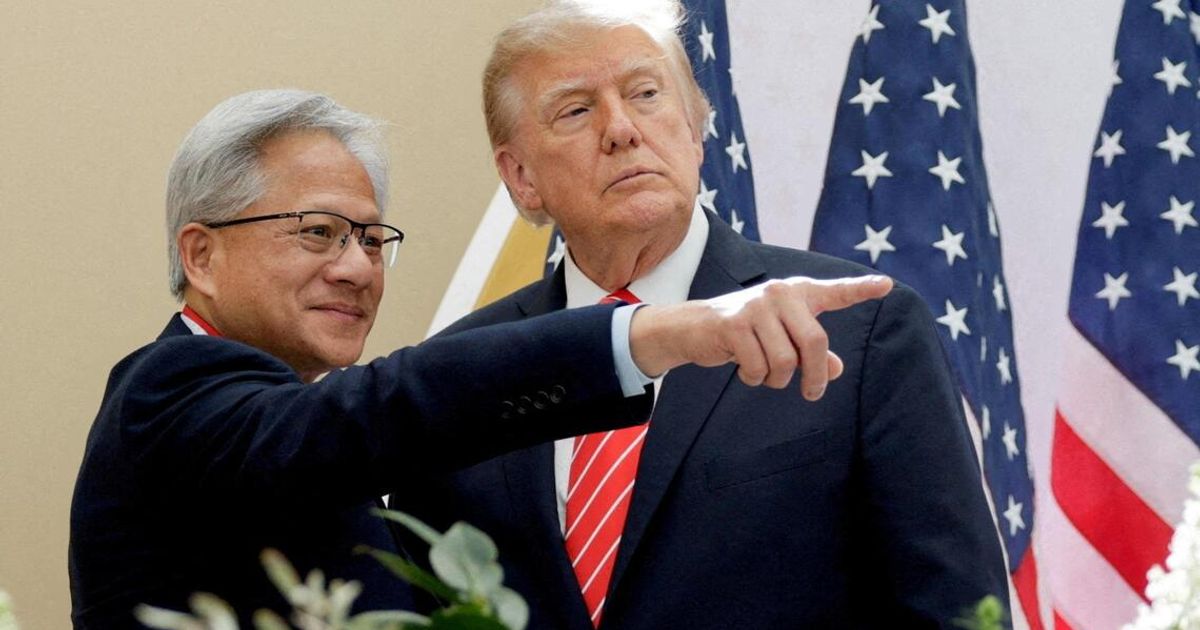
LONDON – Investors worldwide reacted with jubilation to news that the board of Nvidia reinstated Jensen Huang as the company’s CEO. Shares in the US chip giant leapt by more than a third. Stocks in a variety of artificial intelligence and semiconductor corporations also soared on Nvidia’s coattails.Still, the reaction to the latest twist in the Huang story will probably go down in corporate history as a classic case of make merry in haste but repent at leisure.For the episode raises only further grave questions about the way the US government is prepared to interfere in the management and operations of its high-tech industry, and the extent to which the sector is being dragged into the US’ global confrontations.Jensen Huang always claimed he was merely a shrewd businessman, determined to keep his business apart from politics. But he now owes his job to the White House, and to exactly the political calculations Huang wished to ignore.Tech founders and succession planningThe first and probably the most immediate concern is the impact of the Huang story on corporate management practices in the US tech industry.Big corporations are expected to stress-test the resilience of their management succession structures on a constant basis. As any first-year student in management sciences learns, a company relying on the assumption that its star performers will be there forever is a company suffering from literally a fatal weakness.The decision by the Nvidia board to accept Huang’s return a mere few days after claiming that he won’t be allowed back is a very public admission that a commercial entity worth trillions of US dollars is apparently incapable of thriving without its founder.There is no question that Huang is a pioneer in his field, and that Nvidia’s success remains critical to US supremacy in the field of AI and semiconductors. In fact, it is so embedded in the industry that if Nvidia collapsed, it could take the whole assembly in its wake. It is therefore easy to see why Washington decided to prioritise Huang’s return over any other considerations.Still, his rushed comeback is not a sign of fundamental corporate strength, but a reminder of a critical weakness in a US tech sector that is already dominated by just a handful of middle-aged men who continue to behave and dress as though they are destined to remain precocious teenagers forever.Comeback raises legal questionsHuang’s reinstatement is also a reminder that not all US corporations are equal under their country’s laws. According to the currently available information, Vice-President J.D. Vance spent days providing Nvidia’s directors with two specific assurances: that the US government did not regard Huang as a national security threat and that he faced no criminal charges.Nvidia’s board wrote these private reassurances into their filing for the US Securities and Exchange Commission. As Nvidia reported, its directors relied on “input from senior levels of the United States government” to conclude that Huang’s reinstatement posed no national security risk.But the US Federal Bureau of Investigation’s counterintelligence inquiry into Alice Huang, the Chinese national with whom Huang had extensive business and personal links, has yet to produce any conclusions. The US Attorney-General has also not reached a decision. And Nvidia’s own independent review into Huang’s conduct is yet to submit a report.So, what top Trump administration officials provided to the Nvidia board was not the outcome of a legal adjudication but a substitute for one, a political decision to exempt a key chief executive from whatever legal conclusions flow from his alleged conduct.But it is hardly the end of this story. The US Congress, soon to be in the hands of Democrats, is unlikely to be persuaded by the White House argument that a Chinese national who not only forged a strong business relationship with Huang but also occasionally shared his bedroom got nothing more than inconsequential pillow talk from such dalliances.Nor are US lawmakers going to be reassured that all the potential security implications are now fully documented. “The reckless decision to bring Jensen Huang back as CEO does not change the fact that Mr Huang, Nvidia executives, and the company’s board still owe Congress answers about the company’s compliance with US export controls,” said Senator Elizabeth Warren, the ranking Democrat on the Senate banking committee.Serious dents in US tech credibilityThe US always prided itself on leading on technology transfer control regimes. The so-called Coordinating Committee for Multilateral Export Controls was invented by the US in 1949 to restrict the flow of critical knowhow to the Soviet Union during the Cold War and served as the model for the much more sophisticated multilateral export control structure which the US operates today.All this machinery of restricting unauthorised flows of advanced semiconductors is only effective if tech companies in other countries are willing to match them. Politicians in the Netherlands and Japan, for example, have imposed real costs on companies such as ASML and Tokyo Electron, respectively, largely on the US-led argument that security considerations must override commercial ones.This control regime is not a legal structure; it is a coalition held together by the credibility of US seriousness. And that credibility has now been severely shaken.In an ironic twist, the US government picked the very day Huang staged his spectacular return to add Megaspeed, the Singapore-based cloud computing company, as well as six other entities linked to it in South-east Asia, to a blocklist kept by the US Commerce Department’s Bureau of Industry and Security.The enforcement of this decision will ultimately depend on cooperation between intelligence officials in various countries, and this, in turn, rests on an unwritten assumption that intelligence information passed on to Washington – often at considerable cost and risk to those who collected it – will be acted upon rather than just waved away or ignored by the White House on political grounds.The integrity of US counterintelligence relies on the fact that it is a process that continues regardless of the importance of its target subject and cannot be stopped by appeals up the political chain. Yet that’s exactly what has happened in the Huang case.Successive US administrations have complained that the US’ rivals compete unfairly through government intervention in the operations of their commercial entities, and by weaponising their dominance in key technologies.Now, however, the world is treated to the spectacle of a US president who intervened personally in the corporate management of a company not merely by using his influence but by overriding legal norms and procedures, and all in the name of upholding America’s silicon edge.US President Donald Trump has long worked on the principle that he can do whatever he pleases at home while demanding that others around the world do as he says.He should not be surprised if both the US’ allies and foes draw very different conclusions from the White House’s current conduct.
Jensen Huang owes his Nvidia comeback to Trump – and that’s a problem
Full Article
Original Source
Read the full article at Straitstimes →KhanList aggregates and links to publicly available news content. We do not host full articles from third-party sources. Always verify important information with original sources.