
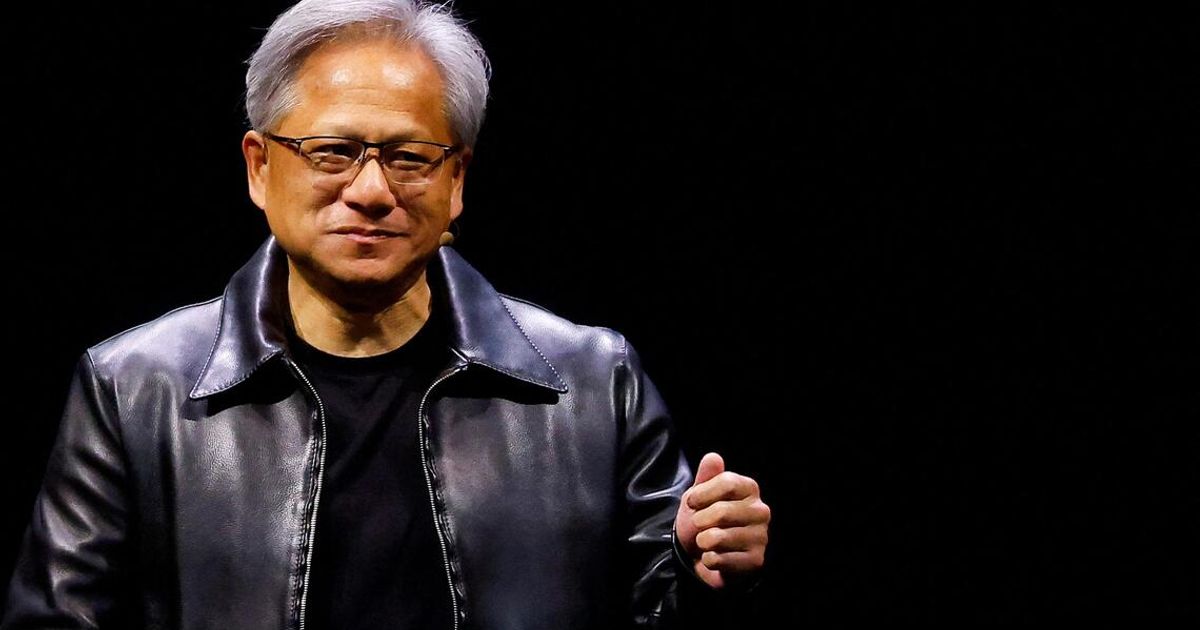
WASHINGTON - Jensen Huang and Donald Trump traipse into a bar – and find themselves ensnared in a Chinese honey trap.The hyper-realistic deepfake was among a series of AI-created clips prompting not fears of misinformation but a ripple of online amusement.Parody AI clips – placing the scandal-hit former chief executive of chip giant Nvidia in lifelike but fabricated scenarios – have been ricocheting across social media platforms following revelations of his extramarital affairs, including one with an alleged Chinese spy.Such viral clips, many circulating without AI labels, offer a measure of levity against the backdrop of longstanding concerns that deepfake technology could become a misinformation superspreader, even as researchers warn that the threat is far from having receded.Many of the lifelike clips drawing laughs – and garnering millions of views across platforms including X – were Bollywood-themed.One casts Huang in a gangster plot featuring Trump and tech billionaire Elon Musk, with their lip movements synced to raunchy Hindi dialogue.Other fabricated clips portrayed Huang breaking into Bollywood song-and-dance routines alongside his wife Lori and women he allegedly had affairs with.In one clip, Trump was portrayed berating Huang for giving a Chinese spy the “good AI chips,” and another reimagines an iconic scene from the film The Matrix, depicting the president lecturing him about how Chinese spies “want your secrets.”Several others depicted Lori catching Huang cheating red-handed.In one, Huang was depicted dining with a woman at a restaurant, only for the camera to reveal Lori sitting right behind them.‘Fear of deepfakes’The trend illustrates how creative AI tools have empowered ordinary users to bring to life almost anything their imaginations can conjure – for ideological purposes, to drive up engagement or simply for fun.Many of the clips were generated in seconds using simple prompts with AI tools such as the Seedance 2.5 video generator developed by the Chinese tech giant ByteDance.“The fear of deepfakes has been with us for a while – but it has always seemed like it was just around the corner and not quite here,” Joshua Tucker, co-director of New York University’s Centre for Social Media, AI and Politics, told AFP.“Going forward, it seems clear we’ll be seeing AI image and video generation being used in both ways: to deceive, but also as a creative attempt to attract attention.”However, not all the AI-enabled fakery was for laughs.Several pro-China social media accounts have circulated synthetic content about the scandal, including an AI image linking Huang to the Chinese Communist Party and an audio file purportedly showing Lori defending the alleged Chinese spy.Misinformation watchdog NewsGuard determined the audio had been fabricated, citing analysis by the voice detector Undetectable AI.‘Seeing is believing’“Parody clips of Jensen Huang are easy to spot, even if they aren’t labelled as AI,” Zohaib Ahmed, chief executive at the AI detection models firm Resemble AI, told AFP.He insisted, however, that the more serious threat posed by deepfakes “hasn’t receded at all.”“Deepfakes used in corporate settings, like a cloned CEO voice asking for a wire transfer, or a face-swapped job candidate on a video interview, are still defrauding companies out of millions,” Ahmed said.Researchers noticed a similar trend ahead of the US midterm elections, when hundreds of AI-generated ads – many of them comical or designed to lampoon political rivals – were deployed in campaigns across the country.Researchers said the ads were not necessarily intended to deceive voters into believing they were authentic, but rather to serve as a political communications tool to break through the attention economy.But even when users recognise such clips as synthetic, “they still have an impact” on the information ecosystem, cautioned Peter Adams, a senior vice president at the education nonprofit News Literacy Project.“You’ve ‘seen’ a candidate doing or saying something harmful, or embarrassing, or otherwise off-putting,” Adams told AFP.“This can cause a phenomenon called the ‘visual literacy bias,’ or the seeing-is-believing bias. It’s hard to shake an association once you’ve seen it.” AFP
Jensen Huang, meet Bollywood. AI parody clips of Nvidia ex-boss spark titters
Full Article
Original Source
Read the full article at Straitstimes →KhanList aggregates and links to publicly available news content. We do not host full articles from third-party sources. Always verify important information with original sources.