
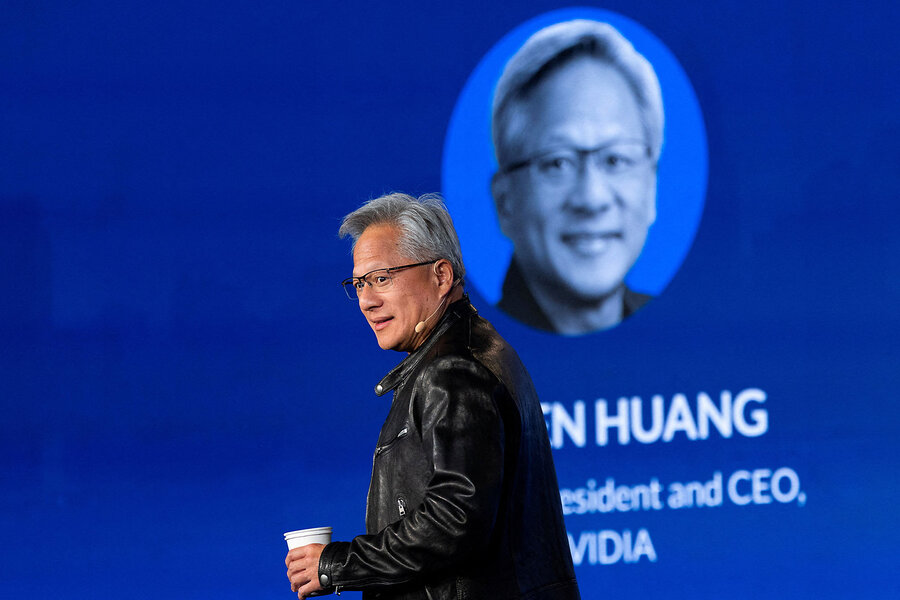
It has all the makings of a spy thriller: The CEO of a leading AI chipmaker has an affair with a businesswoman suspected by U.S. intelligence of working for China, raising suspicions that Beijing used the relationship to gather intelligence and influence U.S. policy on artificial intelligence.Those are the broad outlines of news reports leading up to the sudden departure of CEO Jensen Huang from Nvidia, the tech giant he co-founded.Long an opponent of export controls, Mr. Huang repeatedly urged Washington to ease restrictions on selling advanced chips to China. After admitting the extramarital affair and apologizing, he resigned after a second affair, this time with a direct subordinate, came to light. Reports of another workplace affair surfaced Thursday afternoon. The drama has become a cautionary tale about national security, AI management, White House protocols, and the importance of corporate oversight. It raises questions about Mr. Huang’s judgment, Nvidia’s corporate governance, and what U.S. officials knew about the potential security risks – and when they knew it. And it offers a peek at China’s extensive and sometimes illicit efforts to keep up with the U.S. in the AI race.Using romantic entanglements to compromise high-tech executives is nothing new for the Chinese Ministry of State Security, says Nick Eftimiades, a retired senior intelligence official and author of the book “Chinese Intelligence Operations.” The novelty is the target’s high profile. Until his resignation, Mr. Huang – an informal but influential adviser to President Donald Trump – has been one of the faces of the AI boom, largely because Nvidia chips are in such high demand. The company’s advanced chips can process massive amounts of data simultaneously, making them an ideal engine for AI. Reuters/FileIn an image taken from video, a woman identified as Alice Huang attends a dinner with Nvidia CEO Jensen Huang, in Taipei, Taiwan, May 22, 2025. “That’s the really audacious part” of the Chinese espionage, Mr. Eftimiades says in a phone interview, referring to an October report by The New York Times. “This is the first time that it’s become public that they’re playing this high in the food chain.”Nvidia says it has no reason to believe company secrets or national security have been compromised. And China denies the espionage allegations. “It is nothing but smears against China,” a Ministry of Foreign Affairs spokesperson said. From Beijing’s perspective, the scandal risks drawing attention to what national security analysts describe as a broader Chinese effort to obtain U.S. AI technology through espionage, illicit chip shipments, and other means.Some allegations about these activities are unproven. Criminal convictions, government probes, and tech research support others.Before the other two cases came to light, Mr. Huang apologized for his infidelity in an open letter without naming Alice Huang (no relation), the businesswoman spotlighted by The New York Times. President Trump later stated that the Nvidia CEO told him he “had no idea” Ms. Huang was a suspected spy and that he believed him. On Thursday, the company’s board appointed Chief Financial Officer Colette Kress as interim CEO while it searches for a permanent replacement.What is known – and what isn’t“This episode is only the latest in an effort to acquire foreign technology that is almost as old as the CCP [Chinese Communist Party] itself,” says Arran Hope, editor of the China Brief at the Jamestown Foundation, a Washington think tank, in an email to the Monitor. “But investigations are still necessary: there are many known unknowns and unknown unknowns in this particular case. And the stakes are incredibly high.” Go Nakamura/Reuters/File Nvidia CEO Jensen Huang speaks to members of the media during a meeting in Beijing between business executives and Chinese Premier Li Qiang, May 14, 2026. The revelations have already spawned two investigations. The Nvidia board said Tuesday it had hired prominent New York law firm Wachtell, Lipton, Rosen & Katz to conduct an independent look into whether company secrets or national security have been compromised. Congress has its own questions for Mr. Huang.But there’s much more than the Huang affair to investigate, many security experts say.Start with the chips. In October 2022, the Biden administration imposed sweeping restrictions on the sale of advanced chips from Nvidia and other U.S. firms to China. Mr. Huang and others argued against the ban, saying it would drive the Chinese to build their own advanced chips. The ban was also hurting Nvidia sales to China, a potentially huge market. The following year, a Singapore subsidiary of a Chinese gaming firm was sold off, emerging with a new name, Megaspeed, and a managing director named Alice Huang. The company shifted to a new business: offering AI data services.The company gained access to Nvidia chips, and business boomed. Last year, allegations surfaced that the company was actually diverting restricted Nvidia technology to China. Singapore confirmed it was investigating such allegations in 2025. So was the U.S. Commerce Department, according to The New York Times, until its investigators received an email from Nvidia’s general counsel, saying that the investigators’ boss at Commerce had allowed the company to reach out with questions.The probe was ultimately transferred to the Justice Department. President Trump had already eased restrictions on Nvidia in July 2025, allowing Chinese companies to buy its H20 and MI308 chips. And in December, he announced plans to permit exports of the more powerful H200 chips to approved Chinese customers.On Thursday, Megaspeed said it had cooperated with inspections and was hiring a U.S. law firm to review its inventory of Nvidia chips and compliance with U.S. export control rules.Who knew what when?Whether Ms. Huang is a Chinese spy remains murky. U.S. intelligence officials began surveillance of Ms. Huang over a year ago, according to the Times, and determined that the Chinese Ministry of State Security had recruited her. The paper also reported that Secretary of State Marco Rubio warned Mr. Trump about the relationship and Ms. Huang’s intelligence ties as the president prepared to travel to China in May. Mr. Trump still allowed Mr. Huang to accompany him on the trip, along with other AI executives. The president later said he had been unaware of the allegations at that time.In a Wednesday interview with Politico, Democratic Rep. Jim Himes of Connecticut, who is expected to chair the House Intelligence Committee beginning in January, said after an intelligence briefing he could not tell whether Ms. Huang was a spy or a dupe. Jonathan Ernst/ReutersNow-former Nvidia CEO Jensen Huang speaks to President Donald Trump during a lunch for tech industry leaders at the White House, Sept. 29, 2026. On Thursday, Mr. Huang stepped down from the company he co-founded after allegations of extramarital affairs had surfaced, including one with a suspected Chinese spy. What is clear is that restricted American AI technology has continued to reach China despite U.S. export controls. A year ago, Alan Hao Hsu pleaded guilty to charges of exporting and attempting to export more than $160 million of restricted Nvidia chips. Last month, a former Super Micro Computer contractor, Ting-Wei Sun, pleaded guilty in New York federal court to diverting servers with Nvidia technology to China. In August, Taiwan charged nine people, including an Nvidia employee, with trying to smuggle servers with advanced Nvidia chips to China. Northwestern Polytechnical, a Chinese university linked to the country’s military and subject to U.S. trade restrictions, bought two advanced Nvidia chips last month for about $131,000, Reuters reported this week. The chips were purchased through a Chinese supplier, the report said. Reuters could not establish the chips’ original source.China also recruits employees of U.S. high-tech companies to extract AI secrets, security experts say.American AI companies also say Chinese competitors have used a legal practice known as “AI distillation” – but have done so without authorization – to train smaller models using outputs from advanced U.S. models such as ChatGPT and Claude.Anthropic says it has strengthened its defenses and reduced by an estimated 90% or more the information that distillation attacks can glean. “But no company can solve this alone,” it wrote in February, adding that “distillation attacks at this scale require a coordinated response across the AI industry, cloud providers, and policymakers.”U.S. law hasn’t even settled yet on whether distillation is illegal, Sarah Tishler, a partner at the law firm Beck Reed Riden LLP, wrote in an analysis in May. Deepen your worldviewwith Monitor Highlights.Politics with respectGet political stories with respectful analysis.There‘s a world of new ideas in everyBooks newsletter.There‘s more to life, enrich yours withCulture & Learning weekly.Follow humanity‘s discoveries withScience & Nature stories in your inbox.Gain a spiritual perspectivefrom the stories in your inbox.Want to understand the deeper impact of critical events? Learn the Monitor‘s insight.Already a subscriber? Log in to hide ads. The Huang scandal might help draw attention to and dig up more evidence of the broader challenge, security experts say.“We’ve lost trillions of dollars in [intellectual property] to China,” says Mr. Eftimiades, the retired senior intelligence official. “Events like this that do become public start to educate policymakers, even at state levels, ... as to exactly what the threat is.” ALREADY A SUBSCRIBER? LoginReal news can be honest, hopeful, credible, constructive.The Christian Science Monitor was founded in 1908 to lift the standard of journalism and uplift humanity. We aim to “speak the truth in love.” Our goal is not to tell you what to think, but to give you the essential knowledge and understanding to come to your own intelligent conclusions. Join us in this mission by subscribing.
Jensen Huang is out at Nvidia. China’s quest for American AI isn’t over.
Full Article
Original Source
Read the full article at Csmonitor →KhanList aggregates and links to publicly available news content. We do not host full articles from third-party sources. Always verify important information with original sources.