
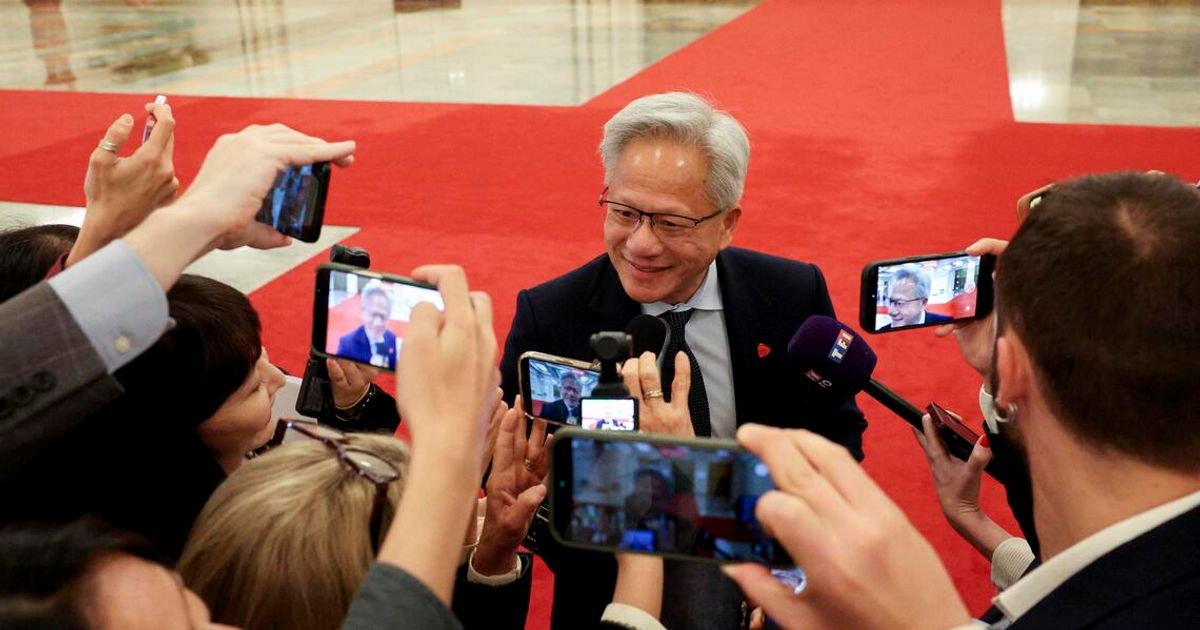
SINGAPORE/BEIJING – Jensen Huang may be back at the helm of Nvidia, but his return offers little reprieve to Chinese artificial intelligence firms that rely on advanced US chips.Analysts say new US rules, which took effect on Nov 19, deal a significant setback to China’s AI development in the near term by making it harder for Chinese firms to rent computing power from overseas data centres.But the curbs are likely to add fresh urgency to China’s years-long push for technological self-reliance, turning what firms once saw as a back-up plan – developing home-grown chips and computing systems – into a priority.China’s AI industry knows it can no longer lean on Huang to help secure access to Nvidia’s advanced chips. Huang, who was reinstated as chief executive on Nov 23, was once one of the most vocal advocates in Washington of continued chip sales to China.“The most important lesson for China is that it cannot depend on the goodwill of individual American corporate leaders, regardless of their commercial influence or willingness to engage with China,” said Tan Kong Yam, an emeritus professor of economics at Singapore’s Nanyang Technological University.George Chen, a partner who leads the digital practice at The Asia Group, a Washington-based consultancy, noted that Nvidia’s board has set up a new committee to oversee national security risks and compliance with export controls.“Nvidia will surely double down on compliance, because it won’t want to be accused again of being too cosy with China,” Chen told The Straits Times.Signs of disruptionsThe new rules announced by the US Commerce Department’s Bureau of Industry and Security on Nov 16 prohibit data centres outside the US from serving Chinese clients with significant computing power, unless licensed by the US government.With remote access accounting for nearly a third of AI computing power for Chinese firms, tech giants have already warned that the US curbs could disrupt their plans.Tencent said reduced access to advanced computing power could lengthen the time it takes to develop a future generation of its Hunyuan AI model. “It sets everyone back in China,” said Tencent president Martin Lau on a Nov 18 earnings call.A day later, Alibaba chief executive Eddie Wu said the company could scale back its long-term data centre expansion target.The uncertainty has reached lenders, too. Bankers had paused work on a proposed US$480 million (S$618 million) loan sought to pay for Nvidia chips at a Malaysian data centre that would serve ByteDance, the Chinese owner of TikTok.Benjamin Ho, lead research strategist for Hong Kong and China equities at Maybank Investment Banking Group, notes how at least two of Nvidia’s server partners have suspended deliveries to customers in South-east Asia amid the new US curbs.“I think model iteration and rollouts will slow down significantly, and you will probably see this become more severe in the coming months,” he told ST.Since Washington began restricting exports of advanced Nvidia chips to China in 2022, Chinese tech firms have increasingly rented computing power from overseas data centres.Even before the November restrictions, Chinese companies were scrambling to secure overseas computing capacity, Reuters reported on Nov 12.Overseas data centres supply roughly 30 per cent of the AI computing power available to Chinese firms, estimates Sigrid Wang, lead technology analyst at Hutong Research, an independent Chinese advisory firm.Before the Nov 16 curbs, the Washington-based Institute for Progress (IFP) think-tank projected that the computing power Chinese firms could tap through overseas data centres would nearly triple, from the equivalent of about one million Nvidia H100 chips at the end of 2026 to 2.8 million a year later. Ho of Maybank expects a fierce fight to ensue among Chinese AI companies for scarce domestic computing resources, noting how top Chinese chipmaker SMIC is already operating at 98% capacity and buyers like DeepSeek are facing wait times of more than a year for the latest chips.In such a battle, Ho said tech giants like Baidu, Tencent and Alibaba are best positioned thanks to early investments in domestic data centres and hardware. Pure AI start-ups like Moonshot AI and MiniMax, on the other hand, are the most vulnerable as they would need to rent computing capacity from their rivals.Limited home-grown chipsAccess to Nvidia chips inside China remains uncertain. Nvidia has confirmed it stopped shipping its H200 processors to China despite receiving some US export licences.Beijing has also urged Chinese firms to use home-grown chips, and withheld approval for a shipment of about 600,000 H200s to enter from Hong Kong, according to a Nov 5 Reuters report.“Were Nvidia to stop supplying China with its H20 and H200 chips altogether, Chinese chipmakers would have a huge gap to fill,” Wang said, adding that Nvidia accounted for 55 per cent of China’s AI chips market in 2025.Chinese firms including Huawei, Baidu, Alibaba and Cambricon have made strides in designing AI processors. But China has limited capacity to manufacture them. This manufacturing bottleneck could tighten further, said Guo Shan, a partner at Hutong, if the US Congress passes the MATCH Act. The bill seeks to press allies such as the Netherlands and Japan to tighten controls on sales to China of the equipment used to make advanced chips.While Huawei has built clusters known as supernodes that connect many chips at high speed, allowing them to train and run large AI models together, they remain prohibitively costly.Wang, the Hutong analyst, said Huawei’s Cloudmatrix 384 can rival Nvidia’s GB200 NVL72 system on some measures, but its eye-popping price of US$8 million puts it out of reach for smaller Chinese AI developers. There is also a trade-off. Linking more processors can help close the performance gap, but it strains China’s already limited supply of home-grown chips.A scholar who advises the Chinese government on AI policy acknowledged that his country’s chips and computing systems still lagged behind America’s, but remained optimistic about China’s long-term potential.He spoke with ST on condition of anonymity because he was not authorised to speak to the media.“Instead of bemoaning how the US curbs will handicap us, we would rather see them as giving us a window period to grow ourselves,” he said.
Jensen Huang is back, but China’s AI chip crunch is far from over
Full Article
Original Source
Read the full article at Straitstimes →KhanList aggregates and links to publicly available news content. We do not host full articles from third-party sources. Always verify important information with original sources.