
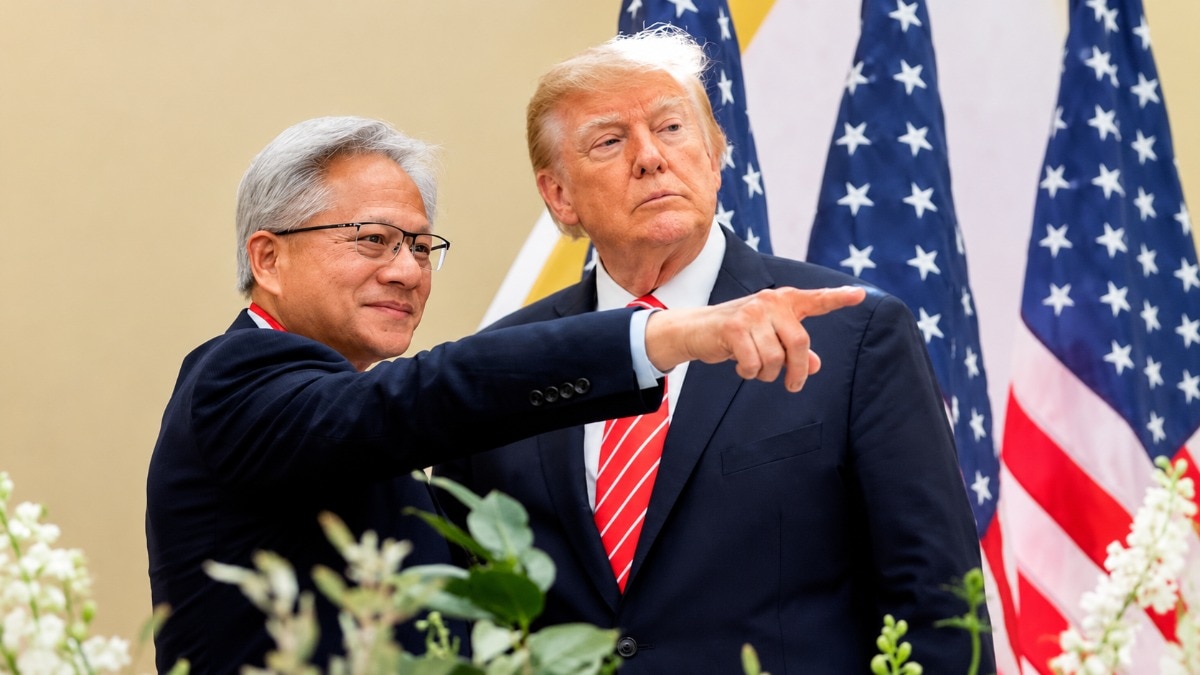
The Nvidia saga that started at the beginning of this month had its finale this week. It ended in Jensen Huang coming back to the company as its CEO. But after one month of drama, the status quo may not last even if everything at the moment is business-as-usual.Image credit: ReutersFor the last few weeks this newsletter has covered the Nvidia saga. It started with a couple of media reports that exposed Nvidia CEO Jensen Huang’s extramarital affairs. He was forced out of Nvidia. The company started looking at a future without its iconic founder. In the subsequent days a lot happened publicly and more happened beyond the sight, behind the scenes. Eventually earlier this week we had the finale of the saga — which has all the makings of a Netflix thriller — with Jensen Huang coming back to Nvidia as its CEO and president. In his comeback a major role was played by another president — US President Donald Trump. As this Newsletter has highlighted earlier, the Nvidia story was not strictly about the affairs of Jensen. There was more to it. It was a power play between two factions in the US government. In the end Donald Trump stepped in to save Jensen and bring him back to Nvidia — not because he is the BFF to Nvidia CEO. But because the Trump administration cannot afford to see Nvidia flounder at this moment. The AI chipmaker is crucial to the current AI boom. Without the AI boom, which can also stand for Artificially Inflated boom, the US economy as well as many other economies across the world would likely go bust. Irrespective of the reasons, Jensen Huang is back as Nvidia CEO. The Nvidia stock is rebounding. The US financial markets are looking healthy again. To repeat a question this newsletter asked earlier as well, where does the world of AI go from here? I feel Jensen coming back to Nvidia and the return of normalcy in the AI world only masks the cracks. For now. Eventually, the AI world will have to reckon with reality and answer how Nvidia has become so crucial to it. The answer may reveal something uncomfortable. It may reveal that Nvidia succeeded not because it has some alien technology but by chance. And savvy deal making done by Jensen. Behind the financial wizardry and an irrational exuberance of stock markets, there may not be that much of a tech edge in dominance created by Nvidia.More importantly, it may no longer be the business as usual for Nvidia. The US government, after a wink-and-nod to triumphant Jensen, is already tightening chip controls to ensure China does not access AI chips in any manner whatsoever. Companies are curtailing their plans to create more data centres in Asian countries from where compute could be supplied to Chinese AI labs. There is a greater scrutiny on where and how Nvidia is selling its AI chips. This will have business implications for Nvidia. At the same time, the effect will also lead to hardening of stances. If there is absolutely no way China can get access to Nvidia hardware, the country is going to double down harder on its AI chip efforts. If the US government is moving to make the fight existential for the Chinese AI labs, the free flowing of ideas may freeze. This will impact the entire AI ecosystem and it is unlikely to be beneficial. It would fragment the world of AI even more, it will slow down some parts of it considerably. The overall effect of it all may even end up killing the irrational buoyancy in the financial markets that has propped up the AI companies so far. Think of a magic show. We all enjoy these shows because of an illusion. We believe them to be real. But if by some chance we get to know the tricks that magicians use, the same show becomes boring. The illusion breaks. The Nvidia saga of the last few weeks may break the illusion that magician Jensen Huang has created. With Nvidia under scanner, a lot of AI and tech companies will start hedging their tech bets somewhere else. This was already happening. Google, for example, uses Nvidia hardware scantily for its AI needs. It has its own TPU chips. In recent months, we are seeing more and more companies trying to figure out a way to live without Nvidia. This includes even whales like OpenAI and Anthropic. The trend may accelerate. Sure in the short run, that is a few months, nothing much will change. But I have a feeling that in another year from now Nvidia will occupy a less important position in the AI world than it currently does.TALKING AI: Indian IT will get its share of winners and losersIn August this year when the Time magazine put out its list of 100 influential people in AI, Publicis Sapient CEO Nigel Vaz found a place in it. Thanks to the role he and his company is playing in helping firms small and big navigate the world of AI. The work that Vaz does may not be as exciting as working on developing a new frontier AI model, but it’s important. He is helping the rest of the world make sense of this new-fangled beast called AI, and how it can be tamed, trained, harnessed to serve companies and people. Earlier this week I sat down with Vaz for a quick chat about enterprise AI, what the transformation looks like for companies, as well as people working in them, will there be job losses due to AI, and that all-important question of what AI is going to do to Indian IT. Here are excerpts:As companies try to navigate the changing world, what are the three steps you would recommend organisations take to thrive in the AI world? I'd say the first, and the most important thing, is being very clear about what you're trying to accomplish. Because AI isn't a technological implication. AI is a business implication. So if you just say, I want to do AI, that's already a recipe for disaster. The second would be modernising and transforming your existing data and technology landscape to be ready for AI. When people say they need an AI strategy, I ask them do you have a data strategy? AI is only good as the data that you have in your organisation and your ability to connect it with other things to create value. And the third is reimagine the way things get done as opposed to merely adding AI to what you do.Impact of AI on organisations is one part of the story. What sort of impact will it have on employees and jobs?The current transformation, at least from my own experience, is similar to what happened in the Dot Com era. There were a lot of people who were extraordinarily worried about the internet and job losses. Generally I am an optimist and my orientation to this is that there will be job losses, there will be job transformations, but overall we will produce and consume much more. Will AI make a lot of the jobs that we have today less relevant? Sure. But it is a fact that AI will also allow us to do so much more, there will be more work to be done.Let’s take a look at the Indian IT sector in particular. Will our SaaS survive the AI era?I've talked about this publicly earlier. The Indian IT sector has to move from a cost-based model to a skill-based model in terms of value. It can't be a cost arbitrage model anymore. On enterprise AI, there's a huge opportunity for leadership from an India perspective. But it goes down to how Indian IT firms execute. You will see some firms win and some lose, depending on their ability to execute the transition from cost arbitrage to skill. And what happens to Indian IT employees, are they winners or losers?My sense is that it will come down to the motivation of folks to re-skill themselves, to capture the (new) opportunities. Today many in the industry are conditioned to doing a very specific kind of work. A lot of it is repetitive and low cost. You have to break away from that and apply your capability to something different.Indian IT employees are 100 per cent capable (of change and re-skilling). Most Indian IT professionals enter the industry — and this includes me — not because we are passionate about technology, but because we have an interest in being successful. Indian IT employees are more than capable of making the pivot when the opportunity presents itself. Do you think companies should use open-source models so they can own their AI platforms instead of relying on OpenAI and Anthropic?Open source AI and closed AI serve different purposes. For me, the value of an open source model is your ability to interrogate the weights of the model, to understand why it makes the choices it makes. In the context of closed models, you don't have that ability.I feel this is like a toolbox. You don't take a sledgehammer out when you need to hang a painting on a wall. You pick it when you want to knock the wall down. Similarly, you need different AI tools for different work. The last one: what do you think of AI doomsday talk, from Dario to Altman everyone is on it?Are there real concerns and risks? Absolutely. But those, for me, were the same risks that existed in any major technology going all the way back to when humans used fire. Fire is a pretty cool thing, but it can be used to burn a lot of stuff down to the ground. My view on this is much less to do with technology. It’s possible with our ability as technology leaders to enable guardrails and governance models to ensure AI is used safely. And I'm much more of a believer in our ability to do that. Will we see some, you know, impact from AI? Probably. But do I think they're going to be existential? I don't.Google gets its mojo back with NeonSince forever Google has been playing catch up with OpenAI and Anthropic in the AI space. Sometimes it comes close, like it did with Gemini 2.5 Pro. But then ChatGPT and Claude pull up ahead again. Now after months of trying, just when people started saying that Google has lost it, the company has a new AI model out. It is called Gemini Neon and it is good enough to bring Google back into the game. In fact, it is so good that many are calling it better than anything OpenAI has, and almost as good as — or in some cases even better — than the Claude Opus 5.5.People are loving Neon and it is evident in the usage it is seeing. Just a couple of days ago Google CEO Sundar Pichai wrote on X: “Neon set a new Day 1 usage record on our paid APIs and Antigravity. Tokens per day are up 82 per cent since Argon launched (only) 6 weeks ago. It's been great to see the reception.” Of course, he is the Google CEO so he is supposed to say all this. But praise has also come from tech insiders, including Twitter founder Jack Dorsey. When DeepMind boss Demis Hassabis said, “You should try Gemini Neon, it's a good model,” the reply came from Jack. He wrote, “Very much so.” More than the capabilities of Neon, people are probably loving it also because they don’t want a two-way race between OpenAI and Anthropic. Google is the kind of player that can substantially alter how AI is used, at what cost, and how accessible it is. At a time when public trust in Sam Altman and Dario Amodei is not very high, people are happy to see something from Google going toe-to-toe with ChatGPT and Claude.Dario talks of Free Will, Wang sounds alarmAfter a brief lull, the AI doomsday talk was again in focus this week. It started with Alexander Wang, the AI boss at meta. So far, Wang and Meta have been more optimistic about AI than pessimistic. But this week out of the blue, Wang wrote a long post on X. “Superintelligence is arriving. How humanity acts over the next year will have great consequence on what future world we live in,” he wrote.He still sounded hopeful, making arguments similar to what Vaz earlier was making in this newsletter. Wang said:“It is hard to imagine a world where humanity maintains control with superintelligence that is 1000x smarter and more capable than humans in every field.”His solution? “We should not be okay with a handover of society to AI,” he said. Essentially, humans must remain in control. The sentiments were shared by Anthropic boss Dario Amodei a few days later. In an X post of his own, Dario wrote: “I do not believe that we should surrender human free will to AI systems, and it’s absurd to suggest that I do.” Dario was responding to a news report that suggested he was all in favour of giving AI as much control as possible. But as he responded to the argument, his post inevitably veered into the argument about how humans should control AI. His solution was similar to what we heard from Wang. “As applied to grand questions of how we govern increasingly capable AI, I have been vocal and consistent that AI needs to be governed by a legitimate, democratic process and that surrendering human free will to AI systems is a terrible idea,” he wrote. Will AI cure cancer soon? Pharma not sureOf late we have heard from a lot of people in the tech industry that AI is going to cure a lot of diseases very very fast. There is a talk, often amplified by Dario Amodei, that AI can help find cure for various cancers in 10 years. Novartis CEO Vas Narasimhan is not so sure. Interestingly he is a board member at Anthropic.It is not that Narasimhan is not seeing the potential of AI. He believes it will speed up drug discovery and research. But, he suggests, it is all limited by the laws of biology. “I don’t think we’ll get away from the fact that you still need to put these (AI-discovered) medicines into animals and then humans to test the biological functions of these compounds,” he said.In other words, even if newer drugs can be concocted faster, the way Pharma industry and regulations work, it will be years, probably a decade or two, before the drugs reach patients in Delhi hospitals.SIX STORIES YOU CANNOT MISS01AI may have cracked internet encryption: Banks and governments face potential security threat02Things won't go well: Google DeepMind AI researcher is stressed, hopes her family stays away from AI03Sridhar Vembu says AI is making him work harder, feels he is wasting time if not using it04Anthropic, OpenAI employees' shocking warning: AI models are now too powerful for public release05Sarvam hits back at trolls, teases multiple models after launching AI token factory06AI godfather says Dario Amodei has medieval mindset, left OpenAI when things went out of control
Jensen Huang is back at Nvidia. AI rally continues. But status quo may not last
Full Article
Original Source
Read the full article at Indiatoday →KhanList aggregates and links to publicly available news content. We do not host full articles from third-party sources. Always verify important information with original sources.