
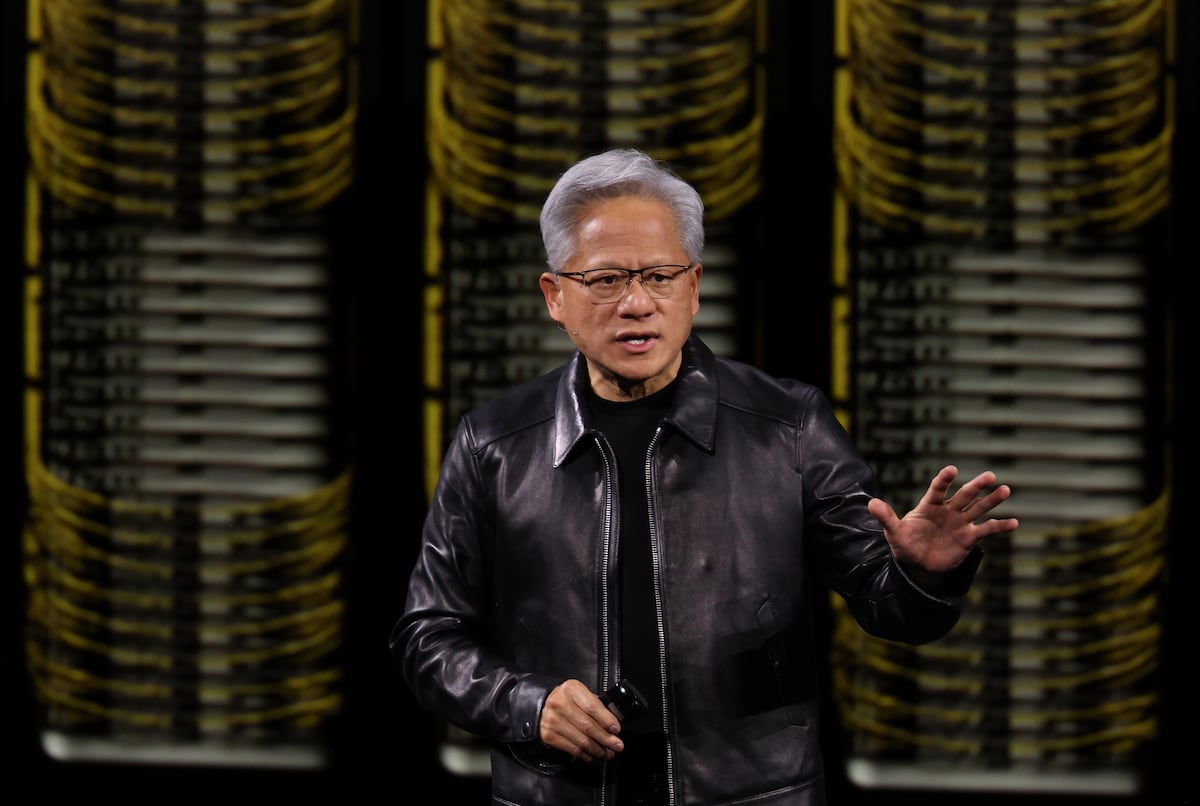
From Steve Jobs’s signature Issey Miyake turtlenecks to Mark Zuckerberg’s plain gray cotton T-shirts, no garment has become as recognizable a uniform of the all-powerful tech elite as the black leather jackets worn by Jensen Huang, Nvidia’s founder. If the AI visionary is making headlines these days, it is not because of his business achievements but because a series of extramarital affairs has come to light, leading to his resignation as the company’s chief executive. Fashion journalist Emma Childs argues in a tongue-in-cheek column for The Cut that Huang’s leather jackets had, in fact, “confessed before he did.” “A $9,000 leather moto is not the outerwear of a man faithfully going home to his wife and kids after a long day of architecting the AI revolution,” she wrote. “That’s a man in a midlife crisis with an active Raya profile and a Harley in the garage. If someone had consulted me years ago, I’d have said Huang is clearly someone who drinks wine with his mistress in the middle of the day.”Childs is not the only one who believes the billionaire’s leather jackets had long been warning the world about what was to come. Michael Smith, co-host of the fashion podcast Pair of Kings, argues that the way Huang treated his jackets was a telltale sign of a broader behavioral pattern. “Owning an expensive jacket does not mean you’re a serial cheater. However, this is a clear indicator of infidelity: stiff as a board, crease barely forming, no signs whatsoever that this jacket has been broken in,” he said. “If a man can not commit to anything, ladies: check his creases. If a man cannot commit to a 5,000 leather jacket, what makes you think he can commit to you?”When Childs and Smith speak of jackets worth thousands of dollars, they are referring to the Tom Ford pieces Huang is known for wearing. They are so coveted that one of them sold at a Sotheby’s auction for nearly $1 million. “This is not only a jacket,” the auction house said of the so‑called Jensen Jacket. “It is the uniform of a ‘first believer’; a symbol of his leadership style embodying authenticity, ingenuity, persistence, courage and joy. It has become a symbol for the vision at the forefront of the AI revolution.”Huang has said on several occasions that it is his wife and daughter who buy the jackets that have become such a defining part of his public image. Writing in EL PAÍS in 2024, Guillermo Arenas noted that while Steve Jobs had the iPhone as his signature product and Elon Musk had Tesla cars, Jensen Huang, the king of microchips, faced a greater challenge in finding an object that audiences would instinctively associate with him. Yet he managed it through his carefully cultivated image and, above all, through the jacket.That association held until the scandal surrounding his repeated infidelities, including the most damaging allegation involving a suspected Chinese spy, prompted a backlash among some of his fans. Huang had “betrayed the leather-jacket community,” Anand Giridharadas wrote in an opinion column for The New York Times. “It was annoying to watch a billionaire cosplaying as a rebel, perhaps in order to mask his extraordinary power,” he said. “Here he was boasting in interviews of not even knowing where his jackets came from, saying his wife and daughter bought them for him, when we in the community could tell you what we ate for dinner any of those fateful days when a new jacket came into our lives.”Beyond overlooking the emotional attachment that can develop with expensive garments, which only improve with wear and age, Huang also strips the leather jacket of the rebellious charge it carries when worn into a boardroom. Or perhaps he reverses its meaning altogether.Behavioral psychologist Carolyn Mair told the U.S. website Salon that tech billionaires are “choosing not to adhere to the sartorial codes of old-money elites, who tend to favor refined, understated luxury.” By rejecting those traditions, they signal “that they don’t need to conform to social rules, because they operate at a level where the rules don’t apply to them. This is a subtle, psychological demonstration of status.”In fact, as Richard Thompson Ford, the Stanford Law School professor and author of Dress Codes: How the Laws of Fashion Made History, argued in a New York Times article by fashion director Vanessa Friedman, Huang’s jacket “signals a down-to-earth rejection of fashionable artifice, while still using the power of fashion.” “[The leather jacket] is the uniform of Marlon Brando in The Wild One and James Dean in photos almost everywhere. Of the Beats and the Beatles; Elvis, and David Bowie (in his Berlin years),” he argued. “It is the opposite of what we think of when we think of a tech nerd, which is why the fact that Mr. Huang chose it as his uniform was so smart. It stands out. It causes a reassessment.”Speaking about figures such as Jeff Bezos and Mark Zuckerberg (who once swapped jackets with Huang and who has described him “Taylor Swift, but for tech”), Friedman argues that they are all executives who understand that the difference between a company successful enough to change the world and one that becomes part of popular culture may lie in the image of the person representing it. “One that’s just enough of a caricature to work its way into the public imagination and become the avatar of a movement,” she wrote.“His leather jacket is a uniform designed to simplify the billionaire’s life, but with a macho, rogue edge that fits perfectly with today’s arrogance in the tech industry. That the richest guys on the planet adopt it to attend top‑level meetings is a brilliant paradox,” said Alvaro Fernandez‑Espina, editor and stylist at EL PAÍS fashion supplement ICON. “They appropriate the aesthetics of rebellion to certify that they have already won. It’s a modern armor; it protects against corporate chill and, at the same time, gives a ‘cool‑villain’ aura fit for a spy movie."“For decades, the tailored suit was the uniform of power because it implied submission to the rules of the game,” he continued. “Today the leather jacket in Silicon Valley does the opposite: it signals that the rules no longer matter because the owner of the board controls the game.”The jacket reflects a broader shift that has taken place over the past decade: power has increasingly moved away from institutions and toward individuals. In that context, clothing becomes part of a strategy, at a time when power and leadership depend on the narrative built around a leader.But why leather? “Leather in menswear is often used to telegraph strength and rebellion, which many people — not just tech elites — desire to project,” fashion critic Derek Guy told Eugene Rabkin, author of Torn: Fashion and Postmodernism, in an article in the Financial Times.In the article, Rabkin examines the phenomenon of techno-oligarchs with a Peter Pan complex. At a time when executives are expected to be visionaries, managers, and brand ambassadors all at once, the leather jacket offers the perfect balance of authority, rebellion, and a youthful image, even for men well into middle age. “There is more at play here than wincing at the spectacle of unfathomably wealthy middle-aged men cosplaying cool. It has to do with the tension between monetary capital and cultural cache,” the journalist concluded.The Washington Post has been equally scathing. “Jensen Huang’s leather jackets are not the saddest part of his story. But they’re pretty sad,” wrote Shane O’Neill, bringing us back to the premise of this article: in his view, the former Nvidia chief executive’s style is “a textbook midlife crisis.”While leather jackets once served as symbols of rebellion and cultural dissent, their adoption by certain figures has left them largely stripped of that meaning. “Our businessmen imagine themselves rebels, and our rebels sound more and more like ideologists of business,” cultural critic Thomas Frank lamented in his essay Why Johnny Can’t Dissent.According to Rabkin, the best-known figures in tech have embraced this narrative of the rebel entrepreneur, cultivating an anti-establishment image in which nonconformity itself has become a leadership strategy.“Jensen Huang, with his collection of Tom Ford leather jackets costing $8,000 each — as if he were Batman — isn’t being careless,” said Fernandez‑Espina. “It’s a 2.0 version of understated luxury: understated luxury on steroids. While traditional executives hide behind a boring tie, the billionaire tech bro prefers the rock-star aesthetic. It’s a way of saying: I’m worth so much that I can walk up to unveil a trillion-dollar chip in a leather jacket.”An image of Huang wearing a vintage studded leather jacket, a Saint Laurent by Hedi Slimane piece, recently went viral and sparked a wave of commentary on social media. It was only later that José Criales-Unzueta revealed in Vanity Fair that the image had been generated by artificial intelligence. The circle seemed complete: the leading prophet of AI was watching his signature garment being reinvented by the very technology that made him famous.In any case, real or AI‑generated, the leather jacket still appears to function as a remarkably effective suit of armor. “Now that Nvidia CEO Jensen Huang, who has done a fantastic job, has resigned, there is only one man to take his place: Tim Cook of Apple. A legend replaces a legend!” U.S. President Donald Trump posted on Truth Social, before adding that he would not mind seeing Huang return.Whoever ultimately takes the job will have to think carefully about the uniform they choose. Journalist Natasha Lee has a suggestion: a cardigan. “Nobody has ever been caught out by a cardigan.”Sign up for our weekly newsletter to get more English-language news coverage from EL PAÍS USA Edition
Jensen Huang and the leather jacket that ‘confessed before he did’
Full Article
Original Source
Read the full article at English →KhanList aggregates and links to publicly available news content. We do not host full articles from third-party sources. Always verify important information with original sources.