
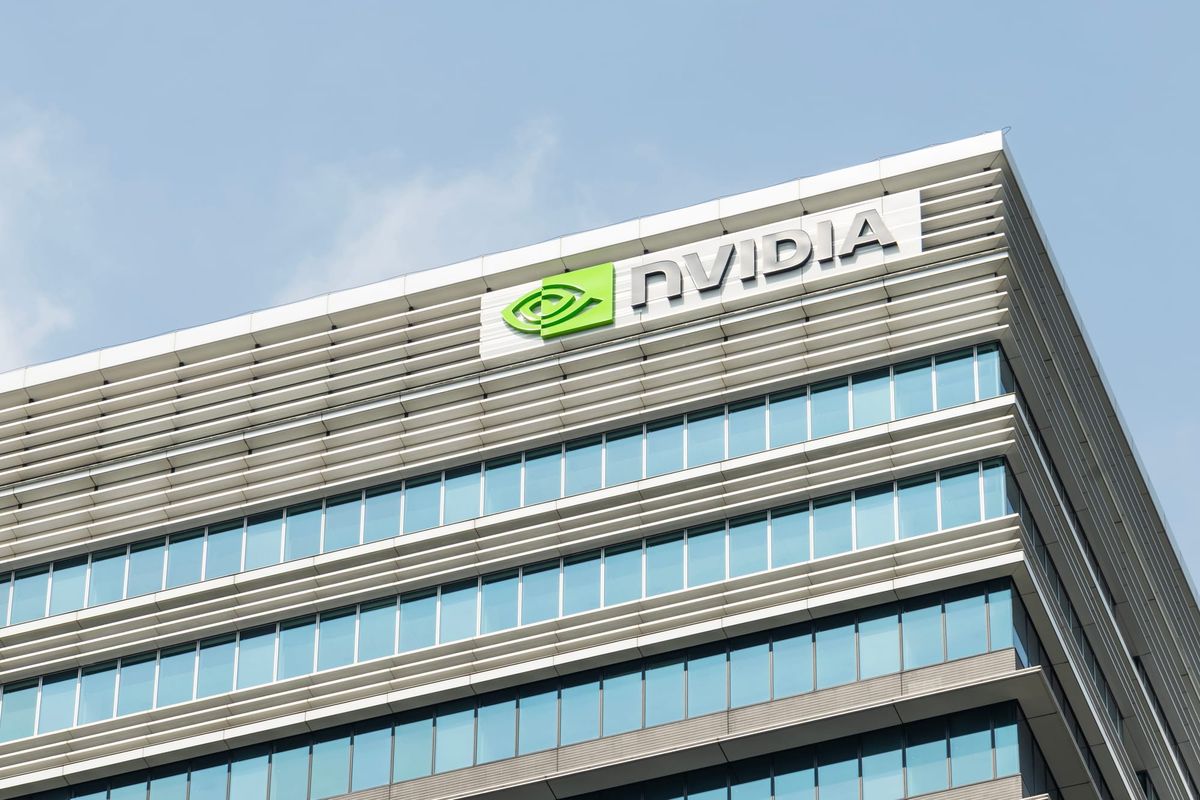
This column touches on aspects of the AI industry. My fiancé works at Anthropic. See my full ethics disclosure here.On Thursday morning, Nvidia announced that CEO Jensen Huang had resigned from the company. Colette Kress, Nvidia’s longtime chief financial officer, will serve as CEO while the board searches for a permanent replacement. Hours earlier, the New York Times reported that Huang had been in a second extramarital relationship, this one with a subordinate. By the end of the day, Reuters had broken news of a third. News of the first reported affair, with the suspected Chinese spy Alice Huang, had led a coalition of investors and fellow CEOs to announce their support for Nvidia’s founder. Nvidia without Jensen was unthinkable, they said. By Thursday, though, the unthinkable had become reality. Huang departed the company he cofounded 33 years ago at a Denny’s without a statement of his own in Nvidia’s announcement. There’s something undeniably tragic about Huang’s downfall, given that in so many ways his is a story of singular American success: an immigrant from Taiwan, sent to the United States at age 9, over 30 years he turned Nvidia into the world’s biggest company. The company’s profound innovations in graphics processing units, including software that made them useful for general-purpose computing, enabled a vast ecosystem that served as a linchpin for industries as diverse as video games, cryptocurrency, and frontier artificial intelligence development.Almost everyone agrees that Huang’s bombastic, personalistic style has been essential to the company’s success, which has been monumental. (During his tenure, Nvidia’s stock generated a 700,000 percent return.) It was also suited to these bombastic, personalistic times — exemplified by President Donald Trump, of course, but also by Silicon Valley’s cult of the founder. The idea that founders have a special status and should not be subject to normal business governance is an article of faith at some of Silicon Valley’s leading venture capital firms. Peter Thiel’s Founders Fund launched in 2005 with a promise never to remove a founder from their own company. Andreessen Horowitz, the largest VC firm by assets under management, promises on its website to “never publicly criticize any entrepreneur or startup,” adding that “doing so is a fireable offense.” (The firm does sometimes remove founders, though.)The cult of the founder arose after a series of high-profile incidents in which CEOs were pushed out of their own companies by meddling VCs, to the ultimate detriment of the business. Friendster’s board pushed out founder Jonathan Abrams in 2004 after losing confidence in him, only to cycle through a series of CEOs before ultimately attempting a doomed pivot into video games. Post-Napster, after Sean Parker was fired as CEO of contacts-management startup Plaxo, he took a job as the first president of Facebook — and negotiated for Mark Zuckerberg to have the voting control over Meta that he continues to enjoy today.Most famously, Apple’s board pushed Steve Jobs out of Apple, leading to the company’s near-collapse. And when Jobs returned to Apple in 1997, he saved the company — inspiring a generation of founders to see themselves as mythical figures who could operate outside the normal bounds of business.There is real value in the cult of the founder, which has enabled bigger and longer-term bets than investors would previously entertain. Amazon, Meta, Google, Salesforce, and Netflix are among the tech giants that thrived under their original leadership. Y Combinator, which backed Stripe, Dropbox, Airbnb, and other generation-defining Silicon Valley companies, succeeded by making early bets on talented founders and not burdening them too much with meddlesome boards.For all the value that this approach has generated, though, it brought with it at least two major problems. One was that, as tech became an ever-larger part of the economy, the once-plucky founders who needed protection from overreaching VCs themselves became oligarchs: billionaires, centi-billionaires, and in Elon Musk’s case, a sometime trillionaire. The richer their companies became, the more successfully they used their power to lobby for their own interests. They established and defended monopolies, or near-monopolies, crushing competitors and narrowing the choices available to everyone else. Meanwhile, the belief that they knew better than their investors expanded over time into a conviction that they knew better than the public, too. In social-media posts and interviews with journalists that grew rarer and more combative, they began to talk about threats to their wealth and authority as if they were threats to progress itself — and worked tirelessly to make sure their interests prevailed.Huang offered a vivid example of this phenomenon. Having legitimately played a key role in the technology behind the AI boom, he minimized any talk of the risks it might bring with it. Asked about the potential for loss-of-control scenarios in 2023, he told The New Yorker: “I know how it works, so there’s nothing there.” (He went on to say that AI functions similarly to a microwave.) In his September interview with Ezra Klein, Huang dismissed predictions of catastrophe as irresponsible and argued that safety requires only better engineering and testing. To him, it was a technical problem that could be solved by companies moving even faster — and buying more Nvidia chips with which to do it.He brought a similar sense of grievance to his campaign against export controls. There are difficult tradeoffs involved in deciding to what extent chip sales to US adversaries should be restricted. Over time, denying China access to the upside of AI risks provoking significant conflict. At the same time, selling state-of-the-art chips to Chinese labs risks the prospect that ever-more powerful AI systems escape US control and are ultimately used against it. Huang, who was reportedly terrified that his GPUs would be commoditized by the Chinese and so worked tirelessly to keep them within Nvidia’s own ecosystem, repeatedly resisted acknowledging that the tradeoffs even existed. When Dwarkesh Patel pressed him on the issue this year, Huang explicitly linked Nvidia’s fate to America’s. “Why would you want the United States to give up the world?” he asked. Later, he dismissed Patel’s framing of the risks as “childish.” To Huang, protecting Nvidia’s sales had become a patriotic obligation; the possibility that the US would benefit from a more measured approach to tech exports seemed almost impossible for him to entertain.The second big problem with Silicon Valley’s cult of the founder, and the flip side of entrusting flawed human beings with near-total power over their enterprises, is what investors call key-man risk. When hundreds of billions of dollars are at stake, it’s irresponsible for a company to have a single point of failure. And yet before news of Huang’s affairs broke, he was a 63-year-old man with more than 60 direct reports and apparently no succession plan. (He reportedly told colleagues he planned to run Nvidia until he was 120 years old.)When a company is generating 700,000 percent returns, no one wants to hear from the corporate-governance nags pointing out that one of the world’s most valuable companies is operating without a Plan B. Huang’s downfall shows why they should: you never know when behavior that was apparently already an open secret within some corners of Nvidia will spill into public view, destroying hundreds of billions of dollars worth of value and implicating an entire federal agency in a chip-smuggling scandal that now looks to extend well into 2027. It would have been no slight to Huang’s accomplishments over the past decade for a board member to insist that Nvidia identify and groom a bench of successors. In fact, had he and the board ensured that a successor was prepared to take the reins, they would have won praise. (Tim Cook’s silky smooth handoff of the CEO job to John Ternus this year makes for a dramatic point of comparison; perhaps that's why Trump now wants Cook for Nvidia CEO.)Unfortunately for Nvidia, and the wider economy that has increasingly come to rely on it, no such precautions were taken. It must have been easy, in the era of Trump and Musk, to assume that accountability had become a thing of the past. To believe any company that is too big to fail must be run by a CEO too big to get in trouble. (Little wonder that Trump reportedly called Huang on Tuesday and urged him to keep his job, no matter how the CEO’s indiscretions may have compromised national security.)But the blue tsunami of this month’s midterm elections suggests that the “lol nothing matters” era of US business and politics may be coming to an end. It has become all too clear that with few exceptions, the ultrawealthy are rarely looking out for anyone’s interests but their own. In the end, like so many American giants before him, Huang was brought down by his sex drive. But the real scandal is that he thought only he could run the company he founded, and now the rest of us have to live with the consequences.A MESSAGE FROM OUR SPONSORWho gave that agent permission?WorkOS Airlock checks agent actions against the task and your rules. Let routine refunds proceed, require approval above $500, and block actions outside the task. Every request and decision is logged.Learn more →On Friday's show: An emergency Thursday re-record of our A segment lets us go deep on who loses with Huang's ouster from Nvidia. Then, a look at METR's disturbing report on AI acceleration after spending weeks inside Anthropic. And finally, listeners ask us their questions in Human in the Loop.YouTube | Apple | Spotify | RSS | NPRThose good postsFor more good posts every day, follow Casey’s Instagram stories.(Link)(Link)guy who cheated on his wife with a waitress after 17 Michelob Ultras at a roofing sales convention in Kansas City: “I understand how Jensen found himself in this situation. for powerful men, this stuff can just happen.”— low yield lucy (@picotop) November 10, 2026 Talk to usSend us tips, comments, questions, and Nvidia CEO candidates: casey@platformer.news. Read our ethics policy here.
Jensen Huang and the end of the ‘lol nothing matters’ era of American politics
Full Article
Original Source
Read the full article at Platformer →KhanList aggregates and links to publicly available news content. We do not host full articles from third-party sources. Always verify important information with original sources.