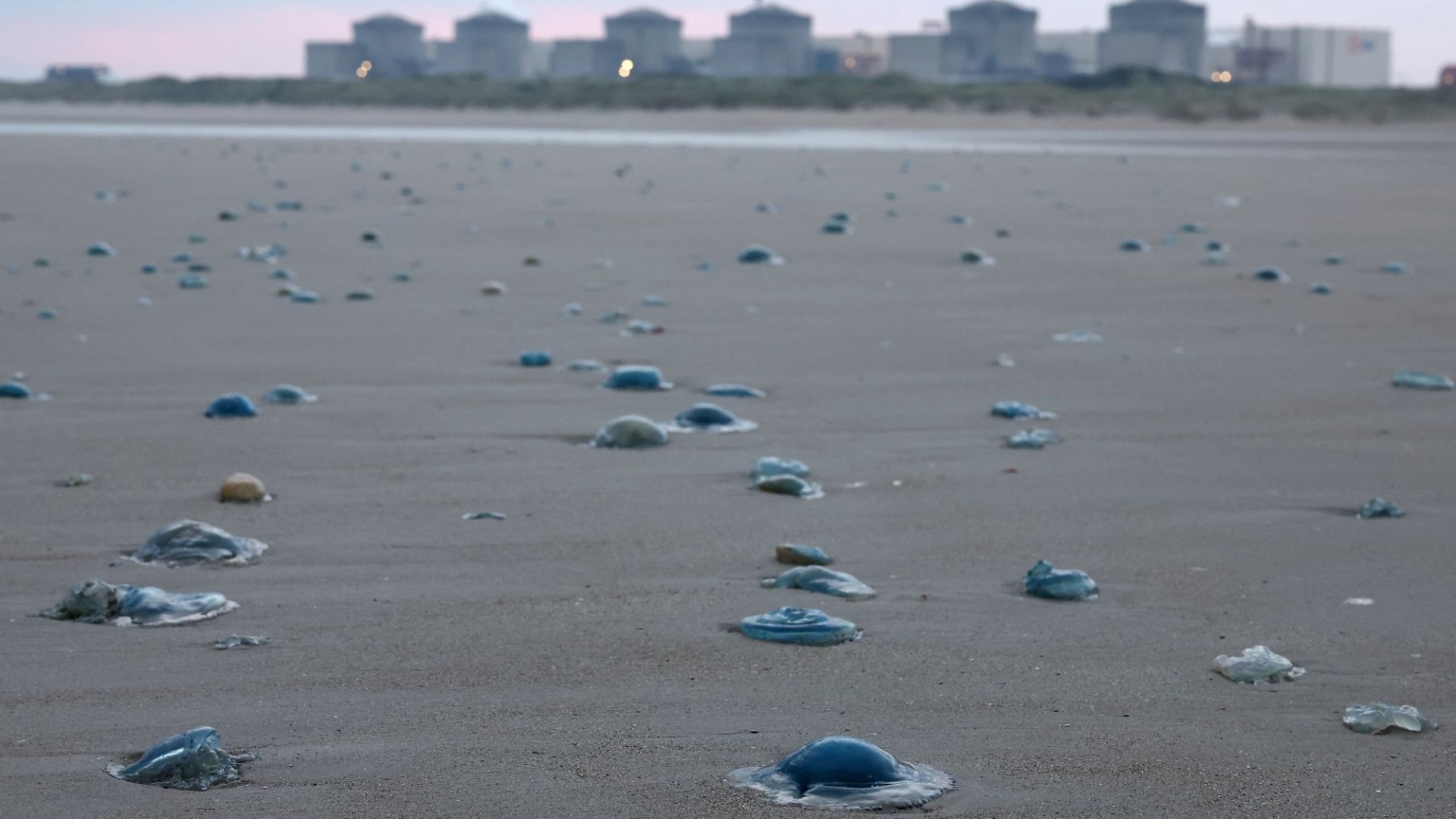
A JELLYFISH invasion has forced reactors at western Europe’s biggest nuclear power station 30 miles from Britain’s coastline to shutdown. A mass of the slimy sea creatures swarmed into EDF’s Gravelines plant near Dunkirk on Monday, triggering a shutdown of three reactors and slashing output from a fourth. Jellyfish lay on the shore near the Gravelines nuclear power plant in Gravelines last year Credit: AFP The extraordinary attack came exactly a year after another jellyfish invasion paralysed the French nuclear site for two days. In the recent intrusion, EDF said the creatures were sucked into filter drums at the seawater pumping stations, overwhelming the cooling unit system. Sign up for The Sun newsletter Thank you! Reactors two, three and four were taken offline, while production from reactor one was cut to just 50 per cent. An EDF spokesperson said: “This situation has no impact on the safety of the facilities, the safety of our personnel, or the environment.” By Tuesday, only reactor six was running at full power, while reactor five was already offline for scheduled maintenance. The six-reactor monster plant has a combined capacity of 5,400 megawatts and supplies around 70 per cent of the annual electricity consumed across northern France’s Hauts-de-France region. It comes as an invasive species dubbed the Asian Moon Jellyfish, which is native to the Pacific, was first spotted in the English Channel and North Sea in 2020. The sinister stowaways are thought to have arrived aboard tankers after being sucked into ballast tanks before being dumped into the sea. Most read in The Sun The species has already caused chaos at nuclear plants elsewhere in the world, including China, Japan and India. Gravelines was forced to overhaul its defences after last year’s jellyfish invasion brought the plant to a standstill. Three reactors at western Europe’s biggest nuclear power station have been forced offline Credit: AFP The slimy sinister stowaways are thought to have arrived aboard tankers Credit: AFP The operator introduced new monitoring and trawling techniques designed to spot and weaken future swarms before they reach the plant. Fixed cameras have now been installed at the intake canals and on the filter drum screens to detect incoming blockages as quickly as possible, an EDF engineer told Reuters. EDF has also teamed up with a French fishing organisation and a sea rescue organisation to monitor for giant swarms and raise the alarm. The warning system can trigger targeted trawling operations, with fishermen sent out to thin the swarms before they reach the plant. Fishing boats were deployed on Saturday after an initial alarm was raised, helping to limit the latest invasion, the engineer said. Jellyfish already trapped inside the plant are being sucked out by vacuum trucks. No new jellyfish are arriving, meaning the clean-up is now nearing completion and the reactors should be able to restart quickly, the engineer said. But the slimy menace is not the only headache facing France’s nuclear fleet. EDF is also grappling with reactors hit by heat-related restrictions across the country as a fifth heatwave is expected to intensify this week. One reactor in northern France has been offline for most of the summer because of low river levels, while another has suffered limited restarts and remained largely offline for most of July. Gravelines has already suffered the sting of a jellyfish invasion. After last year’s shutdown, it took almost two weeks for the plant to fully restart. The final reactor remained disconnected from France’s national grid until at least ten days after the creatures struck. On Sunday, nuclear output suffered a 15.6 per cent shortfall, according to AFP calculations based on EDF data published since 2015. Comment now
Jellyfish invasion forces reactors at nuclear plant 30 miles from Britain to SHUT DOWN as cooling units are overwhelmed
Full Article
Original Source
Read the full article at Thesun →KhanList aggregates and links to publicly available news content. We do not host full articles from third-party sources. Always verify important information with original sources.