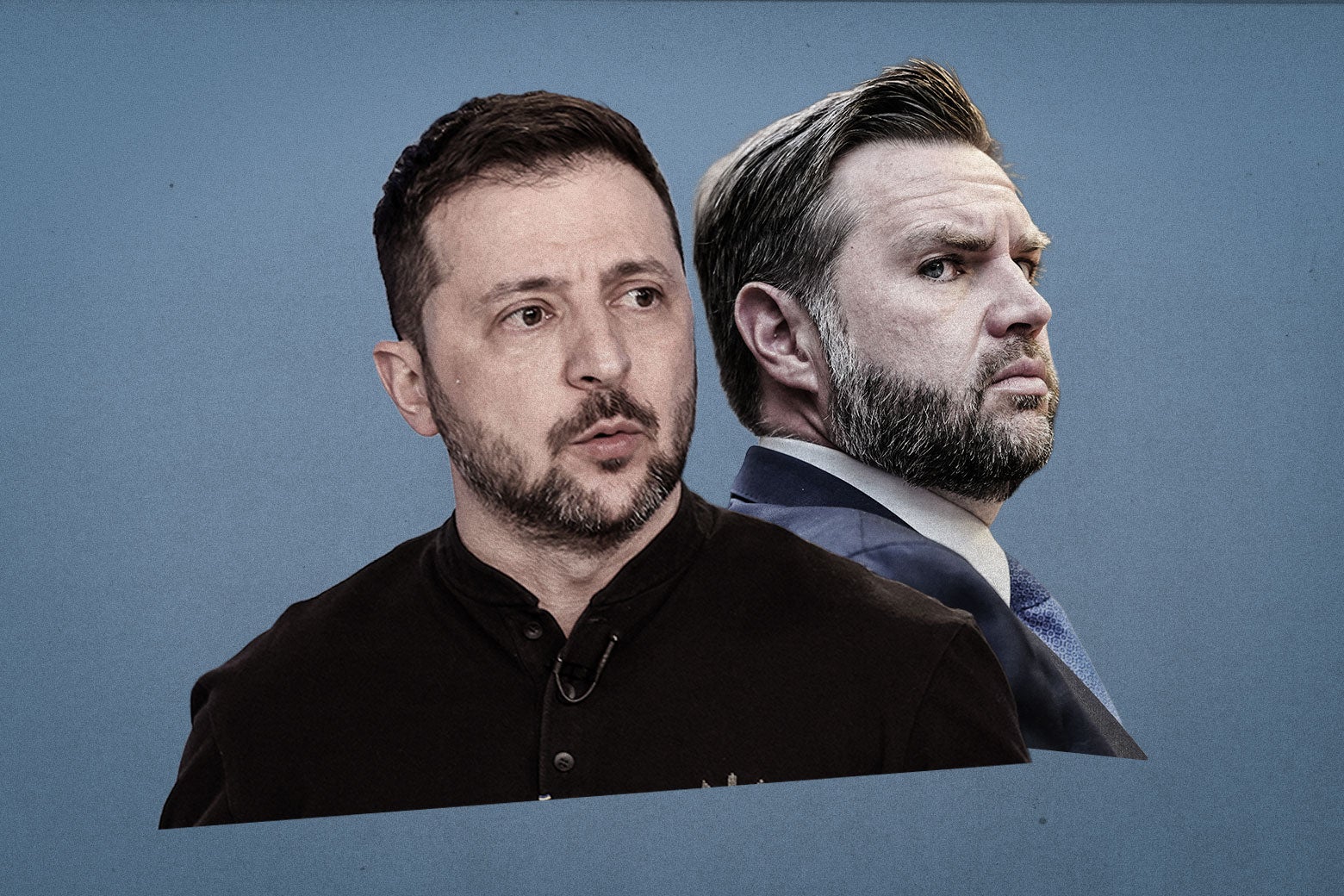
War Stories By Enter your email to receive alerts for this author. Sign in or create an account to better manage your email preferences. Unsubscribe from email alerts Are you sure you want to unsubscribe from email alerts for Fred Kaplan? Aug 13, 20263:00 PM Photo illustration by Slate. Photos by Win McNamee/Getty Images and Aaron Schwartz/AFP via Getty Images. Sign up for the Slatest to get the most insightful analysis, criticism, and advice out there, delivered to your inbox daily. Some higher-ups in the Trump administration are starting to realize they need two assets that they’ve previously disparaged: allies and military officers who know how to think independently. In an embarrassing moment on July 31, according to the Financial Times, Vice President J.D. Vance had to plead with Ukrainian President Volodymyr Zelensky to stop firing drones at oil-shipping vessels in the Black Sea because the attacks—while slashing Russia’s energy revenues—were also raising global gasoline prices, hurting not only the economy but President Donald Trump’s popularity. It must have been particularly embarrassing because Vance’s hostility toward Ukraine and toward Zelensky personally has been even more virulent and consistent than Trump’s. It was Vance who incited the disastrous exchange at the Oval Office meeting in February 2025, accusing Zelensky of being insufficiently thankful for the U.S. aid he had received, which prompted Trump to deride Zelensky for holding no “cards” in his war with Russia—then to cancel the ceremony and lunch at which the two leaders and their teams were to sign and celebrate an investment accord. Afterward, Trump hailed the tense exchange as “great television” (the meeting was broadcast live) and followed the grisly show with cutbacks in military aid to Ukraine, which, though subsequently somewhat resumed, has never been restored to previous levels. And now, 18 months later, Vance had to beg the leader whom he had humiliated—and whom he has publicly demeaned and insulted several times since—because it turns out that he, Trump, and the world oil market need a favor: In short, they would like for Zelensky to act the way an ally acts, compromising his own interests a little bit to advance his allies’ interests. Zelensky complied with Vance’s request, which was reportedly made in secret (perhaps to avoid the embarrassment). Now let’s see if Trump will grant Ukraine the license to produce Patriot air-defense missiles, the only weapons that can shoot down Russian ballistic missiles. Trump said he would when he met with Zelensky last month, then backpedaled soon after. On Thursday, Zelensky proposed that the U.S. supply him with just 10 percent of its Patriots. (He might have asked for more, but he knows, like everyone else, that the U.S. shot off roughly half of its Patriot stockpile in the unnecessary war on Iran.) A good idea. We’ll see if Zelensky’s assent to Vance’s plea moves Trump to respond in kind. If he doesn’t, we’ll see how long Zelensky will wait before once again attacking oil ships in the Black Sea. Trump got a taste of the lesson’s flip side—what happens when a nation, even a big nation, doesn’t have allies—when he asked members of NATO to help him out in the war on Iran and, except for a few token gestures by one or two members, they said no. They might have received this request more warmly if Trump had treated them a bit better over the years, if he hadn’t yelled at them so much and threatened to quit the alliance, even suggesting that he might not come to their aid if they were invaded by Russia. They still might not have taken part in the Iran war, but they might have cordially advised him of the many reasons why going to war made no sense, thus bolstering the warnings that some of his own advisers were issuing (though all too gingerly, knowing the grim fate of Trump’s inside dissidents). One widely reported result of Trump’s indifferent-to-hostile attitude toward allies is that many of them are seriously discussing ways to form new relationships—in security, trade, supply lines, and other transactions—that rely much less on the U.S. This trend is affecting not just the leaders but the populations of those countries. In a recent Pew Research Center poll of 36 nations, the people in 25 of them hold a more favorable view of China than they do of the United States. Of the nine that like us equally or better, just two—Hungary and Poland—are members of NATO. The second realization—that more independent thinkers are needed in the military—may not yet have percolated through the White House or the uppermost levels of the Pentagon, where “War Secretary” Pete Hegseth has ordered soldiers to take testosterone tests and has eliminated programs in which officers can take yearlong fellowships to study strategy and history at elite civilian universities. Hegseth has denounced these programs as “woke.” And yet, on July 29, a senior officer in the intelligence branch of U.S. Central Command, which plans and executes military operations in the Middle East, emailed a broad group of analysts and officers, stating: “We are looking for new creative and unconventional ways to pressure and punish Iran.” As Katie Bo Lillis and Zachary Cohen, the CNN reporters who broke this story, put it, “The crowdsourcing-style query, which military officials said was unusual over email, is one sign of the limited—and potentially unpalatable—options available to Trump to force Iran into a detail on his terms.” The idea of “kicking off” a “brainstorming session via email” was “to see if anyone had a better idea.” Better ideas of this sort are unlikely to come from the sessions—rollicking as they may be on other grounds—in which Hegseth, visiting a military base or a warship, orders the gathering warriors to drop and give him 50 pushups. They’re more likely to come from officers who’ve been seasoned on the battlefield and in academic seminars. I wonder if Hegseth has asked Gen. Dan Caine, the chairman of the Joint Chiefs of Staff and one of the president’s favorite generals, what, if anything, he learned during his fellowship at Harvard’s John F. Kennedy School of Government—and whether, when it comes to recruiting senior staffers, he looks for men and women with high T or high IQs. Donald Trump Iran Ukraine J.D. Vance
J.D. Vance Is Learning an Important Foreign Policy Lesson the Hard Way
Full Article
Original Source
Read the full article at Slate →KhanList aggregates and links to publicly available news content. We do not host full articles from third-party sources. Always verify important information with original sources.