
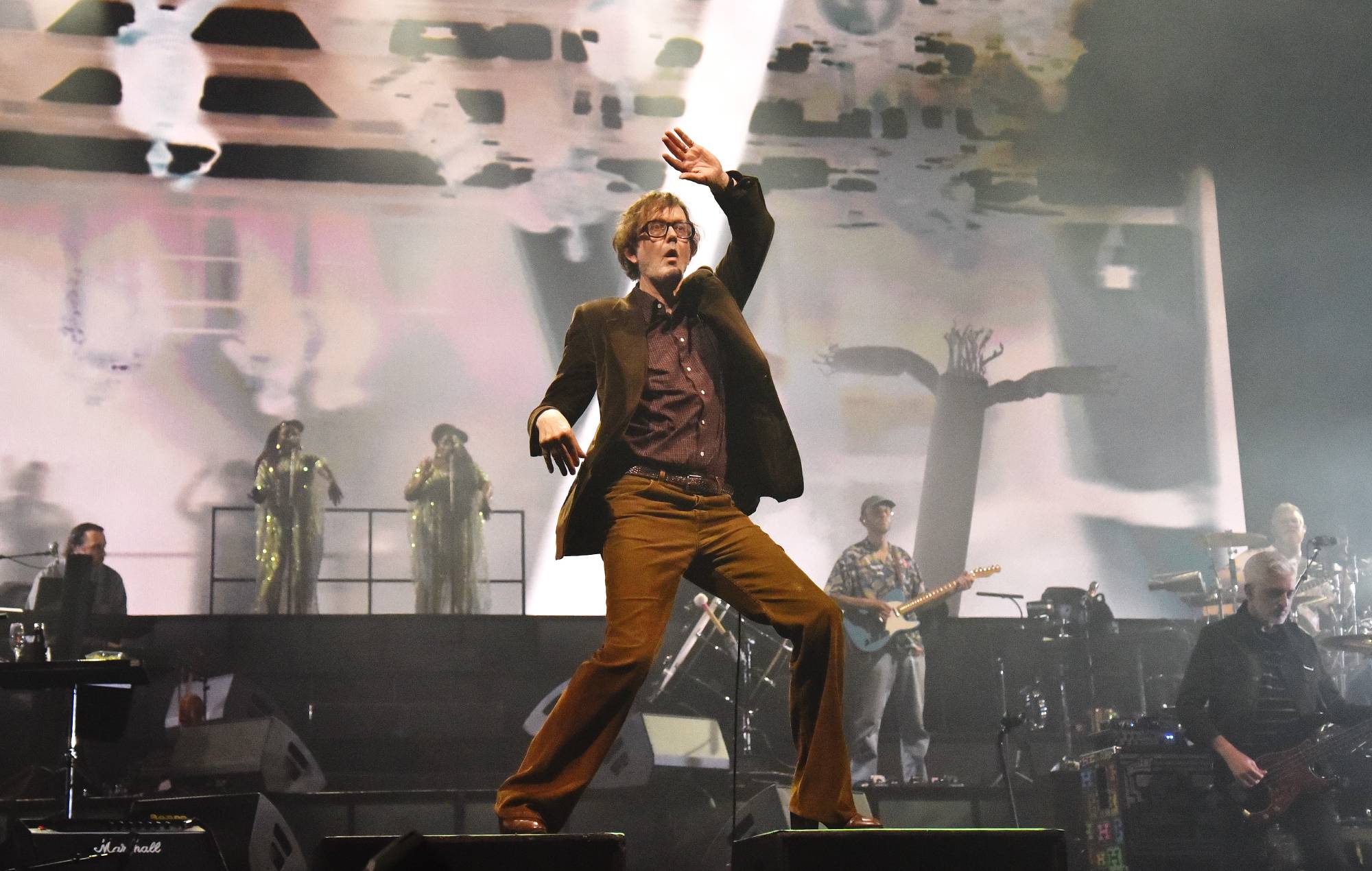
Jarvis Cocker has spoken to NME about Pulp‘s new film What Do You Do For An Encore?, the unique DNA and history of the band, and what the future holds for the Sheffield indie icons. READ MORE: Garth Jennings tells us about Pulp’s “celebratory” new film ‘What Do You Do For An Encore?’ Directed by Garth Jennings – who helmed the classic music videos for Pulp’s ‘Help The Aged’ and ‘A Little Soul’ – the 90-minute movie captures the band’s two sold-out shows at The O2 in London last summer, featuring narration from the group, unseen archive material and rare behind-the-scenes footage. The movie also follows the group’s “extraordinary journey from obscurity to cultural touchstone” up to the huge tour for their first album in 24 years, ‘More’. Cocker sat down with NME just before the London premiere of the film – and ahead of the afterparty which bled into the frontman celebrating his 63rd birthday at Soho’s Bar Italia, as made more famous by the Pulp classic from ‘Different Class’ – where he explained how the tour that followed the release of ‘More’ had a certain newfound spirit to it. “That’s one of the interesting things about the documentary for me is that, by accident really, it ended up being filmed,” Cocker told us. “It was the week that ‘More’ came out, so the thing that I was concerned about was if the new songs would fit with the old songs. Would they play well together, or would they not? You know, this is a 24-year gap between the last record. So it was an amazing thing that we played them; they fit in, and it all went well. “I think that did give us a bit of energy. It was great to play the old songs. That’s the time when they come back to life, is when you play them live. But then to have new stuff as well, it was like a new beginning or something.” READ MORE: Pulp’s Jarvis Cocker interviewed: “This is like going back to when you start a band” Check out the rest of our interview with Cocker below, where he also told us about what it takes to be a member of Pulp (and there have been a lot), paying tribute to Steve Mackey, playing for a new generation, and how the beauty of music is ultimately that “you don’t know where it’s going to take you, but hopefully it could take us somewhere good”. NME: Hello, Jarvis. Did releasing ‘More’ leave you with something to prove when playing these shows?Recommended “I suppose so, yeah. The thing that was a relief was that there was no kind of disconnect. It was like we just left the room and then made an album. I don’t know what we did in that 24 years, actually! I suppose, I had a son and I did do some solo music and stuff like that. With the Pulp thing: any band that’s good is to do with the combination of the people in it.” People sometimes underestimate how all the individual elements of Pulp you are more than the sum of your parts…. “It’s a funny selection of people. Candida [Doyle, keys] has got their issues with their arthritis and so she is limited in her playing, but that’s what makes a group. You have to just find out what you can do and then you end up having a sound that is to do with your capabilities. None of us are particularly trained musicians. Candida is the only one with grade four piano or something. Everybody else is like, ‘Whatever’.” Did you not even learn recorder at school? “No, I went through a period of trying to learn how to read music, but I just couldn’t do it.” An interesting bit of the film is when you show the timeline of the sheer number of people who have been in Pulp over the last 48 years (that’s 24 members, dear reader). How important was it for you to spotlight this cast of characters? “Well, the criteria for being in Pulp was never musicianship. It was more that you got on with the person, because that was part of the reason I wanted to have a band in the first place. I was quite a shy child, and I was no good at sports, so it was my way of trying to get a gang. It was more important that you would get on and not fall out in the van going to a concert and stuff like that. We’ve never had anybody who was particularly musically gifted.” Beyond getting on and haphazard musicianship, would you say there’s any shared DNA between Pulp members? “Just individuality, I suppose, and that you are your own person. When it started off, it was the misfits at school who weren’t really into sport, although the first drummer did leave because he wanted to play football. It was more like kids who were a bit, for want of a better word, considered to be a bit weird at school, and then it’s probably stayed like that, you know. We were once famously compared to the escape party from One Flew Over The Cuckoo’s Nest, when they go on that van trip, when we arrived to play a show in Hull. I suppose that hasn’t changed that much.” Jarvis Cocker performs live with Pulp. CREDIT: Joseph Lynn It’s beautiful how both the concert and the film take the time to pay tribute to the late, great Steve as well, and just show how he was cool as fuck… “Yeah, he was. I’m very grateful to Garth for doing that because we obviously wanted to pay tribute to Steve, but it’s hard to do that and you don’t want to go too far with it, but I’m very happy with it. “Steve was the member of Pulp that I was closest to. He was really important because when I moved down to London, I thought I had a flat in Camden, but when I got here, the guy had given it to somebody else. So I was homeless, basically. Steve was squatting in Camberwell and just said, ‘There’s a room below us that’s free, you could go there’. So he kind of rescued me totally there. “I don’t think the band would have carried on really. He joined as the bass player, so then there were two members living in London. Even though we went into kind of like a period where we didn’t really do very much, because Steve was a very organised and quite a driven person, he wanted it to work. Without that kind of impetus from him, I probably would have given it up. So I owe a lot to him.” We interviewed Garth, and he said that he was amazed by how Steve never had a bad haircut either, which is a very rare feat… “Yeah, true.” Jarvis Cocker with Steve Mackey performing with Pulp at Glastonbury 1995. CREDIT: Mick Hutson/Redferns In terms of getting Garth on board as creative director, what was your brief to him, or did you just let him run wild? “When we announced that we were going to play again, he got in touch and said, ‘That’s great news, if I can help in any way…’ For some reason I just took that as he was offering to design the stage show, which it since turned out he wasn’t. I went to see him in his office in Paris and talked about it, and it turned out that we’d both recently seen the ABBA show [Voyage]. We both spoke about that and how, apart from the thing of it obviously being amazing with the ABBA-tars, the way that show has real people playing as well, and it was an interesting way of staging something. That was an inspiration. The stage show that you see in the documentary is what Garth came up with; he designed all that. When we started talking about making a film – because that actually is his job as a filmmaker – he said, ‘Well, I can do that’. “We were going to do it at the end of the first bit of touring when we played at Eventim Apollo in Hammersmith, but the finance disappeared at the last minute so we couldn’t do it. It was much better to do it when we did it really, because the fact that it kind of captures that moment where Pulp come back to life as a creative force is great.” READ MORE: Pulp: What Do You Do For An Encore? review: Britpop misfits take a deserved victory lap Did having new generations of fans at those shows give the whole experience a different energy? “Yes, I can’t explain that. When we were offered these shows back in 2022 or something, the promoter said that when he went to shows, they would put Pulp songs on and everybody would sing along. So he knew that we had new fans. Any performer’s nightmare is going on stage and no one’s there, so I just said, ‘Are you sure that’s true?’ “It took quite a long time for him to convince me. I just thought, ‘OK, he’s sincere. Let’s try it’. That’s been an amazing thing, because we always wanted to be a pop band. We always said that, and pop music for me is young people’s music. Pop music was how I tried to decide what I was going to do, how life was gonna be. It gives you tips about dating and kissing and stuff like that, so I was really happy that younger people were still finding that in the music. The pop hadn’t gone flat; it was still fizzy, it was still invigorating people in some way.” Is it something in the spirit of Pulp? Are bands like yourselves and Oasis needed right now so we can enjoy an escape and peek our heads above the bin fire that is life? “Yes, maybe, but the thing is that Pulp songs aren’t relentlessly cheery! The only Pulp song that’s slightly like that is ‘Something Changed’. A lot of people have told me that they played that at their wedding, and that it is a fairly straightforward love song, but that was part of my self-appointed way of writing. I felt that where I’ve been let down by pop music was that the words were a bit unrealistic. “It was always my ambition to try and write about what I thought love and things like that really were like: the awkward bits of it and stuff like that rather than, ‘Yeah, everything’s great!’ So I hope Pulp don’t give a false picture of life, but I hope it is inspiring that you can just take things from your life and dramatise them. That’s what I like, that’s what I search for in other people’s music or any kind of art – I want to feel like they’re telling me something about themselves and that they’re not trying to put on an act. If that makes people happy, I’m happy.” The end of the film poses the question of why Pulp are still doing this, and you reply, ‘Well, why wouldn’t you?’ How much should we read into that? How do you see the future of Pulp? “I mean, I think there is a future. The thing is, I don’t like to make pronouncements on the future because the whole thing about the future is you just don’t know what’s going to happen. We did the album ‘More’, and making it was quite a pleasant experience; playing it has been good, so that’s an inspiration, but obviously it came after a 24-year gap. We just can’t do that anymore because I’ll be dead in 24 years. What will probably happen is that everybody is going to have a bit of a rest. Maybe I’ll ring people up towards the end of the year and say, ‘Shall we have a practice or something?’ We’ll just see what will happen. I like to think of Pulp as an organic thing. Sometimes it bears fruit and sometimes it doesn’t, but I feel fairly confident that we will manage to do something else, but I don’t know when.” As a keeper of notebooks, do you have any thoughts, designs, ambitions on what you would imagine a new Pulp album would be? “That’s an interesting question because we’ve kind of picked up some newer members, and there are like nine of us now. Some of the newer members, like Emma Smith and Richard Jones, are from a more classical music background, and that’s interesting. I might try and explore that a bit more. “I don’t know. That’s the good thing about music: you don’t know where it’s going to take you, but hopefully it could take us somewhere good.” Pulp’s Jarvis Cocker. CREDIT: Press So what are you going to do now? “I’m still doing the radio show on BBC 6 Music, so that keeps me a bit busy. I’m looking forward to spending some time with my wife, and the dog. Myself and my wife are also curating an art show that’s going to be on at the Hepworth Gallery in Wakefield in May next year. That will take up quite a bit of time. I keep myself busy, you know.” Two of your last shows were playing ‘More’ in full plus deep cuts at the orchestral Southbank gig for Rough Trade’s anniversary and the rarity-packed headline show for End Of The Road. Considering they were quite special setlists, were they recorded and will they be released? “You know what, I don’t know. That’s a good question. I hope that they got recorded. At the Southbank we played ‘Wickerman’, which is the first time we played that for ages, and then at End Of The Road we played ‘Deep Fried In Kelvin’, which is the first time we’d ever played that song. I always forget to ask. I think they were probably recorded, but who knows? I don’t think we would release it, but I don’t know.” Jarvis, the end of our time is near: is there anything you’d like to add or want the world to know? “That’s a big question. No, I just hope that they enjoyed the film, you know? It’s been quite a thing to see all the archive footage. It’s a bit like when they say how your life flashes before your eyes, but I’m not dead. That’s what I’d like you to know: I didn’t die, I didn’t die…” Pulp: What Do You Do For An Encore? will stream exclusively on MUBI from tonight (Friday September 25).
Jarvis Cocker tells us about Pulp’s new film and future: “It was like a new beginning”
Full Article
Original Source
Read the full article at Nme →KhanList aggregates and links to publicly available news content. We do not host full articles from third-party sources. Always verify important information with original sources.