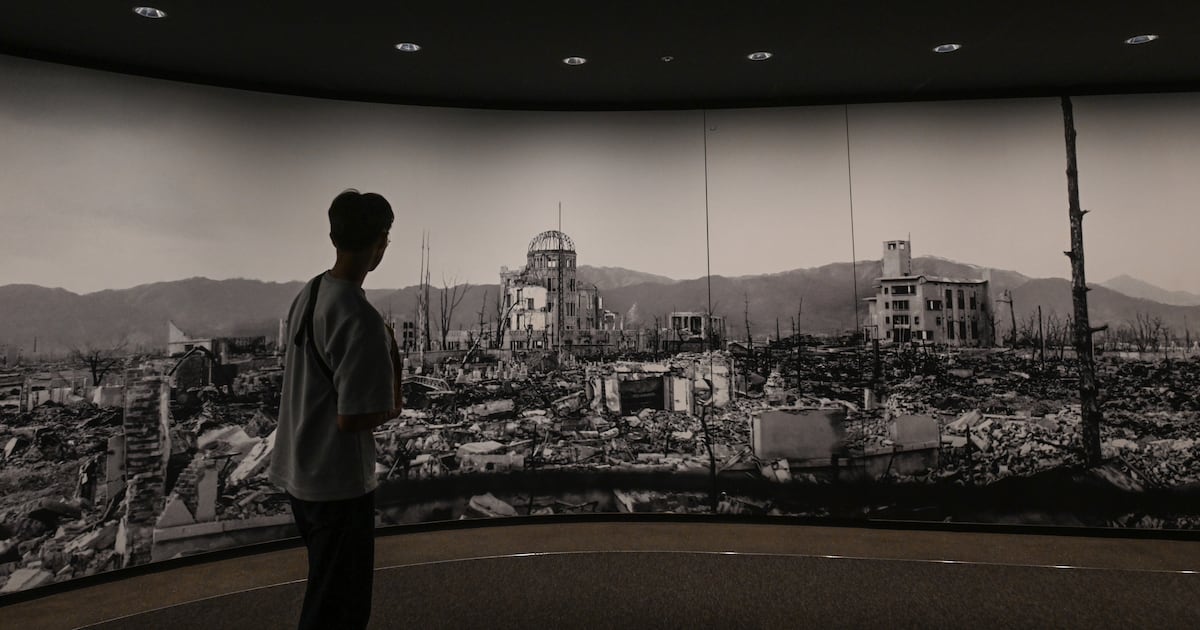
Tsutomu Yamaguchi was 90 years old when he finally began talking about his life as a double-hibakusha – one of about 150 people who survived both US atomic bombings of Hiroshima and Nagasaki. As Yamaguchi stepped off a tram in Hiroshima on the morning of August 6th, 1945, exactly 81 years ago, the “Little Boy” bomb detonated over the city. He fled home to Nagasaki, where the “Fat Man” was dropped two days later, killing 70,000 people. “There is a famous Japanese proverb,” Yamaguchi told audiences. “What happens twice, happens three times. There must never be a third nuclear bombing.” Last month, defence minister Shinjiro Koizumi became the latest Japanese politician to appear to challenge that pledge by saying Japan should debate having nuclear weapons, despite being the only country where they have been used.READ MORE“It’s a difficult issue to discuss, but one we cannot avoid touching on is nuclear,” he said. Japan “must debate and advance all policies without taboo”.A visitor prays after offering flowers in front of the cenotaph ahead of the 80th anniversary of the atomic bomb dropped on Hiroshima at the Hiroshima Peace Memorial park on August 5th, 2025, in Hiroshima, Japan. Photograph: Buddhika Weerasinghe/Getty Koizumi cited Europe’s shifting military posture, notably France’s decision this year to expand its nuclear stockpile, and Finland’s vote in June to overturn its decades-long ban on nuclear weapons. That change allows nuclear weapons to be imported, transported through or hosted in Finland, which shares a 1,340km border with nuclear-armed Russia.Koizumi’s government has become increasingly shrill in its warnings about nuclear-armed China. Japan’s latest defence white paper, released this week, describes the challenge from China as “unprecedented” and “the greatest strategic challenge” to Japan’s peace and security. [ China spooks Pacific neighbours with long-range missile testOpens in new window ]In May, Koizumi pointedly rejected Chinese claims that Japan is on the path to “remilitarism”, countering that China’s nukes were the real concern. “There’s a country that has a huge arsenal of nuclear weapons and strategic bombers,” he said, without naming Japan’s huge neighbour. “Japan has neither of these weapons. And yet Japan is labelled [with] ‘new militarism’. Isn’t it strange?”The wrecked framework of the building then known as the Hiroshima Prefectural Industrial Promotional Hall shortly after the atomic blast on August 6th, 1945. It is now known as the Hiroshima Peace Memorial, featuring the Atomic Bomb Dome. Photograph: Bettmann Archive As Koizumi knows, however, Japan has for decades sheltered under the US nuclear umbrella. Despite its enormous moral heft in the disarmament debate, his government has neither signed nor ratified the UN Treaty on the Prohibition of Nuclear Weapons, the first legally binding global agreement to ban nuclear weapons. As with Finland, Japan’s so-called three non-nuclear principles, formally adopted in 1971, commit the country to never producing, possessing or allowing the entry of nuclear weapons. Those principles were undermined, however, by a backroom deal that allowed nuclear-armed American ships and aircraft to traffic anywhere through or over Japanese territory for decades. Japan has stockpiled more than 10 tons of plutonium, with nearly four times that amount stored in France and Britain for reprocessing. That is enough to make thousands of warheads like the ones that incinerated Hiroshima and Nagasaki. The stockpile has continued to grow despite its limited use in commercial and fast-breeder nuclear reactors.Crows fly around the Atomic Bomb Dome on the eve of the 80th anniversary last year of the atomic blast at Hiroshima. The ruins serve as a memorial to those killed and as a reminder of the physical devastation caused. Photograph: Richard A Brooks/AFP/Getty Speculating on whether Japan might ever build a bomb has long been an intellectual and military parlour game. While running for president last year, Donald Trump gave the idea a typically off-the-cuff public airing, saying it might not be a “bad thing” if Japan (and South Korea) developed nuclear weapons.[ Despite its tragic history, Japan pays only lip service to the anti-nuclear causeOpens in new window ]While few doubt that Japan has the required capital, technology and raw materials, there is more to joining the nuclear club than that, says Alessio Patalano of the Department of War Studies, King’s College London. “You need civil-military relations set up; command and control, a national security council. And you need political confidence, to understand the complexity of how to use nuclear weapons.” Other obstacles are popular opposition and the certainty that having such weapons would trigger a regional arms race. Still, the argument for a nuclear deterrent has some political support.Prime minister Sanae Takaichi has so far dodged a firm recommitment to the non-nuclear pledge. In parliamentary discussions on Japan’s 2026 defence strategy, she said the country “is not yet at the stage” where she could “definitively state” that the wording of the pledge will remain the same.In 2022, Takaichi’s predecessor and mentor Shinzo Abe also urged Japan to consider a Nato-style arrangement, which allows the United States to station its nuclear warheads in Europe. “Japan should not treat as a taboo discussions on the reality of how the world is kept safe,” he said.[ Era of nuclear disarmament may be coming to an endOpens in new window ]Such talk alarms hibakusha, however. “It would once have been unthinkable for Japanese politicians to say such things, but I feel like the taboo is being pushed back,” says Masako Wada (82), who was an infant in Nagasaki when the city was bombed on August 9th, 1945. “Lawmakers are getting younger, and they have no experience of war with these weapons. It’s so dangerous to make such statements – and they make me angry.” Koizumi’s call is politically risky because of the deep unpopularity of nuclear weapons among ordinary Japanese people. A large poll this month found that more than two-thirds support the non-nuclear principles. Tourists take photos of the Atomic Bomb Dome at sunset during the annual Hiroshima Flower Festival in May this year in Hiroshima, Japan. Photograph: Artur Widak/NurPhoto/Getty In South Korea, another US ally, by contrast, the figure is often over 50 per cent.What worries Wada and other survivors most is that the nuclear taboo seems to be slipping away as the bombings fade from memory: “What happens after we are gone?”
Japan’s nuclear taboo faces its sternest test in decades
Full Article
Original Source
Read the full article at Irishtimes →KhanList aggregates and links to publicly available news content. We do not host full articles from third-party sources. Always verify important information with original sources.