
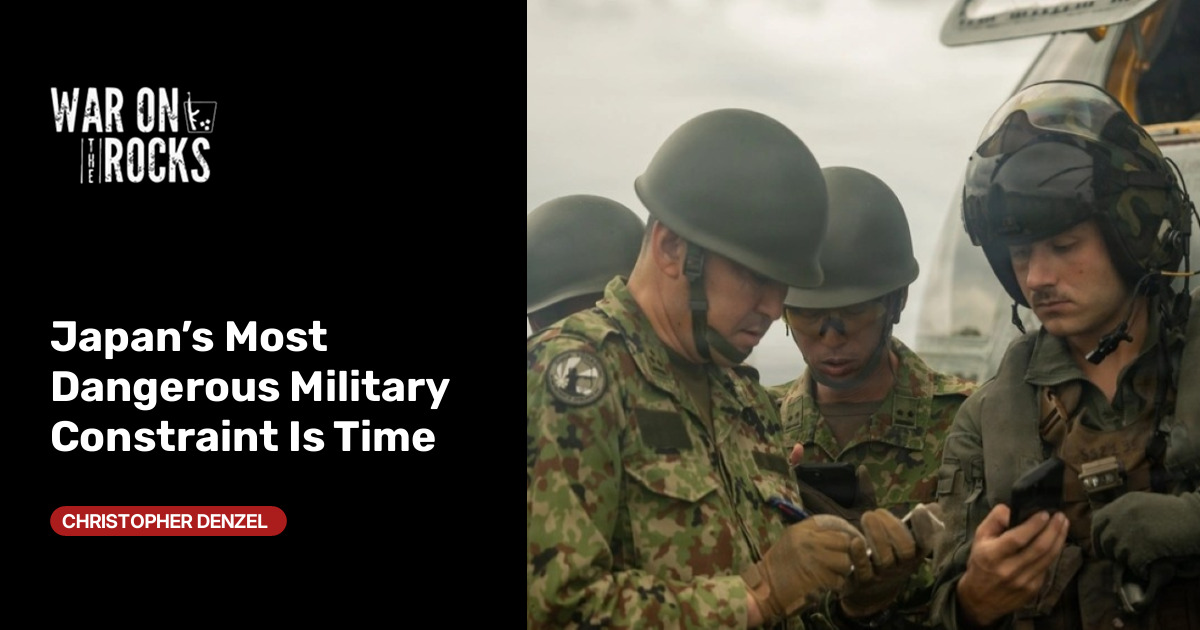
During a 2022 wargame I ran, bilateral planners reached a familiar barrier. U.S. forces needed to disperse from concentrated bases before the adversary’s first missile salvo. Participants believed Japan could grant emergency access to private land only after an attack, which would be too late — the authority’s trigger was also its deadline.This appeared to be a hard political constraint: the kind alliance planners record in after-action reports, script into next year’s exercise, and then carry, untested, into contingency plans, where assumptions harden into fact. But in 2022 one participant read the law differently, identifying an earlier cabinet option every other expert had overlooked — the same law and policy, but a different interpretation.The distinction matters beyond the results of one wargame. In preparing for a crisis, bilateral planners cannot predict what Japan’s cabinet will decide or when. But they can probe legal and administrative barriers to action. By finding procedural room to maneuver within existing law and policy, planners can preserve operational flexibility without presuming political choices.This requires a new approach to bilateral planning and a refined understanding of its utility. Wargames should challenge assumed constraints, exercises should normalize viable solutions, and policymakers in both governments should analyze the timelines of decision and action, building a shared understanding of when delay forecloses options. Such an approach requires the involvement of both civilian and military institutions. The goal is not to predict Tokyo’s response in a crisis but to preserve options and time to act for leaders in both capitals.Buying Time for TokyoThe stakes were clear: China cannot take Taiwan without impinging on Japanese sovereignty, and Japan cannot secure itself without Japanese and U.S. forces in place. Yet a narrow reading conflated what Japan’s law permits with what Tokyo might authorize. That invites two misleading conclusions: Japan is hopelessly rigid, and Washington can only hope Tokyo decides in time. Both miss how procedural and political flexibility interact.Procedural flexibility is room within existing law and process that officials can use without presuming a sovereign decision or changing cabinet policy. It may already sit in statute or alliance managers may construct it through administrative process. Political flexibility is a government’s latitude to make sovereign decisions, including recognizing an acute national security threat, reinterpreting constitutional constraints, revising national security law, or accepting political costs to sustain an alliance.Planners can develop and rehearse procedural flexibility bilaterally but they cannot credibly script political flexibility. Unscripted games present Japan as rigid because participants cannot deviate from stated positions and conservative legal readings. Scripted exercises present a cabinet moving at the pace of exercise objectives, not political reality.Procedural flexibility enables political flexibility without removing politics from process. In planning for a Japan contingency, what Washington considers prudent deterrence may appear politically sensitive or escalatory in Tokyo. Developed in games and rehearsed in exercises, flexible procedures can give a cabinet options and widen its decision window without presuming its choices about when or how to enter a conflict.The record demonstrates Japan’s political flexibility, but not how fast it works in crisis. Planners should assume Tokyo decides as cautiously and as late as its politics allow. Treating this as a design choice forces bilateral planners to find procedural flexibility within stated policy constraints. Leaving rigid readings unexamined embeds them into the procedures of the institutions that should act in a crisis. When a cabinet later exercises political flexibility, it may confront a bureaucracy unprepared to implement it.Decades of expeditionary warfare have conditioned U.S. planners to assume diplomats deliver access before major operations. That assumption fails in a war fought from Japanese territory, where access depends on Japan’s political approvals and institutions.The issue of access is distinct from authorization of combat operations, whether “defensive” or “offensive.” If an adversary attacks Japan, the security treaty’s Article V effectively permits the United States to conduct operations to defend Japan. Beyond this, combat operations from Japan, including those in defense of Taiwan, are subject to Prior Consultation arrangements under Article VI of the treaty. Neither circumstance changes the conditions of U.S. access to Japanese land, which remain subject to questions of Japanese law and procedures.Military planners should therefore treat access as an operational design problem, not as one for others to solve. Procedure dictates whether U.S. forces reach their fighting positions. Sovereign decisions determine whether Japan becomes a co-belligerent. Both have immediate tactical consequences, meaning planners should address them together.The Islands That Could Decide the WarPlanners new to the alliance may wonder how critical gaps persist after seven decades of U.S. forces permanently stationed in Japan. Bilateral defense planning dates to the threat of a Soviet invasion, but Beijing’s credible, direct threat to Japan’s national survival is comparatively recent. A Taiwan campaign, now within the People’s Liberation Army’s reach, would run headlong into Japan’s southwest islands. In October 2026, the Chinese navy’s Liaoning carrier group crossed the Miyako Strait and conducted flight operations south of the Sakishima Islands. These operations were part of a broader series of operations normalizing the positioning of Chinese forces east of Taiwan and demonstrating the ability to use the waters surrounding Japan to isolate Taiwan and complicate intervention.The Miyako Strait, the widest passage between the East China and Philippine seas, spans 150 miles between Okinawa and the Sakishimas. The Sakishimas, in turn, run from Miyako to Yonaguni, Japan’s westernmost island, just 70 miles from Taiwan. Unlike the uninhabited and disputed Senkakus, the Sakishimas are uncontested Japanese territory, home to more than 110,000 citizens. Japan is developing plans to evacuate them, but activating those plans may depend on how a cabinet characterizes a crisis. Military dispersal and evacuation may proceed on different timelines, competing for ports and airfields and potentially constraining deployment where civilians remain.Ultimately, Washington and Tokyo should defend the Sakishimas, whatever they decide about Taiwan. In three years of bilateral planning for Japan’s defense, I repeatedly heard Japanese officers and officials argue that Beijing could not confidently regard Taiwan as isolated while Japan held the Sakishimas. This makes these islands the “new Fulda Gap,” where the United States and Japan will fight “the first battle of the next war.” Tokyo would not be asking whether to fight for Taiwan but whether the alliance could keep Japan secure.On a rigid reading, Japanese authorities cannot keep pace with the escalation alliance planners expect. Japanese law follows a positive list approach. The Cabinet can only exercise the authorities enumerated in statute, with scoped discretion granted only where law specifies it. Without implementing procedures, authorities may remain inaccessible. Since 1954, Articles 76 and 88 of the Self-Defense Forces Act have permitted the use of force in response to an attack, including the threat of one. But it took until 2003 for Japan to enact a law establishing how a qualifying contingency is declared. Under the positive list approach, the missing procedure may have barred the order’s issuance. As one retired Self-Defense Forces officer put it, “In the [Self-Defense Forces], when there are no regulations, no action can be taken.”Access gaps persist elsewhere. The Status of Forces Agreement grants U.S. access to ports and airfields, but most are run by prefectures, municipalities, and private companies, and Tokyo lacks a peacetime mechanism to compel that access. Since 2024, Tokyo has established mechanisms to facilitate peacetime access for the Self-Defense Forces and Japan Coast Guard, but the government still lacks the power to grant peacetime access or priority to either Japanese or American forces. Temporary U.S. use of public or private land requires bilateral approval under Article II 4(b) of the Status of Forces Agreement. The II 4(b) process is slow, requiring public and local-government coordination and disclosure of the operational detail behind each request.The Politics Behind Japan’s LawThis narrow reading is incomplete because the cabinet does not respond mechanistically to Beijing’s actions — it makes political judgments about them. Recognition of a security situation is a political judgment, informed by the gravity of the threat.Political flexibility runs both ways. Pessimists ask whether Tokyo would overlook a narrowly scoped strike on a U.S. base to avoid escalation: Would Japan trade Osaka for Kadena? Optimists ask whether a cabinet needing an authority will read the law and circumstances liberally enough to grant it. Either involves sovereign discretion; planners may assume either outcome, but cannot treat that assumption as a commitment by Tokyo.Such questions are also diplomatic, and wargames cannot answer them through military planning alone. Officials best placed to answer these questions are therefore absent or unable to speak frankly.Japan’s record favors the optimists. Its postwar constitution remains unamended, but Japan has repeatedly reinterpreted Article IX, which famously renounces war potential. Japan’s cabinet first read Article IX to forbid any military. The Korean War then prompted the creation of the National Police Reserve, which evolved into the Self-Defense Forces when Tokyo asserted that Article IX in fact permitted national self-defense.In recent decades, Tokyo has revisited other once-sacrosanct limits, nearly all of which the cabinet set and reversed by policy, not law. In 2022, the cabinet committed to spending 2 percent of gross domestic product on defense, abandoning a 1 percent limit maintained even after the policy’s formal repeal in 1987. The bar on collective self-defense fell with a July 2014 cabinet decision and the 2015 Legislation for Peace and Security. Japan is modifying its Izumo-class “helicopter destroyers” to operate F-35Bs, while Tokyo continues to classify them as multi-functional destroyers rather than “attack aircraft carriers” (which policy still forbids). Since 1956, Tokyo has held that strikes on enemy territory might qualify as self-defense but it refrained from acquiring weapons capable of carrying them out until its 2022 decision to acquire “counterstrike” weapons. That commitment reversed a policy restraint, not a constitutional prohibition. Tokyo has relaxed its arms-export restrictions in stages – most recently in April 2026 – after first introducing them in 1967 and broadened them to a ban in 1976. The semantic distinctions help explain Japan’s enduring reputation for legalism.The record demonstrates Japan’s capacity for political flexibility, but not its speed in crisis. Each policy shift was controversial — some once unthinkable — and since none answered an existential threat, optimists have cause to believe a Taiwan crisis would prompt even greater political latitude. Many of these moves took years to make, and longer still to incorporate into rules, training, agreements, and practice. In the moment of truth, speed may depend more on procedure than on politics. War on the Rocks Membership Newsletters. Podcasts. Analysis. Exclusive members-only dispatches, premium shows like The Russia Contingency with Michael Kofman, and expert analysis of the conflicts shaping national security. Turning Legal Space into Operational AccessIn the wargame series I helped run, games tested solutions one year, and the next, command post exercises rehearsed the solutions that survived. Within a year, viable solutions were standard play, entering institutional memory. Procedural flexibility suits this cycle because it exists in law or planners can built it within existing legal frameworks. Planners can test such changes as bilateral hypotheses without presuming how a cabinet would act in a crisis, then normalize them if feasible and bureaucratically acceptable.The participant who read the law differently in 2022 was a Ministry of Defense lawyer. Planners understood that Japan could recognize an “armed attack situation” when an attack was imminent, but they treated it as a single situation (as the law describes) and interpreted that threshold narrowly. An armed attack situation declaration ostensibly grants Japan the use of force, but government policy places three strict conditions on that authority, including actual attack occurrence. In planners’ minds, this constraint narrowed the applicability of the underlying law.The lawyer’s innovation was identifying the operational significance of an overlooked statutory distinction: An “imminent” armed attack situation (distinct from an anticipated armed attack situation) could provide access authorities without itself authorizing the Self-Defense Forces to use force in violation of Japan’s “three conditions.” When the bilateral audience expressed incredulity about this unfamiliar armed attack situation, the lawyer pointed to the distinction in the government’s defense white paper — as a footnote. We later confirmed it had been in the law since 2003. Japan has never recognized a security situation, and exercises had rarely stressed this question. Participants at the 2022 wargame assumed Japanese law provided no solution, until they discovered one. The next year’s white paper drew an explicit, prominent distinction between the imminent and occurrence forms of armed attack situation, and by 2024 former was somewhat routine in exercises.This “discovery” shifted subsequent wargames to earlier stages of crisis. In 2023, planners focused on another gap, before Japan could reasonably judge any attack imminent. A Ministry of Defense participant insisted, correctly, that Article II 4(b) was the only authority to allow U.S. force dispersion. But planners equated that authority with the standard peacetime approval process used for routine training access. Article II itself permits the access but does not prescribe the process.Peacetime implementation can take six months or more and requires public disclosure of the plan for use, which would grant access too late and reveal tactical plans to the adversary. Because the bilateral force could not credibly defend Japan under those conditions, the official requested an ad hoc legal review from his ministry. The official returned the next day with an expedited process that met the legal requirements while allowing timely approval and preserving operational security. The proposed process entered command post exercises in 2024 and was standard play by 2025.Because the 2023 legal review did not codify or authorize the expedited process, planners can only speculate about the extent to which coordination with local governments and landowners can be accelerated. II 4(b) agreements, expedited or not, still require U.S.-Japan Joint Committee approval, and Japan should separately secure the rights to provide the land through ownership, agreement, or compulsory authority. While the urgency felt in a crisis might alter the political calculations and local interests that so often slow the process in peacetime, it cannot rule out political opposition. The hypothesized solution demonstrates a possible path to earlier access, not an assured one.These cases show why it is necessary to test assumed constraints. The 2022 discovery illuminated an earlier political option players had prematurely foreclosed. The 2023 case did not erase political considerations, but identified an additional, potentially faster procedural path to access without an armed attack situation declaration. Neither case removed political constraints. But both expanded the options available without making assumptions about a cabinet’s future decisions.Beijing’s interpretation of these actions matters, as do Washington and Tokyo’s expectations of that interpretation. Beijing’s sharp reaction to Prime Minister Sanae Takaichi’s November 2025 remarks about a hypothetical Taiwan crisis constituting a survival-threatening situation (a statutory situation alongside an armed attack situation) illustrates the risk. Beijing could interpret Japan’s recognition of an armed attack situation or bilateral military dispersal in the Sakishimas as preparation for intervention, even if intended merely to defend Japan. Or deployment and dispersal could instead demonstrate resolve that deters. Procedural flexibility and the time and options it provides political leaders cannot guarantee Beijing’s response, but it can preserve choices about when and how these leaders act.Giving Tokyo Time to DecideProcedural speculation risks false confidence just as untested constraints can produce unwarranted assumptions of rigidity. The incorporation of an earlier armed attack situation and an expedited II 4(b) into routine exercises shows tacit acceptance or plausibility, not future political action. Yet procedural flexibility directs planners toward problems they can address and builds adaptability even if specific solutions fail. Institutions with narrow readings may struggle to implement political flexibility as quickly as leaders exercise it. That lag is greatest in crisis, when threat narrows information processing and drives centralization, formalization, and reliance on established procedure amid time pressure and uncertainty.The goal is not to assume proposed procedures will work, but to develop institutional adaptability that produces options and buys time for political decisions. Wargames and exercises should therefore challenge, not merely rehearse, the procedures they uncover, testing their tactical effectiveness and whether they withstand political and bureaucratic resistance. While this approach cannot make political flexibility predictable, the 2022 case shows how procedural analysis can reveal political flexibility planners are unaware of.When Washington assumes Tokyo cannot act in a crisis, it presses for wartime commitments that Japanese counterparts cannot grant in advance. Bilateral channels built for procedural coordination become venues to request political decisions that only a cabinet can make — unilaterally and at the time of need. Such requests undermine American credibility and frustrate Japanese counterparts.Rigid procedures leave the cabinet few major choices, which look rash when made early. A cabinet might fall if it acts precipitously in a crisis that then resolves on its own, yet one that acts too slowly as a crisis devolves into war may cost Japanese lives and territory. Political leaders’ calculations in those moments will depend partly on whether they have previously analyzed and internalized the costs of delay. Rehearsals familiarize decisionmakers with those consequences, and procedural flexibility buys them time to choose.The goal of this analytic cycle is to give the cabinet more time and options for a well-informed, timely sovereign decision. Preparation for that choice should reach every echelon, uniformed and civilian.The two allies’ national security institutions should use wargames to find procedural flexibility and then normalize, challenge, and rehearse these processes in command post exercises. Wargame orthodoxy counsels limiting participants and observers. But because these problems require institutional reach, and solutions are hard to predict, more observers give this method a greater chance to succeed. This is not without its downsides. Policy-level observers may reduce candor or the willingness of participants to experiment, but where tactical and policy challenges are so closely intertwined, this cross-pollination may be a necessary condition to a wargame’s success.What this approach produces is procedural flexibility. Planners cannot know in advance whether exposure to these consequences will improve a cabinet’s judgment under pressure. Both governments should analyze and share realistic decision timelines, option expiration windows, and the cost of delay.In a Taiwan contingency where U.S. forces need to operate from the Sakishimas, Japanese reinforcements will first need to deploy to the islands, secure access off base, and disperse beyond their small garrisons to make room for U.S. forces. These preparations should occur weeks before the cabinet even considers recognizing an armed attack situation, all against the backdrop of crisis management, civil protection, evacuation, and potential refugee flows. Published estimates of a peacetime II 4(b) process range from three months to more than five (timelines U.S. planners in Japan consider optimistic). Without procedural flexibility, the alliance risks falling behind early in a decision sequence that is much longer than often imagined, potentially leaving policymakers with fewer, more disruptive, or more escalatory decisions.While the decisions remain each government’s own, distinguishing between procedural and political flexibility allows the allies to widen the window in which Tokyo’s decision can still matter. The Sakishimas are only as defensible as the procedures and authorizations that get forces into position before the first salvo.Christopher Denzel is a Marine Corps strategic and operational planner currently serving in the Strategic Plans Branch (J-56) at U.S. Forces Japan. His work focuses on strategy, campaigning, and command and control modernization in the Indo-Pacific, with extensive experience integrating planning, intelligence, and wargaming in joint and allied environments.He is a graduate of the U.S. Army School of Advanced Military Studies and the National Intelligence University, and has held operational planning billets across the joint force, including at U.S. Cyber Command and III Marine Expeditionary Force.The views expressed are his own and do not represent the views or positions of U.S. Forces Japan, the U.S. Marine Corps, the Department of Defense, or any other part of the U.S. government.Image: Lance Cpl. Ryan Sotodavila via DVIDS
Japan’s Most Dangerous Military Constraint Is Time
Full Article
Original Source
Read the full article at Warontherocks →KhanList aggregates and links to publicly available news content. We do not host full articles from third-party sources. Always verify important information with original sources.