
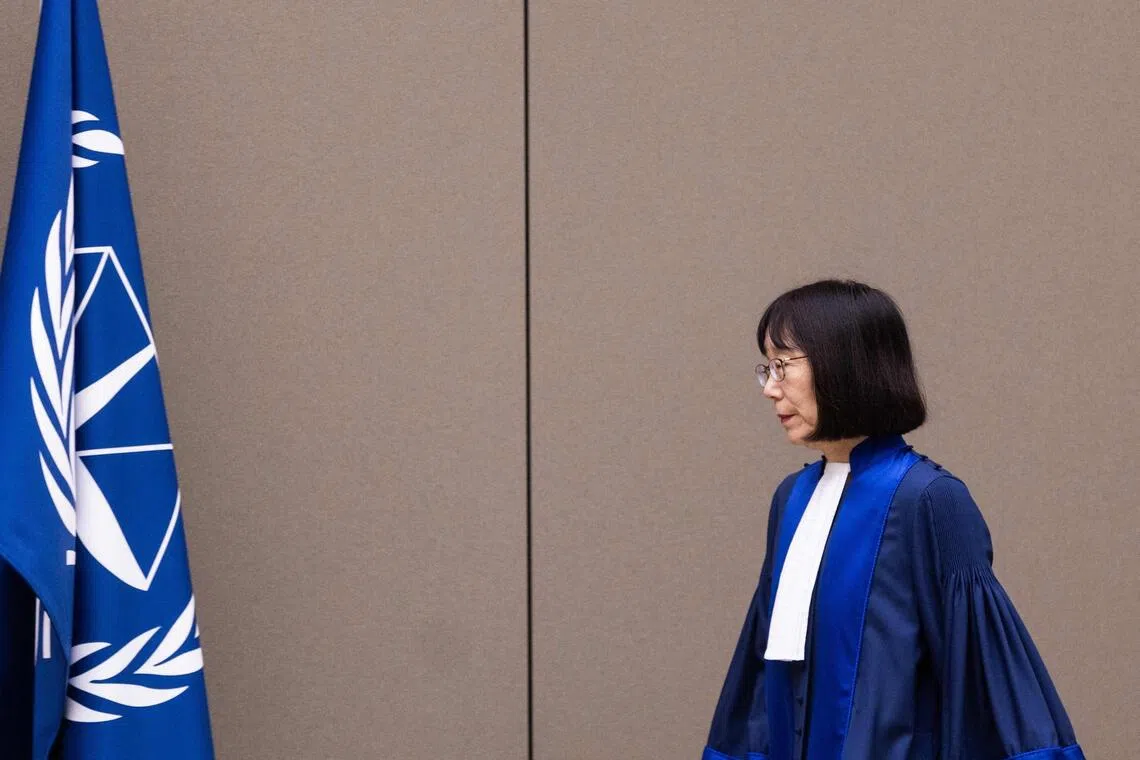
TOKYO – The US’ sanctioning of International Criminal Court (ICC) president Tomoko Akane, a Japanese citizen, has put Japan’s support for the rules-based international order to the test.And Tokyo’s perceived meek defence of its own citizen has raised questions over whether its foreign policy is built on enduring principles or mere deference to its sole security ally.When Akane was sanctioned on Aug 18 – triggering strong condemnation from European capitals – Japanese Prime Minister Sanae Takaichi described the development only as “very unfortunate”. Only after intense domestic criticism did she adjust her wording a week later, describing the sanctions as “incompatible with Japan’s position”.The 70-year-old judge is the latest of at least 13 ICC officials to be targeted by Washington, over the court’s war-crime probes into US military action in Afghanistan and arrest warrants for Israeli leaders over Gaza.The US is not a member of the ICC and maintains that the ICC has no legal power or jurisdiction over American citizens.Washington first imposed sanctions on ICC officials in 2020 during US President Donald Trump’s first term, but these were revoked by his successor Joe Biden.In February 2025, at the start of Trump’s second term, new sanctions were imposed. At the time, Japan did not join 79 member states in condemning the action, with then PM Shigeru Ishiba only saying that Tokyo would “continue monitoring developments with serious concern”.No Japanese were sanctioned at the time.Ryo Sahashi, a University of Tokyo international relations scholar, told The Straits Times that Japan’s initial instinct was to simply repeat the cautious 2025 playbook, but Takaichi had gravely misread the room.This time, the sanctions cut especially deep because they directly hit a Japanese citizen. Many credit cards rely on American payment systems like Visa and Akane said she has been shut out of international banking. Such a financial exile is typically reserved for global terrorists and drug traffickers.Sahashi said this symbolised Japan’s core strategic dilemma: managing its US security alliance while championing the rules-based order.“People in Japan sometimes forget this when they say that China is destroying the international rules-based order,” Sahashi said. “But the challenge created by the US is also very big.”Heng Yee Kuang, who heads the Security Studies Unit at the University of Tokyo, added: “Japan is hardly an exponent of megaphone diplomacy but given how Japan has consistently championed the rule of law, it is caught between a rock and a hard place.”Now, as the rule of law comes under direct assault by Japan’s chief security guarantor, its cautious diplomatic dance risks undercutting its credibility, experts said. This is especially as Japan frequently invokes the “rules-based order” to criticise coercive behaviour by China and Russia.“Japan must demonstrate that its underlying principles do not change according to the identity of the country involved,” Ken Jimbo, a foreign policy expert at Keio University, told ST.“If Tokyo appears unwilling even to articulate those principles when Washington is involved, its claim to provide regional leadership based on the rule of law will gradually lose substance,” he said. “Japan’s credibility as an honest broker rests less on neutrality between countries than on consistency in defending rules.”Domestic pressure on Takaichi’s government mounted quickly with major news outlets uniting in a wave of editorial criticism.On Aug 20, the most-read Yomiuri newspaper lamented that Takaichi, under US pressure, “seems unable to demonstrate even the resolve to protect a Japanese citizen’s right to continue performing her duties, let alone uphold the rule of law”.The same day, the left-leaning Asahi newspaper warned that “kowtowing to the US and focusing solely on short-term gain is dangerously flimsy diplomacy”.On Aug 24, a cross-party coalition of lawmakers led by former Defence Minister Gen Nakatani condemned Takaichi’s response as “far weaker” than those of her European peers. In a statement, the group demanded that Tokyo lodge a formal diplomatic protest with Washington and demand the immediate withdrawal of the sanctions.Nakatani was quoted by domestic media as emphasising that the US-Japan security alliance and defending the rule of law are “not mutually exclusive”.On Aug 25, Takaichi rejected assertions that her administration was pandering to Washington, saying that Tokyo had “repeatedly lobbied the US at various levels to the last moment” and vowing to “protect” the ICC.Still, this does not erase the fact that there will likely be no direct condemnation, no protest and no demand for revocation of the sanctions – which would have been Tokyo’s playbook when dealing with countries like China, North Korea or Russia.Analysts suggest Takaichi’s caution stems from strategic anxieties. The ICC furore erupted just as Trump ordered a downsizing of joint military drills with South Korea.Moreover, Trump’s public fallout with Italian Prime Minister Giorgia Meloni, despite their close friendship, after she publicly defended the Pope against his criticisms would not have gone unnoticed.For Tokyo, the cost of crossing the mercurial US President might be too high.Jimbo noted that it was in Japan’s fundamental national interest to maintain a favourable balance of power in North-east Asia and preserve a rules-based international order.While these two objectives were mutually reinforcing for much of the post-war era, they were now “increasingly pulling Japan in different directions”, he said.“When Japan’s national survival and immediate security are considered... there is no realistic substitute for the US security commitment under the Japan-US alliance,” Jimbo said.“It is therefore understandable that Tokyo is reluctant to position itself in direct confrontation with Washington, especially when the credibility and predictability of the US commitment to the region are already under question.”Yet, he warned that “strategic restraint should not become normative ambiguity”, emphasising that Tokyo must continue to articulate its core principles clearly lest its diplomatic rhetoric be seen as a double standard.“As the ICC’s largest financial contributor and a country whose national serves as its president, Japan bears a particular responsibility,” Jimbo said.“This does not require turning the issue into a public confrontation (but) the objective should be to defend the institution while containing the diplomatic dispute.”Speaking via video link to the Japan National Press Club from The Hague where the court is based on Aug 26, Akane remained resolute: “The ICC will not be defeated… It is the last bastion for protecting the rule of law.”“There is a growing view that Japan should stand firm at this moment and support the ICC,” she said. “I feel great expectations being placed on Japan. From here on is the crucial test. The member countries are all watching Japan and looking to it with high expectations.”Whether Tokyo can rise to the occasion, or whether its “rule of law” diplomacy will be exposed as hollow, will now depend on how skilfully Takaichi can navigate the path between principles and geopolitical realities.
Japan’s commitment to the ‘rule of law’ is tested by US sanctions on its own citizen – the ICC chief
Full Article
Original Source
Read the full article at Straitstimes →KhanList aggregates and links to publicly available news content. We do not host full articles from third-party sources. Always verify important information with original sources.