
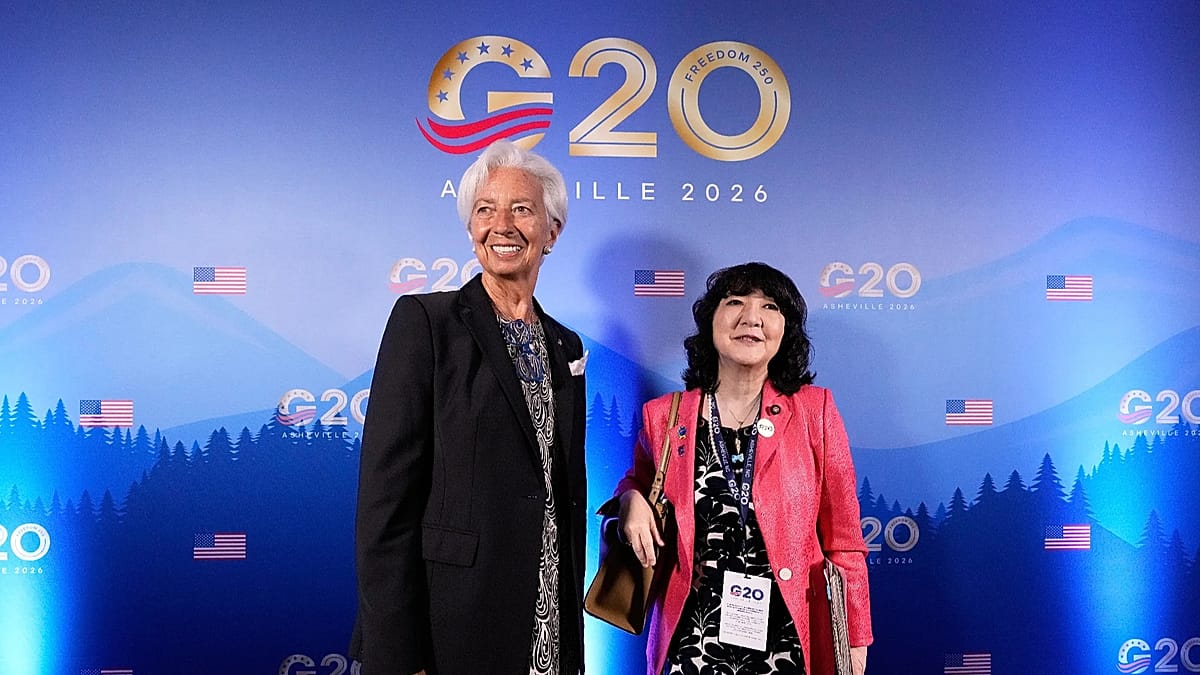
The world's third-largest bond market crossed a line on Tuesday that it held for three decades, though the speed of the ascent is the more remarkable part. ADVERTISEMENT ADVERTISEMENT The yields on Japanese 10-year bonds reached a level unseen since September 1996, driven by inflation, fiscal worries and near-certainty that the Bank of Japan will tighten this month, with that last expectation being actively encouraged from Washington at the G20 gathering in North Carolina. The Japanese 10-year yield has more than tripled in two years and roughly doubled since Prime Minister Sanae Takaichi took office last October on a platform of fiscal expansion perceived by concerned investors as reckless. Shorter maturities are at extremes too, with the Japanese 5-year at a record high and the 2-year at a peak of over three decades as well. The immediate driver is monetary policy as the BOJ's rate stands at 1%, a level last seen 31 years ago, reached through a slow sequence of hikes. Firstly, 0.5% to 0.75% last December, and then to 1% in June. It meets on 17 and 18 September, with markets pricing an 80% to 90% chance of a further hike to 1.25% which would represent a 0.75% increase to Japan's benchmark rate in just nine months. The bond sell-off is also not confined to Tokyo. Global bond yields hit their highest since 2008, with a Bloomberg gauge of government debt rising for a fourth day to 3.72%, as climbing oil prices fuelled inflation concerns and Federal Reserve Chair Kevin Warsh's hawkish Jackson Hole address boosted the probabilities of a US rate hike as well. For instance, 30-year US Treasuries are currently enduring their worst run since 2006. Washington's push for faster rate hikes in Tokyo US Treasury Secretary Scott Bessent spent the first day of the G20 meeting in Asheville, North Carolina, nudging Japan towards tighter monetary policy. "I have information that the market doesn't have, and it's my belief that the Japanese government and the BOJ will do the things that will lead to a stronger yen," he stated publicly during the event. When asked directly by reporters whether he meant higher interest rates, Bessent replied: "I think the market is pricing that in now." A day earlier, the US Treasury Secretary had gone further by saying he expected the Bank of Japan Governor Kazuo Ueda "to do the right thing" on monetary policy. According to the Japanese public broadcaster NHK, citing an interview with the US Treasury under secretary for international affairs, Erin Browne, Bessent told both Ueda and Finance Minister Satsuki Katayama that Japan's next move should be a rate hike, and urged Tokyo to signal that it is putting public finances on a sustainable footing. However, Katayama's account of the same meeting was narrower. "We confirmed that an orderly yen exchange rate is essential for the stability of global financial markets, including those of the United States, and that the continued coordinated efforts of Japan and the United States contribute to achieving this shared objective," the Japanese finance minister told reporters. Katayama said monetary policy did not come up at all, declined to say whether current yen levels are orderly, and had earlier described the joint intervention statement as one that "was a very strong one and still lives." A senior finance ministry official was blunter, saying the Bank of Japan sets policy according to Japan's economy rather than what Washington tells it to do. Ultimately, the currency is what Washington is watching. The Japanese yen traded around 160 per dollar on Tuesday which is the level markets treat as the threshold for renewed intervention, up around 3% after weakening to its softest since the rare joint operation the US and Japan mounted in late July. Bessent described recent moves as not disorderly, pointing away from a repeat of that intervention and towards rates as the preferred remedy.
Japan's 10-year yield hits 3%, a first since 1996 as rate hikes dominate the G20
Full Article
Original Source
Read the full article at Euronews →KhanList aggregates and links to publicly available news content. We do not host full articles from third-party sources. Always verify important information with original sources.