
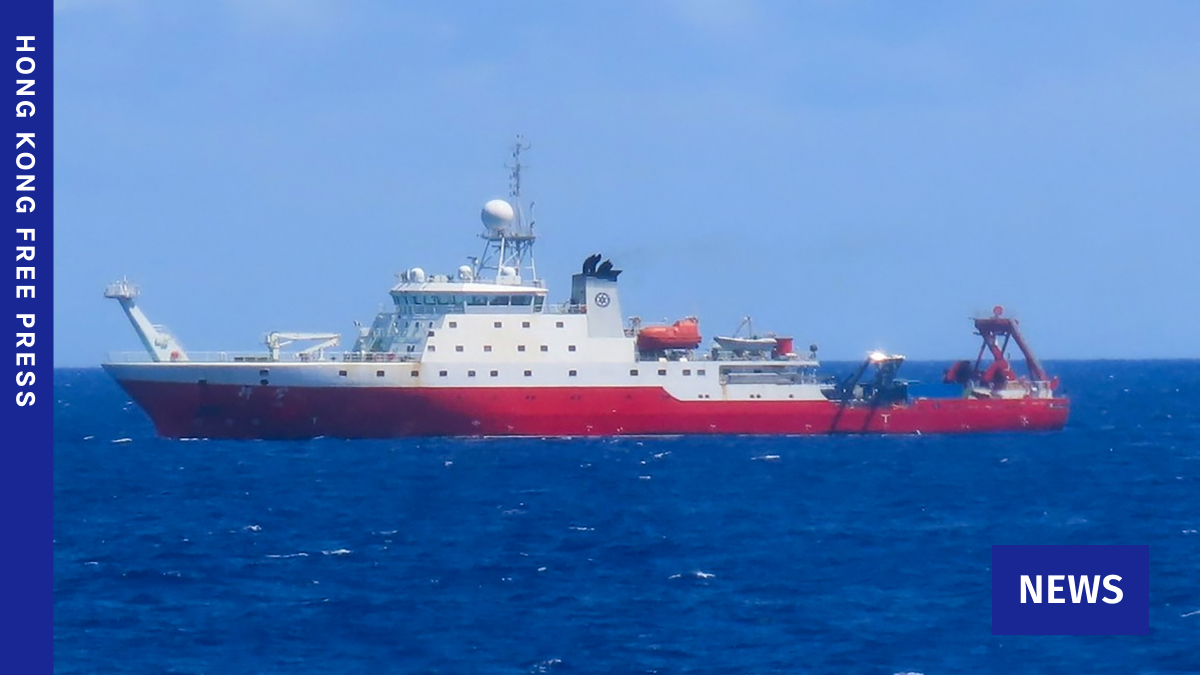
The Japanese coast guard said on Tuesday a Chinese survey ship had left Tokyo’s exclusive economic zone after being ordered repeatedly to stop research operations that Japan said were unauthorised. This undated handout photo received from the Japan Coast Guard on October 5, 2026 shows the Chinese marine research vessel Kexue operating within Japan’s Exclusive Economic Zone, Photo: Handout/Japan Coast Guard/AFP. The Chinese vessel Kexue was first seen on September 27 in waters around 70 kilometres (45 miles) north of Ishigaki island in Japan’s southernmost prefecture of Okinawa, “intermittently extending wire-like objects into the sea from her side and stern”, coast guard spokesman Masashi Asano told AFP. The vessel eventually left on Friday after the coast guard sent “radio messages demanding the survey be halted, stating that scientific research in our maritime zone without… consent will not be tolerated”, Asano said. The number of unapproved surveys by Chinese ships in Japan’s EEZ has already more than doubled compared to last year, he said. The United Nations Convention on the Law of the Sea stipulates that scientific research in an EEZ — an area of up to 200 nautical miles (370 kilometres) offshore from a country’s land — requires an agreement from the nation that holds exclusive rights to the exploration and use of natural resources. The Japanese flag. Photo: Wikicommons. Asano said the frequency of unapproved surveys in Japan’s EEZ had “surged” since around the time Japan and the Philippines announced they would start maritime border negotiations. There have been 14 cases so far this year, compared to six last year, and one or two cases in the three years prior, he said. Prime Minister Sanae Takaichi and Ferdinand Marcos agreed on May 28 to start formal negotiations to “delimit the maritime boundary of the exclusive economic zone and the continental shelf between the two countries… in order to enhance legal certainty in the region”, according to a joint statement. Beijing claims most of the South China Sea, a vital global trade route, despite an international ruling that its assertion has no legal basis. Japanese Prime Minister Sanae Takaichi attends an event on May 29, 2026. Photo: Sanae Takaichi, via X. Its coast guard has clashed repeatedly with that of the Philippines, sparking fears of an armed conflict. Separately, coast guard vessels from both Japan and China routinely engage in standoffs around the Tokyo-controlled Senkaku islands in the East China Sea, islands that Beijing claims and calls the Diaoyu. Takaichi called China an “important neighbour” in a policy address on Monday and pledged to build a stable relationship between the rival nations. Diplomatic relations between the Asian economic giants have been at rock bottom since Takaichi suggested in November that Tokyo might intervene in any attack on Taiwan, which Beijing claims as its territory. Safeguard press freedom; keep HKFP free for all readers by supporting our team Support HKFP | Policies & Ethics | Error/typo? | Contact | Newsletter | Transparency & Annual Report | Apps Make a one-off donation. Dateline:Tokyo, Japan Type of Story: News ServiceProduced externally by an organization we trust to adhere to high journalistic standards. Agence France-Press (AFP) is "a leading global news agency providing fast, comprehensive and verified coverage of the events shaping our world and of the issues affecting our daily lives." HKFP relies on AFP, and its international bureaus, to cover topics we cannot. Read their Ethics Code here More by AFP
Japan says it told China survey ship to leave Tokyo’s economic waters
Full Article
Original Source
Read the full article at Hongkongfp →KhanList aggregates and links to publicly available news content. We do not host full articles from third-party sources. Always verify important information with original sources.