
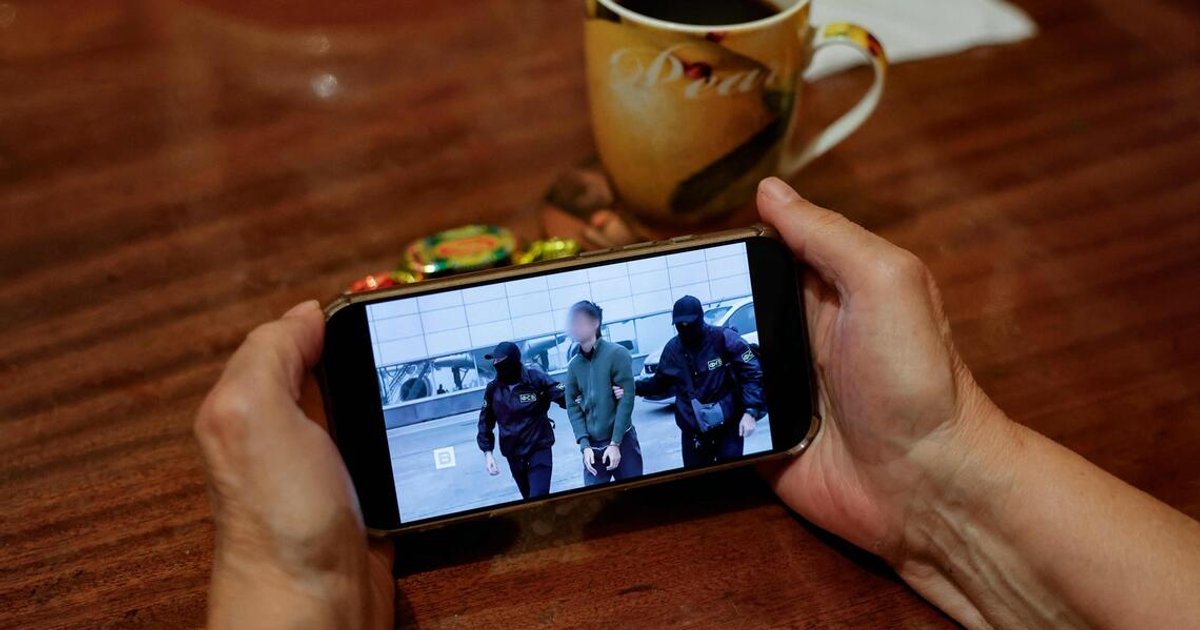
TOKYO – Japan and Russia marked 70 years since the signing of a landmark postwar agreement to restore bilateral ties on Oct 19 with relations plunging to a new low following Moscow’s detention of a Japanese journalist on espionage charges.Moscow has not allowed Japanese diplomats access to the journalist identified as Yuki Imai, a 34-year-old Russia-based correspondent for Hokkaido Shimbun, who was arrested on the island of Sakhalin, whose southern tip is about 40km from Japan’s Hokkaido island.The journalist’s detention is the latest in a rapid succession of actions by Moscow that Tokyo deems provocative. Japan has protested the arrest, saying the charges are completely untrue.On Aug 13, Russian President Vladimir Putin visited the island of Etorofu (known as Iturup in Russia), administered by Moscow and part of an island chain claimed by both Japan and Russia, his first visit there since taking power in 2000. Two months later, Moscow hosted a commercial delegation from China’s Heilongjiang province on the island to conduct feasibility studies for joint fisheries and tourism ventures.And on Oct 22, Chinese Premier Li Qiang concluded a three-day visit to Russia, where he said during a meeting with Putin that Beijing and Moscow “serve as a valuable force for stability in a world marked by turbulence and transformation”. The Kremlin has made headlines for floating a three-way meeting between Putin, US President Donald Trump and Chinese President Xi Jinping on the sidelines of the APEC summit in China in November.Experts said these moves reflect a fundamental geostrategic shift on the part of Russia. As it suffers a severe economic strain from its war in Ukraine, it is deepening its strategic alignment with Beijing. It is also retaliating against Tokyo’s expanding security cooperation with NATO, which comprises the United States, Canada and 30 European nations.And Moscow’s move on Etorofu/Iturup is upending a decades-long diplomatic deadlock over the island chain comprising Etorofu/Iturup, Habomai, Shikotan and Kunashiri (Kunashir in Russia). Administered by Moscow as the Southern Kurils and claimed by Tokyo as the Northern Territories, the chain’s closest islet lies just 3.7 km off Hokkaido.Troops of the then Soviet Union began occupying these islands on Aug 28, 1945, after Japan’s surrender in World War II. Japan considers Moscow’s occupation of these islands an illegal land grab conducted in violation of the 1941 Japan-Soviet Neutrality Pact. Russia, however, said its control of the islands was an immutable outcome of its World War II victory, with its sovereignty beyond debate.While the 1956 Japan-Soviet Joint Declaration formally ended the state of war between the two nations, the unresolved territorial dispute has prevented them from ever signing a formal WWII peace treaty.Taken together, Moscow’s increasingly aggressive posture is raising critical questions about its broader strategy in East Asia, and whether Russia is using coercive posturing to project performative power in the Indo-Pacific amid deepening isolation from the West.Imai’s arrest in Sakhalin – where Japan continues to hold strategic stakes in the Sakhalin-1 and Sakhalin-2 oil and natural gas projects despite Western sanctions, including on Russian oil over the Ukraine invasion – constitutes what observers describe as a calculated act of “hostage diplomacy”.Japanese media published livid editorials. The Asahi Shimbun accused Moscow of “arbitrarily setting up a foreign media reporter as a spy for the purpose of detaining him”. The Yomiuri Shimbun noted: “Japanese news agencies do not accept government control or censorship, and it is unlikely they would engage in espionage... Russia should not treat foreign media as if they were state-controlled media under its own jurisdiction.”James D.J. Brown, an expert on Russia-Japan ties at Temple University Japan, dismissed the espionage allegations as a baseless fabrication. He drew parallels between Imai’s detention and that of Wall Street Journal reporter Evan Gershkovich, who was arrested in March 2023 and sentenced to 16 years on trumped-up spying charges, but ultimately freed in an August 2024 multinational prisoner exchange.“Democracies end up with a lot of pressure being placed on their governments, which will do everything to get this poor person out,” Brown said, noting Russia’s track record of using such detentions to force prisoner swaps or extract geopolitical concessions.“Russia sees Japan, geopolitically, as a vassal state of the United States, and uses the term ‘collective West’ to include Japan as well. So they would think, well, even if it’s a Japanese citizen, he can be part of a broader exchange for Russians held in Europe or the US,” Brown added.In his view, the primary trigger for Russia’s increasingly hardline stance against Tokyo was Japan’s deepening security integration with NATO. In May, Japan announced a 2.2 billion yen (S$17.9 million) contribution to NATO’s Prioritised Ukraine Requirements List initiative, with the funds specified for the acquisition of non-lethal equipment to comply with domestic export restrictions on lethal weapons to countries at war.That same month, Tokyo announced that it was deploying four Self-Defense Forces personnel to the NATO Security Assistance and Training for Ukraine headquarters in Wiesbaden, Germany, for a one-year tour.“I think that’s especially sensitive for Moscow,” Brown told The Straits Times. “Russia hates any Japanese cooperation with NATO, and sees this as NATO expanding to the Far East and trying to encircle Russia.”Imai is alleged to have been collecting information about Russia’s defensive capabilities on Sakhalin, with Moscow scheduled to conduct bombing drills around the nearby disputed islands from Oct 13 to Oct 17.Taisuke Abiru, a senior fellow at the Sasakawa Peace Foundation think-tank, noted that Russia’s stance on the islands underwent a permanent structural shift in 2020, when constitutional amendments codified strict prohibitions against any cession of Russian territory.He added that Russia has also aligned its WWII victory narrative with that of China’s in its “War of Resistance Against Japan”. Both countries also routinely condemn Japanese “new militarism” as a means of exerting pressure on Tokyo’s defence policy.Inviting Chinese commercial interests onto Etorofu/Iturup also serves both political and practical imperatives for a war-weary Kremlin.“Russia is very enthusiastic to get Chinese investment, and this is not just economics but also serves to send the political message: ‘These islands are ours’,” Brown said.This flurry of activity raises the fundamental question of whether Moscow’s strategy is a largely performative piece of diplomatic theatre designed to project strength as an Asian power despite economic strain and the military stalemate in Ukraine.Abiru, pointing to how Putin has attempted to preserve diplomatic manoeuvrability in Asia including with ASEAN and India, noted that Russian strategists remain acutely wary of becoming a junior partner entirely dependent on Beijing. In this context, Abiru envisions a “long-term, dual-track reality” for Tokyo and Moscow, where security friction and economic cooperation coexist.“Russia is wary of becoming overly dependent on China and recognises the need to maintain its relationship with Japan,” Abiru said, noting that Putin described Japan as a “natural partner” as recently as 2024.And despite heavy Western sanctions, Japan has deliberately kept its equity stakes in the Sakhalin projects. Energy serves as mutual leverage: Russia relies on revenue and ongoing operational expertise, while Tokyo relies on supply stability.This decision is driven directly by energy security. Throughout the Ukraine crisis, Tokyo has been importing Russian liquefied natural gas and, more recently after shipping disruptions in the Strait of Hormuz, even a limited amount of crude oil.When asked at a recent news conference whether this position dilutes Japan’s rule-of-law advocacy, Trade Minister Ryosei Akazawa defended the policy in pragmatic terms.He said: “It boils down to how you define national interest. If we were to walk away from our stake, another country would simply move in, and the vast assets that we developed using enormous amounts of taxpayers’ money would be taken away for free.”Abiru similarly sees energy cooperation as an enduring necessity even as the territorial dispute simmers, arguing that as long as Japan remains tied to Sakhalin for its resource security, trade will remain an important thread keeping the two neighbours connected.“Japan needs to pursue a tenacious diplomatic approach that balances the management of security tensions with the pragmatic pursuit of cooperation,” Abiru emphasised.Brown, however, warns that this pragmatic balancing act will become increasingly untenable if Tokyo expects a business-as-usual resumption after the Ukraine war, pointing out that Europe’s relationship with Moscow has irrevocably changed.“For the Europeans, there is a view that there is no going back to the status quo ante. Even if the war ends, Russia is still going to remain an adversary,” Brown said.“Japan is a lot more naive, and this reflects a lack of understanding of Russia’s position,” he added. “Putin, after all, changed the Constitution to make it even harder to make territorial concessions, and Russia will only continue to use Japan for leverage.”
Japan-Russia ties hit new low amid Moscow’s geostrategic shift
Full Article
Original Source
Read the full article at Straitstimes →KhanList aggregates and links to publicly available news content. We do not host full articles from third-party sources. Always verify important information with original sources.