
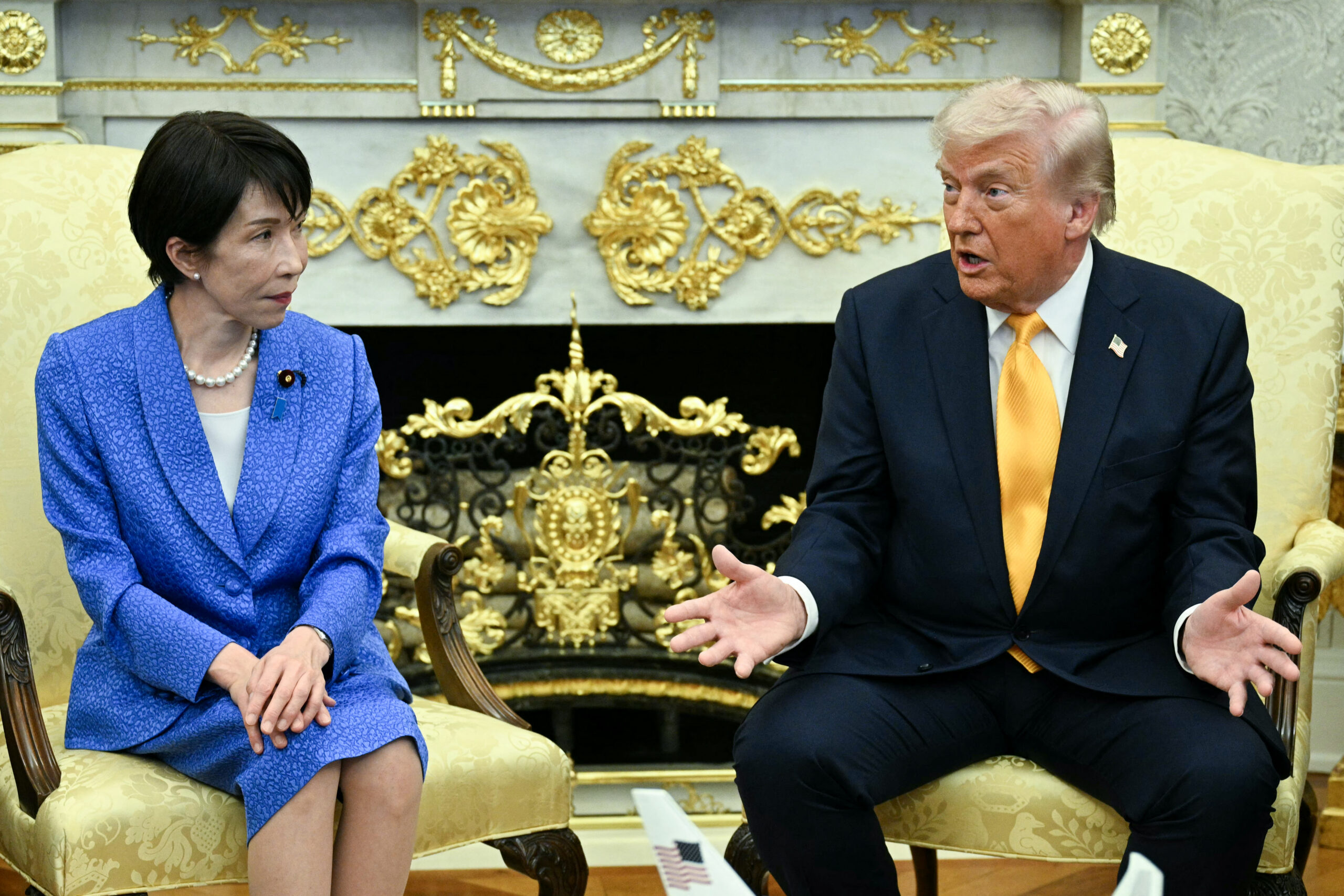
Japan To restore economic sovereignty, something more than currency intervention is required. (Jim WATSON / AFP via Getty Images) “This is the completed form of the Japan-U.S. currency alliance.” So declared Atsushi Mimura—Japan’s vice minister of finance for International Affairs and the top official supporting Finance Minister Satsuki Katayama on exchange rate policy—during the coordinated Japan-U.S. currency intervention (specifically, the purchase of yen and selling of dollars) carried out in July. The intervention, which was the work of Katayama and U.S. Treasury Secretary Scott Bessent, was the first such joint action in approximately 28 years. Japan’s exchange rate against the dollar had hovered around the 103–110 yen range from about 2016 until 2021, when the yen began to weaken. By the time of the intervention earlier this summer, the yen had fallen to the 163-yen-to-the-dollar level—a historic low not seen in 39 years. Many market participants have pointed out that the primary reason for this depreciation of the yen is the low level of interest rates in Japan compared to other advanced economies. During and immediately after the second Shinzo Abe administration (2012–20), Japan maintained an ultra-loose monetary policy to escape deflation. For a time, the policy interest rate in Japan was at or below 0 percent. However, in recent years—and in line with other countries—Japan began gradually raising its policy interest rate. The rate hikes started in earnest in 2024 to combat inflation. Monetary authorities had also attempted unilateral interventions on several occasions to prop up the currency as rates rose, but failed to halt the rapid depreciation of the yen. Following the coordinated U.S.-Japan intervention in July, the dollar-yen exchange rate temporarily shifted toward a stronger yen and a weaker dollar, reaching the 155-yen-to-the-dollar level. However, as the yen soon thereafter resumed its slide, it remains unclear what the long-term effects of the intervention will be. One-time adjustments cannot hide the fact that there are deeper, structural issues underlying the recent weakness of the currency. If the yen continues to depreciate, prices in Japan will rise further, raising costs for ordinary Japanese people. Rising inflation leads to higher long-term interest rates, which in turn cools the Japanese economy, further harming average citizens. Seen in this light, Bessent’s yen rescue might appear to be a welcome act. Indeed, President Donald Trump described the recent coordinated intervention between Japan and the U.S. as a “signal of friendship” toward Japan. At first glance, the intervention would seem to be just that, a helping hand extended by a friend during a time of need. In reality, however, the U.S. stands to gain even more from this measure than Japan does. America’s Achilles’ heel is its federal government debt. That debt has now reached $40 trillion, with annual interest payments amounting to $1 trillion. Even Trump, who wields immense power on the global stage, cannot overcome the bond market forces that tend to exert selling pressure on U.S. Treasuries. His ambitions regarding reciprocal tariffs and the acquisition of Greenland have already been forced into postponement or revision, due—at least in part—to warning signals from the market. Furthermore, with the prospect of having to issue yet more debt to fund its war on Iran, the U.S. fears that a weak yen and rising long-term Japanese interest rates could have spillover effects on its own interest rates and financial markets. While a weak yen reflects weaknesses in the Japanese economy, the U.S. also faces vulnerabilities that make it impossible to ignore the situation. The truth is that the U.S. decided to undertake this coordinated intervention to protect its own economy, not that of Japan. Typically, when Japan intervenes in the foreign exchange market to correct a weak yen, it does so by selling off its holdings of U.S. Treasuries. This, however, carries the risk of driving up U.S. Treasury yields—an outcome the U.S. is keen to avoid. If Japan were to sell off Treasuries in order to support the yen, then the market might perceive limits on the available intervention funds, potentially weakening the intervention's overall impact. Consequently, Bessent proposed a mechanism by which the Federal Reserve would lend the dollars that Japan needs to fund its yen-buying interventions. This would appear to be a step that could lead to further steps in the future. The reason is that, typically, a “currency alliance” implies an arrangement—such as the mutual provision of funds—designed to keep the exchange rate between two nations within a specific range. It is worth noting that by lending dollar funds to Japan under this framework, the Fed would earn interest income, an approach characteristic of the Trump administration’s business-oriented mindset. Conversely, Japan would incur a new interest payment burden. Furthermore, since this arrangement involves the Fed supplying dollars to the market, it would generate a monetary easing effect for the U.S., thereby aligning with Trump’s desire to see the Fed lower interest rates. Through this move, the U.S. would gain leverage over Japan and further expand its influence on Japan’s financial and economic landscape. For the Trump administration, which aims to revitalize domestic U.S. industries, an excessively strong dollar is far from desirable. During negotiations sparked by Trump’s imposition of tariffs on many countries worldwide, the Japanese government agreed to invest $550 billion in the U.S. economy. The U.S. financial sector has already begun moving to lend the necessary funds to Japan for this purpose. The flipside is that Japan’s procurement of the massive dollar funds required for such an investment would itself contribute to a weaker yen and a stronger dollar. Globally, there is growing concern regarding the weakening of the U.S. dollar’s status as the key reserve currency. This trend has been driven by factors such as the move away from the dollar following economic sanctions against Russia over its invasion of Ukraine, as well as the undermining of the petrodollar system by U.S. attacks on Iran. Against this backdrop, the recent series of developments serves to stabilize the dollar-based system by more firmly integrating Japan—the world's largest investor in the U.S. and the largest holder of U.S. Treasury securities, with a portfolio worth $1.1 trillion—into the dollar-centric framework. In this way, the Japanese economy is further deepening its integration with the United States in the financial sphere. While the above structural problems are important, however, the even larger point I wish to raise here concerns how both Japan and the United States should approach financial globalization. In the 1990s, Wall Street brought the Japanese economy under effective U.S. control. Following the end of the Cold War, American strategy shifted away from countering the communist bloc. Instead, capitalizing on the wave of globalization triggered by the fall of the Berlin Wall and the disintegration of the Soviet Union, the U.S. sought to manage the savings and financial assets of other nations and position itself as the hub of global capital circulation. Key targets of this strategy included Russia under the Yeltsin administration—as Russians were being forced into a rapid transition to a market economy—and Japan, which was languishing after the bursting of its economic bubble at the end of the 1980s. Driven by the imperatives of finance capital and neoliberalism, the United States employed various forms of propaganda to weaken Japan’s state functions and accelerate the shift from public to private control. This steered Japan toward structural reforms that effectively turned the country into a hunting ground for Wall Street. As a civil servant in Japan’s Ministry of Finance at the time, I viewed this process as a form of economic colonization—a successor to the post–Second World War occupation by Douglas MacArthur’s GHQ. It is undeniable that Japan’s post-bubble “Lost Decades” were partly the result of a system that allowed the U.S. to siphon off the wealth accumulated through the hard work of the Japanese people. Japan’s rapid postwar economic growth was underpinned by a collaborative public–private framework in which so-called main banks supported corporations. Under this system, companies enjoyed stable management, allowing them to prioritize long-term investment, profit-sharing with employees, and enduring business relationships. These companies derived their strength from managing their operations with a focus on diverse stakeholders, including local communities. The forces of financial globalism dismantled this system, shifting Japan toward a model of shareholder capitalism that prioritized investors and dividends over wages. Amidst the wave of structural reforms, Japanese companies could no longer rely on stable funding from main banks. Instead, they prioritized return on capital to win favor with overseas investors, shifting toward a cost-cutting economic model that focused on reducing fixed costs. The disposal of non-performing loans following the bubble’s collapse further accelerated this trend. Amid the surge in market fundamentalism driven by financial globalization, major financial institutions in Japan such as Nikko Securities, Hokkaido Takushoku Bank, and the Long-Term Credit Bank of Japan collapsed in 1997 and 1998. Subsequently, the domestic circulation of funds within the Japanese economy weakened. As a result, surplus Japanese capital was directed toward overseas investment rather than domestic investment. The latter was viewed as unattractive due to expected future market contraction associated with another problem Japan faced: a shrinking population. Japan became the only major economy where real wages failed to rise in tandem with productivity gains. A structural pattern took hold in which Japanese wealth flowed out to the United States and other nations—enriching foreign economies and benefiting investors and financial interests—rather than being reinvested domestically to enrich Japan itself. This dynamic underlies the fact that, until recently, Japan maintained the world’s largest net international investment position. Consequently, Japan has fallen into a state of underinvestment compared to other major nations. The administration of Prime Minister Sanae Takaichi, who came into office on massive public support, seeks to reverse this situation. Rather than strictly reflecting economic fundamentals, the current depreciation of the yen is driven largely by market speculation. Forces profiting from speculation are orchestrating sell-offs of the yen and government bonds by framing Japan’s expansionary fiscal policies and proposed consumption tax cuts as reasons to sell. But the Takaichi administration’s promotion of investment through expansionary fiscal policy aims to overcome the very underinvestment that weakened the Japanese economy in the first place and has been a root cause of the yen’s depreciation. The eventual goal of the Takaichi policy suite is to place Japan on a new growth trajectory. Fundamentally, this should serve as a catalyst for buying the yen. Meanwhile, the Sanseito party advocates for the phased abolition of the consumption tax, which now stands at ten percent. Sanseito’s argument is that putting more money into citizens' pockets will reverse the declining birthrate and open up a future for Japan. Standing in the way of these efforts is a market dominated by globalist forces. Sanseito is the only national political party in Japan to champion an anti-globalist stance, viewing globalism—which pursues profit by disregarding or even denying the existence of nations with their own unique histories, cultures, traditions, national characters, and socio-economic systems—as a force to be confronted and defeated. History shows that other globalizing ideologies, such as colonialism and communism, have triggered wars, exploitation, and the oppression of peoples. In recent times, too, the shadow of military-industrial interests hangs over major conflicts. Furthermore, beyond the financial sector discussed here, areas such as IT, healthcare, excessive decarbonization, surging immigration, and even “cancel culture” and the overreach of political correctness serve as examples of how globalism can destroy unique national orders, widen inequality, and cause social upheaval. Forces rejecting this status quo and adopting an anti-globalist stance are rising rapidly in Japan, Europe, and America. Trump, who returned to the presidency promising to put “America First,” was expected to fight against such globalism. People around the world are working to protect their countries and their families from globalist incursion. Regarding financial markets, I have personally proposed a policy wherein the government issues digital currency to redeem government bonds held by the central bank. This would create a system where this currency would circulate as stablecoins, a technology currently undergoing development. If this currency issuance were carried out in response to user demand for exchange, then it would not, in itself, trigger inflation. This should be seen as an antiglobalist policy, as it would leverage the government’s right to issue currency—an aspect of national sovereignty—to enhance the independence of the nation's fiscal and monetary policies from financial markets. The wealth built through the labor of the Japanese people should serve the welfare of the Japanese people, not foreign financial interests. This is also the fundamental position of the Sanseito party, which advocates for a “Japanese First” approach. Subscribe Today Get daily emails in your inbox We in Japan are fighting the same forces as ordinary Americans. It was globalism that caused the U.S. economy to become overly skewed toward finance and IT, leading to the offshoring of manufacturing bases and the consequent weakening of the U.S. industrial foundation. This resulted in the decline of the American middle class and undermined the very basis of U.S. national defense. While some point out that the U.S. attack on Iran casts doubt on Trump’s antiglobalist stance, there remains an expectation—even within the U.S.—that the Trump administration, with its “America First” agenda, will continue its original mission of pursuing national greatness. I continue to see “America First” as a tremendous opportunity for Japan, and for antiglobalist efforts everywhere. “Japanese First” is a natural complement to the healthy nationalism flourishing in America now. Currencies should work for a nation’s people, not for a small group of privileged investors. Money should enrich citizens, not globalists. Peace and prosperity should be our goal.
Japan and America Should Join Forces to Fight Financial Globalization
Full Article
Original Source
Read the full article at Theamericanconservative →KhanList aggregates and links to publicly available news content. We do not host full articles from third-party sources. Always verify important information with original sources.