
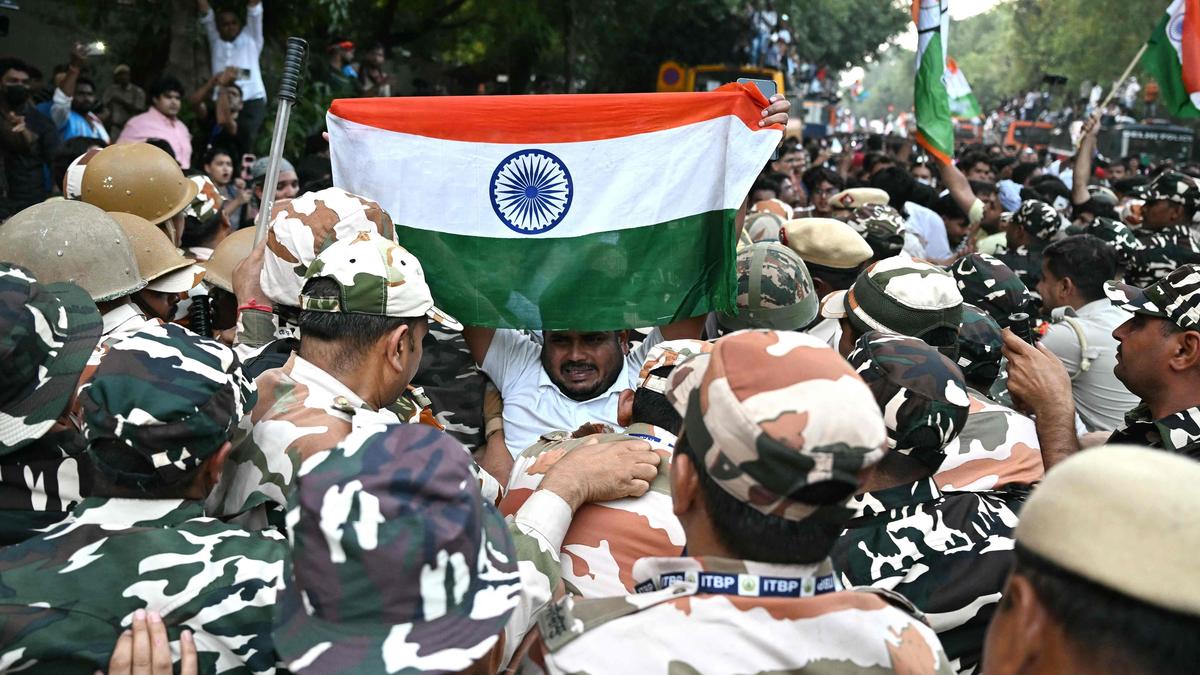
Over the past few months, three distinct streams of dissent have emerged in India: the Cockroach Janta Party (CJP)-led agitation, actions by left-wing student organisations, and campaigns spearheaded by the Congress and the INDIA bloc. Although these streams have largely evolved independently, their paths have increasingly converged around shared concerns about democracy, dissent, citizens’ rights and the fairness of the political and electoral process. Their significance lies in their capacity to bring disparate grievances and constituencies together in a broader challenge to the government.Dissent finds new voicesThe first phase of the agitation unfolded at Jantar Mantar in June and July, focusing on education reform, the National Eligibility-cum-Entrance Test (NEET) paper leaks and demands for the (then) Education Minister’s resignation. The CJP played a pivotal role in galvanising public discontent, drawing large numbers of young people into the streets, where they articulated their grievances through a distinctive blend of humour, creativity and youthful energy. This indicated that dissatisfaction with the ruling establishment extended well beyond the established Opposition parties, with the political disaffection of this constituency having been seriously underestimated. The Minister’s eventual resignation gave the movement fresh impetus, demonstrating that sustained public pressure could secure political concessions.On Gandhi Jayanti, Opposition parties, student groups and civil society activists took to the streets, demanding the Chief Election Commissioner’s (CEC) resignation over the Special Intensive Revision (SIR) of electoral rolls. Mobile Internet services were suspended around Jantar Mantar, gates at a number of Metro stations were closed, and more than 700 protesters were detained in the vicinity by the police. The CJP’s call for a protest at Jantar Mantar 2.0 on October 10 met with an even heavier crackdown. A massive deployment of police and paramilitary forces brought much of the capital to a near standstill, effectively preventing the gathering from taking place. Two days later, thousands gathered in central Delhi for the unprecedented ‘Dilli Chalo’ march, led by Leader of the Opposition (Lok Sabha) Rahul Gandhi, Congress and prominent INDIA bloc leaders.The contrast was telling. While the ‘Dilli Chalo’ march showed the Congress’s capacity to draw large crowds onto the streets, the CJP’s calls brought youth discontent into sharper public focus. For Mr. Gandhi, this offered an opportunity to unite various concerns and channel them towards a more focused political agenda. The Jantar Mantar uprising created new political space outside parties. Its most significant contribution was to break the climate of fear. The mass protest demonstrated the ability of established Opposition parties, particularly the Congress, to consolidate concerns over electoral integrity, institutional accountability and the right to protest into a broader political challenge to the government. While movements can mobilise people and articulate dissent, parties provide the organisational means to sustain it and translate it into political action. Neither form of collective action is sufficient on its own. Ultimately, political change depends on parties being able to turn mass mobilisation into a sustained challenge to those in power.At the heart of this public upsurge is a widening struggle over the sanctity of the vote, a cornerstone of democracy. By early September 2026, the exercise had resulted in the exclusion of 13.37 crore names from draft electoral rolls across 30 States and Union Territories — equivalent to 14.1% of the pre-SIR electorate — raising concerns about the possible disenfranchisement of eligible voters. The central question is whether the revision is transparent, verifiable and subject to adequate safeguards against arbitrary exclusion, particularly given concerns about the reliability of the procedures and centralised software used to remove names.The protest, accompanied by a petition to the Supreme Court of India seeking an investigation, an audit of voter deletions, safeguards against arbitrary exclusion and suspension of the process, underscored the political force of a convergence between mass participation, Opposition mobilisation and legal action. The petition also put the judiciary to the test, challenging it to protect constitutional rights through judicial review rather than allow executive decisions to evade scrutiny.The ECI’s independence had already been questioned following the enactment of the Chief Election Commissioner and Other Election Commissioners (Appointment, Conditions of Service and Term of Office) Act, 2023, which excluded the Chief Justice of India from the panel appointing Election Commissioners (ECs) and provided immunity from civil and criminal proceedings for acts undertaken in the discharge of official duties. Reports of disagreements among the ECs over unilateral decisions taken by the CEC further fuelled questions about the ECI’s functioning. These doubts intensified opposition to SIR, adding a new dimension to the challenge by linking electoral administration to democratic accountability.The issue of electoral fairnessThousands have taken to the streets, protesting the voter-list overhaul and raising concerns over the ECI’s constitutional obligation to act impartially. Gathering momentum since early October, the protests signal a significant shift in Opposition politics. The demand for scrapping SIR and the CEC’s resignation, once unthinkable, has emerged as a rallying point of protests. It has also brought the contest over electoral fairness beyond the institutional arenas of Parliament and the courts and onto the streets. When eligible citizens are excluded from voter rolls without adequate safeguards or effective remedies, the conduct of elections alone cannot guarantee democratic legitimacy. These concerns have raised the spectre of a shift from electoral democracy towards electoral autocracy, underscoring the extent of democratic backsliding in the country.The vulnerability of powerThe current political moment exposes the vulnerabilities beneath the Bharatiya Janata Party (BJP)’s dominance, as growing public resentment begins to test its hold on power. The BJP’s failure to secure a parliamentary majority in the 2024 general election had already dented its aura of invincibility. Meanwhile, the government’s efforts to reshape the electoral architecture through multiple mechanisms have fuelled concerns that it seeks to institutionalise a permanent majority and forestall a recurrence of its electoral setback.Unable to offer political solutions, the government has instead deployed its coercive powers to quell dissent, particularly among the youth. Such measures, however, cannot obscure deeper concerns over the erosion of the constitutionally guaranteed right to vote. Nor can the government deflect scrutiny by accusing the Opposition, the CJP or left-wing groups of fomenting anarchy or conspiring to bring down the regime. Such allegations of regime change — which simply means transition of power through elections — are especially unconvincing given the BJP’s own record of pursuing regime change of governments whose policies, programmes and practices it opposed.By resorting to repression, the government has exposed the limits of its political dominance and sharpened the disconnect between the young and the ruling party, as well as eroded trust in the institutions it controls. In short, it is losing the plot. The larger democratic stakes are clear: this is ultimately a fight over the foundation of democracy itself — the right to vote. Although these developments have yet to produce a new political alignment, they have widened the space for dissent and intensified scrutiny of the concentration of executive power. Most strikingly, the ECI has come to be seen as a proxy for the executive, with doubts about its impartiality sharpening broader concerns about executive overreach and the erosion of institutional autonomy.The challenge now is to convert this heightened public scrutiny into a sustained political check on right-wing dominance. The central question is whether this wave of public dissent over the electoral process can connect with wider popular resentments over the education system, unemployment and rising prices, and translate them into political change. That remains to be seen.Zoya Hasan is Professor Emerita, Centre for Political Studies, Jawaharlal Nehru University
Jantar Mantar to ‘Dilli Chalo’, protest challenges power
Full Article
Original Source
Read the full article at Thehindu →KhanList aggregates and links to publicly available news content. We do not host full articles from third-party sources. Always verify important information with original sources.