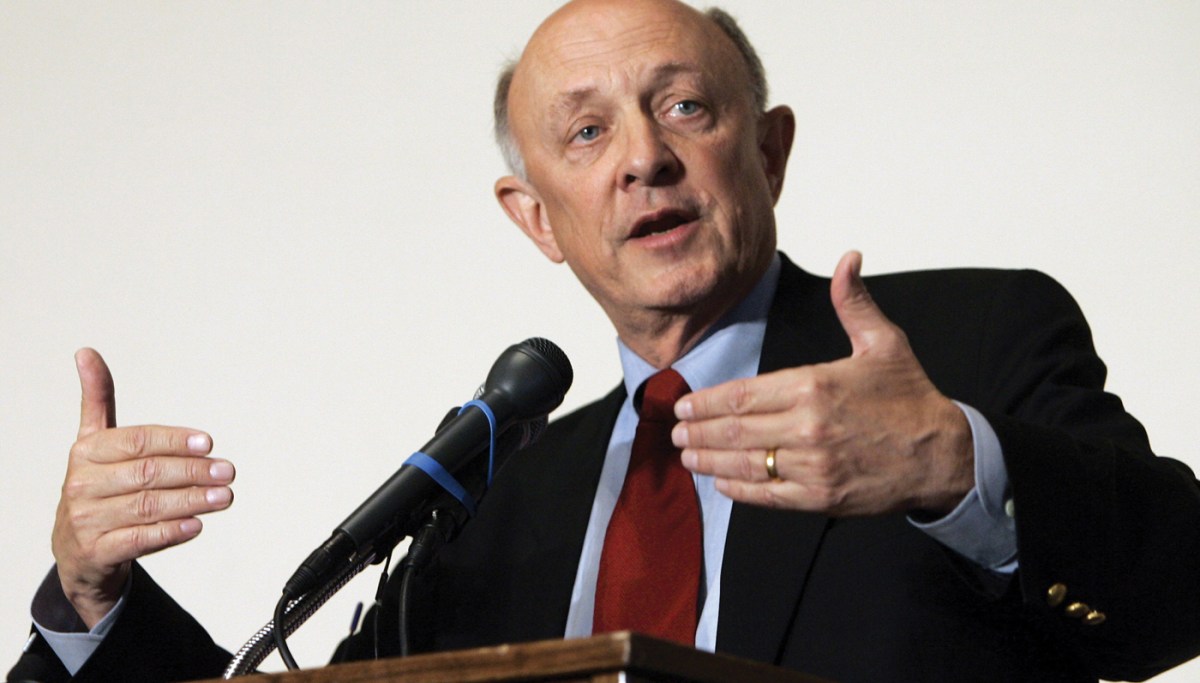
In September 1994, a disturbed pilot crashed a stolen Cessna onto the White House’s South Lawn. R. James Woolsey, then the director of central intelligence, spent the rest of his life joking that it was him, trying to get an appointment with President Bill Clinton. He meant it half in jest. But the fact that the country’s chief spy could go two years without a real relationship with the president he served says almost everything about the strange, thankless, and consequential tenure that defined his career. Woolsey died July 21 at his Washington home at 84. Recommended Stories Robert James Woolsey Jr. was born in Tulsa, Oklahoma, on Sept. 21, 1941, the only child of a lawyer father and a homemaker mother. He was absurdly credentialed before he turned 30: Phi Beta Kappa at Stanford University, a Rhodes Scholarship to the University of Oxford, a law degree from Yale University, where he edited the law review. He also managed to be an ROTC cadet who served two years as an Army officer — a contradiction that previewed a career spent defying easy political categorization. He advised the U.S. delegation to the Strategic Arms Limitation Talks in Helsinki and Vienna, served as general counsel to the Senate Armed Services Committee, and held senior posts under four consecutive presidents of both parties: undersecretary of the Navy under Jimmy Carter, an arms-control negotiator under Ronald Reagan, and America’s ambassador to the talks limiting conventional forces in Europe under George H.W. Bush.That bipartisan resume is what made Woolsey, a lifelong registered Democrat, an appealing pick for Clinton, who named him director of central intelligence in 1993 partly to reassure defense hawks skeptical of a young president with no national security background. It proved to be a mismatch from the start. Woolsey and Clinton rarely spoke; by Woolsey’s own count, he had virtually no real one-on-one meetings with the president during his entire tenure. The plane-crash line became his way of making peace with the snub, and he repeated it so often that it eventually stopped sounding bitter and started sounding like the driest kind of Washington wit. Former CIA Director R. James Woolsey. (AP Photo) The substance of the job was no easier than the politics of it. Woolsey took over an agency still adjusting to a post-Cold War world that Washington had wrongly assumed had gotten safer. He spent his two years warning that it hadn’t, closing out his tenure with a line that outlived his time in office: “We have slain the dragon, but there are still many snakes in the woods.” Barely a year into the job, the CIA discovered that one of its own veteran officers, Aldrich Ames, had been spying for Moscow for nearly a decade — one of the most damaging espionage failures in the agency’s history. Congress and much of the press wanted a purge. Woolsey reprimanded 11 current and former officials but refused to fire anyone outright, telling reporters flatly, “Some have clamored for heads to roll in order that we could say heads have rolled. Sorry, that’s not my way.” It was a decision that cost him what remained of his political capital; by December 1994, with Republicans about to take Congress and precious little support from the White House, he resigned.LINDSEY GRAHAM, 1955-2026 Woolsey’s post-CIA career turned out to be, in its own way, more influential than his time running the agency. He became one of Washington’s earliest and loudest voices warning that Islamist terrorism, not great-power rivalry, was the defining threat of the new era, and he was among the most prominent public advocates of the 2003 invasion of Iraq, framing the post-9/11 conflict as nothing less than a fourth world war against Islamist extremism. He was also, decades before it became fashionable, an evangelist for energy independence, arguing in congressional testimony and think tank panels that America’s dependence on foreign oil was as much a national-security liability as a policy failure, and holding out hope that new technology could someday make oil as unremarkable a commodity as table salt. In his later years, he described himself less as a Democrat than as a “Scoop Jackson Democrat” — hawkish on defense, centrist on everything else — a label that fit a man who advised both the late John McCain’s 2008 campaign and, briefly, Donald Trump’s 2016 transition before breaking with the president over his attacks on the intelligence community.It would be easy to remember Woolsey only for the awkwardness of his CIA tenure — the cold shoulder from his own president, the scandal he inherited, the resignation nobody mourned very loudly. But that would miss the man who kept getting summoned back to Washington by presidents of both parties for three decades because he was, whatever else you could say about him, seriously good at the job of thinking about threats before anyone else wanted to. He never did get that meeting with Clinton. But as Woolsey liked to tell it, at least the Cessna made the front page.Daniel Ross Goodman (@DanRossGoodman) is a Washington Examiner contributing writer and teaches theology and religious studies at St. John’s University. His next book, Dante’s Guide to Life: How The Divine Comedy Can Change Our Fortunes, Our World, and Ourselves, will be published this fall by Angelico Press.
James Woolsey, 1941-2026
Full Article
Original Source
Read the full article at Washingtonexaminer →KhanList aggregates and links to publicly available news content. We do not host full articles from third-party sources. Always verify important information with original sources.