
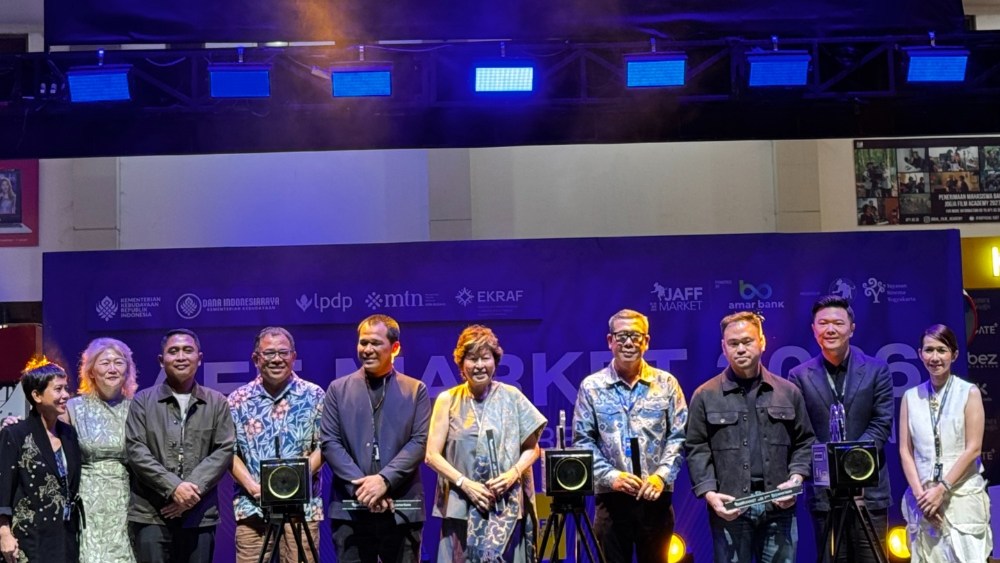
JAFF Market, which organizers bill as Indonesia’s biggest film market, opened its third edition at the Jogja Expo Center in Yogyakarta with market director Linda Gozali urging the local industry to judge its growth on quality as well as scale. The three-day market runs alongside the Jogja-Netpac Asian Film Festival (JAFF). Gozali said the first edition was conceived as an experiment. “It is actually a question that we threw into the Indonesian ecosystem whether or not we truly need a film market. And the response was definitely overwhelming,” she said. Gozali said the market’s third outing called for some reflection on whether the industry can “actually endure and survive the economic upheaval, the socio-political instability, as well as whatever issues that are actually evolving in the global era.” The 2025 edition centered on local and international collaboration, she said, with the goal of turning leads into multiple deals. “This is a transitional period, and therefore let’s define what growth is,” Gozali added. “We have to define growth not just in terms of the quantity, no. Because growth in quantity itself will reduce at a time where there are challenges around the environment. So we look at growth as well from the quality point of view.” The exhibition floor hosts 116 exhibitors, and the opening day was reserved as a business day for accredited badge holders. Amar Bank is powering the market for the second year running. The JAFF Future Project selection comprises 12 projects. Indonesian titles are Dhiwangkara Seta’s “Absence” (stylized “αLPα”), Timoteus Anggawan Kusno’s “Orphaned Atlas” (an Indonesia-France-Netherlands co-production), “Pupus: The Orchid of Merapi,” “A Quiet Sunshine,” “Somewhere Between” and Sidharta Tata’s “Slaughterground,” along with “Gokil,” presented with Jakarta Film Week. From elsewhere come Glenn Barit’s “Luz and Flor” (Philippines), Rein Maychaelson’s “Primal” (Indonesia, Singapore, South Korea), M. Raihan Halim’s “The Smuggler” (Singapore), Boo Junfeng’s multi-country co-production “Trinity” and Rosie Lourde’s “Wreck and Ruin” (Australia), which arrives via a partnership with the Adelaide Film Festival and Malaysia’s mylab. The IP Connection strand, formerly known as JAFF Content Market, has opened to international properties for the first time. Of its 10 selections, four come from overseas: the comic “Disposable Dolly” (Hong Kong), the book “Cat Rental Company” (Taiwan) and two South Korean titles brought in through a partnership with Busan’s Asian Contents & Film Market (ACFM), the book “My Upstairs Neighbors” and the webtoon “Friend Request.” The six Indonesian properties are animation “Komarong,” board game “Mantra,” comics “Blood Upon the Snow,” “Lao Sam 1892” and “Yuuko’s Gloomy Days,” and novel “Hati-Hati Ada Dua Hati” (roughly, “Watch Out, There Are Two Hearts”). Among the new initiatives is a Producers Exchange, whose first batch numbers 14 producers: Lisa Scott and Rae Choi (Australia), who come via the Adelaide Film Festival, Jason Karman (Canada, Indonesia), Nana Riskhi and Nick Musa (Indonesia), Wong Kew Soon (Malaysia), Otgontuya Zorig (Mongolia), Danzen Santos Katanyag (Philippines), Sam Chua Weishi and Wendy Lie (Singapore), Kimbo Kim (South Korea), Shao-Yi Chen (Taiwan), Phimphloi Nan Saensuk (Thailand) and Rajib Mohajan (Bangladesh, U.S.). Chua is pulling double duty: she is also one of the producers of “Primal.” The Indonesia-France Film Lab X MTN Lab, now in its third year, is run by the French Embassy and the Institut français d’Indonésie (IFI), with Paris film school La Fémis supplying the mentors. Indonesian partners include the Ministry of Culture’s Directorate of Film, Music and Arts, whose national talent management program MTN gives the lab its name, along with the Indonesia Film Agency (BPI) and the Association of Indonesian Film Producers (Aprofi). This year’s six projects, all debut or sophomore features from director-producer pairings, are “A Straight Way to Love,” “An Interesting Incident,” “Father Figure,” “My Tears, a Sea for Jakarta to Sink,” “Saltstorm!” and “Super Neli.” A second new program focuses on film writing across journalism, criticism and the essay form. It has 15 young participants, among them journalists, writers, lecturers, researchers and communications professionals. The first day’s conference program includes a big-ideas session on where Indonesian cinema goes next, along with a session on how cultural phenomena can grow beyond trends and open doors to cross-border projects. The second day will turn to the question of where the country’s audience actually sits, with Gozali noting that many foreign collaborators arrive drawn by the “lucrative Indonesian market.” Sessions that day will also cover AI in microdramas, documentaries, budgets and what it takes for an Indonesian production house to last 30 years. “Economically speaking, we are actually in a cautious mood,” Gozali said. The final day will take in animation, box office breakouts and actors who have moved into producing, plus a talk on action and stunts from Japanese action director Tanigaki Kenji. Ahmad Mahendra, director general of culture development, utilization and fostering at Indonesia’s Ministry of Culture, delivered a brief keynote in which he said he hoped the market would keep growing and strengthening the country’s film ecosystem, and that the ministry could lend its support. The market was then declared open as guests inserted memory sticks into a projector. Joining Mahendra on stage were JAFF founder Garin Nugroho, festival director Ifa Isfansyah, JAFF Market executive director Ajish Dibyo, business director Sekarini Seruni, business strategist FX Iwan, board members Lorna Tee and Yulia Evina Bhara, and Amar Bank senior VP Josua Sloane. French ambassador to Indonesia Fabien Penone also attended, along with Cecep Rukendi, deputy for media creativity at the Ministry of Creative Economy, and Andhika Permata, head of Jakarta’s Tourism and Creative Economy Agency. “People say the third is the charm,” Gozali said. “Hopefully it is, fingers crossed.”
JAFF Market Opens Third Edition With Call to Measure Indonesian Cinema’s Growth by Quality, Not Just Volume
Full Article
Original Source
Read the full article at Variety →KhanList aggregates and links to publicly available news content. We do not host full articles from third-party sources. Always verify important information with original sources.