
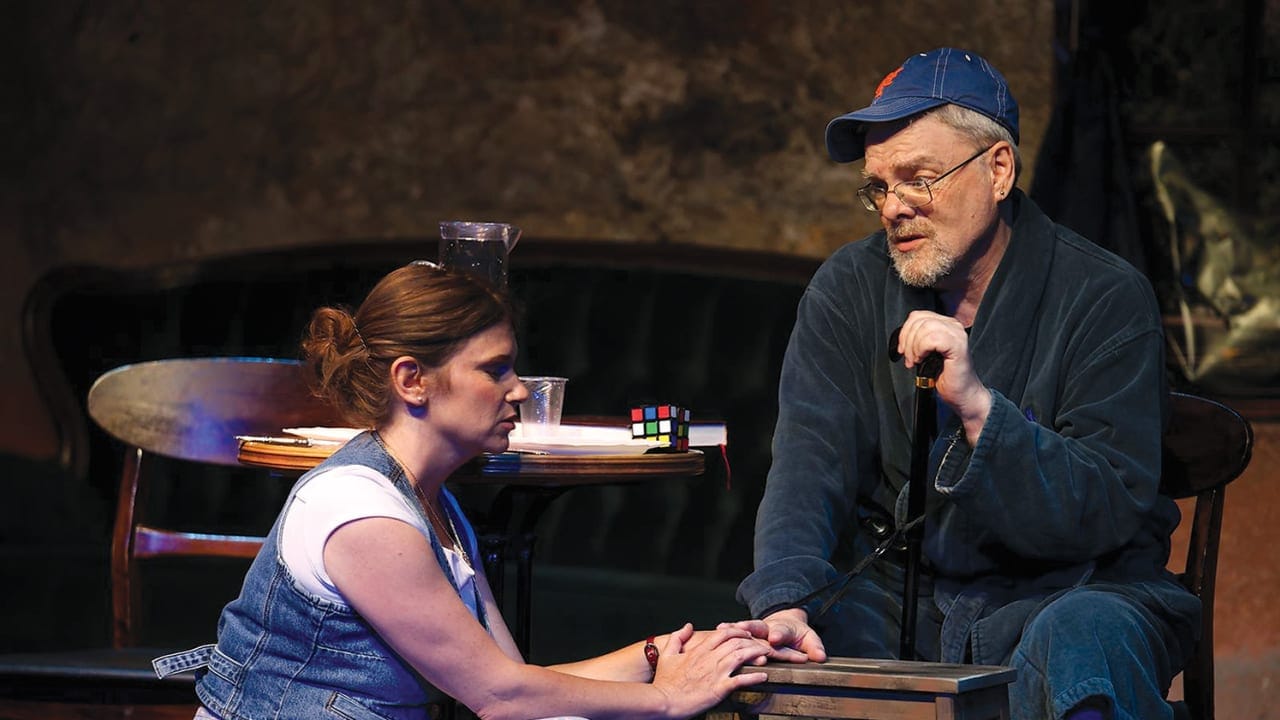
NOVEMBER 15, 2026 18:41The scene is a rehearsal room in Rehavia, Jerusalem. Three actors – a man, a woman, and a girl – stand in the middle of the room while a tall, charismatic man moves between them.Animated and dramatic, he shows them how to bring even more out of themselves, modeling gestures and tone. “Let your blood listen to the words,” he exhorts them. “Your body has to say that, not your mouth!”This is director Jacob Lunon, who brings his talent, expertise, and experience working in the American film industry and off-Broadway to Jerusalem’s English-speaking theater scene.The play is Jacob’s Stepladder, which stirred up so much interest in its run at the Khan Theater in June that it has been invited back for a second showing (partly with new actors).“Even though this is community theater, I want the acting to be professional level,” Lunon insisted. “I only take actors who have been through my acting class.”Jacob’s Stepladder was written by Art Feinglass, who founded the Seattle Jewish Theatre Company, which is behind this production.‘Jacob’s Stepladder’ is actually a very personal project for the playwright. (credit: Tzvi Popovich)Based in Seattle and New York, Feinglass spends part of his year in Jerusalem. He’s the artistic director of Crossroads Theater Shed, and also has strong roots in Israel, having studied here and served during the Yom Kippur War.Feinglass has often focused on social issues involving JewsIn his plays, Feinglass has often focused on social issues involving Jews. Mississippi Summer deals with Jewish participation in the 1960s American civil rights movement, while Arrivals is about Ashkenazi and Mizrahi immigrants trying to build new lives. Both were performed off Broadway.Jacob’s Stepladder is actually a very personal project, drawing on his own biography and experiences as a single father. Feinglass noted, “The term ‘single father’ had not even been invented when my wife went off to India to join a cult and I took over raising my two daughters.”“That turned out to be the most rewarding thing I’ve ever done. I built the play on that experience,” he added.The story revolves around the Brodys, a small Jewish family living in the US. The father, Jacob (Mark Spiro), is an atheist. The mother, Miriam (Malka Batash), has a strong spiritual side.We discover that at one point, she joined the cult of guru Bhagwan Rajneesh, leaving her husband and young daughter Sarah (Amit Chill) behind; later, she metamorphoses into a corporate lawyer, well-versed in all things material.As the story progresses, each of its three acts carrying us forward by one decade, tensions rise to the surface. The characters evolve, interact, and make choices, and their pain, anger, and yearning for love draw the audience in.While I only saw a partial rehearsal, I found the characters engaging and believable and wanted to know them better.THE CASTING has successfully met the challenge of portraying the same characters across three decades. Batash plays Miriam throughout the play.Jacob is portrayed by Spiro in the first two acts and by Simon Montagu in the third, while Sarah is played by Amit Chill, Aliza Greenspan, and Deborah Rachel Kemper, respectively.I witnessed some excellent acting, and it was particularly delightful to watch young Amit (11-year-old Sarah) prancing in excitement around the room after her father promises her a shopping trip.What struck me in considering this tale is that these characters don’t end up where they began. There is movement, and that is very human. At each stage, the members of this family help each other grow: sometimes through support, and sometimes through adversity.Batash noted that the play is about patterns of abandonment down the generations, and the choices people make as adults based on their childhood wounds.Reflecting on the experience of playing Miriam, she said: “This was a hard character to figure out, but I can understand that, feeling unloved, she was seeking attention and would do anything to get it, even join a cult.”Excellent live music accompanies the showI was also very taken by the live music that accompanies the show. Violinist Chava Basilyan and pianist Ori Ben-Lavi first met at the Yellow Submarine in a project intended to encourage local musicians, and their collaboration on Jacob’s Stepladder is a powerful one.Ori Ben-Lavi. Composition and violin: Chava Basilyan. (credit: Tzvi Popovich)The music is almost all original, composed by Basilyan. The plaint of her violin plucks at our heartstrings and reminds us that beneath this modern play with its Armani suits and baseball games lie larger spiritual forces.When I asked her about the inspiration for one particularly lovely piece, she explained: “I wrote it to reflect the journey of the soul.”Pianist Ben-Lavi said of the music, “It takes you to another world.”The stepladder in the title obviously serves as a symbol, but precisely of what I will leave you to puzzle out as you watch!Overall, the combination of Feinglass’s characterization and dialogue, Lunon’s spirited direction, the talented and dedicated cast, and soul-stirring music augurs well for a memorable evening of Jewish theater. May the production prove a ladder to success for everyone involved.What: Jacob’s Stepladder, an original comedy-drama about a Jewish family. Who: Seattle Jewish Theatre Company. Director Jacob Lunon. Writer Art Feinglass. Original music by Chava Basilyan.Where: Khan TheaterWhen: Nov 18-26. 90 minutes.Why: Immerse yourself in a tale of love, abandonment, and growth.Follow us on Google
'Jacob's Ladder': Immerse yourself in a tale of love, abandonment, and growth at the Khan Theater
Full Article
Original Source
Read the full article at Jpost →KhanList aggregates and links to publicly available news content. We do not host full articles from third-party sources. Always verify important information with original sources.