
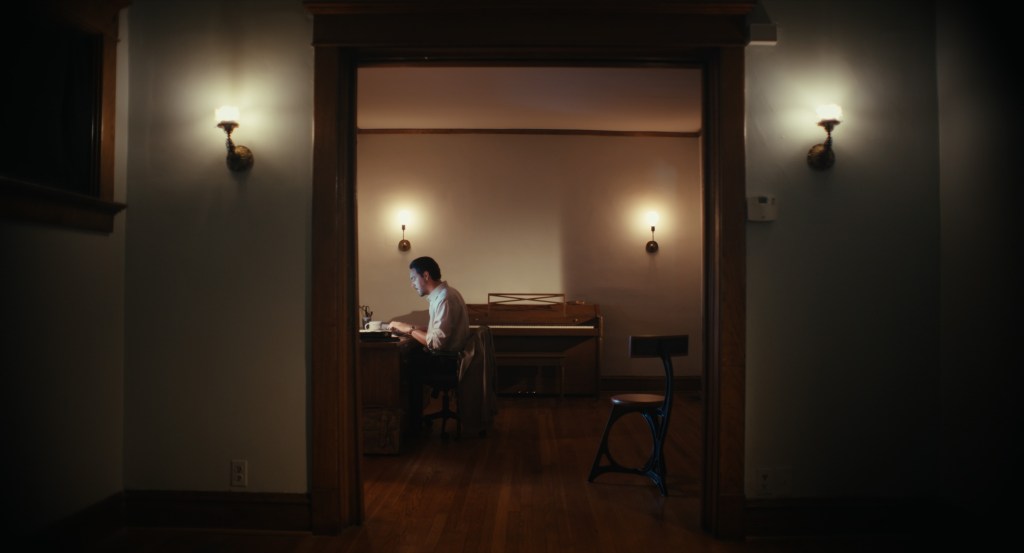
Paul Schrader writes great parts for great actors, and has been doing so for 50 years, since Robert De Niro played Travis Bickle in Martin Scorsese’s Taxi Driver. Since then, to name but a few, he’s given us William Devane in Rolling Thunder, Richard Gere in American Gigolo, Willem Dafoe in Light Sleeper, Nick Nolte in Affliction and Ethan Hawke in First Reformed. Way before toxic masculinity was ever diagnosed, Schrader was rooting around in the psyches of men who, for one reason or another, just didn’t feel safe in their own skin anymore. We can now add to that list The Basics of Philosophy, a tight, literate psychological drama that clocks in at a highly economical 94 minutes and yet somehow tackles one of the greatest existential questions of all time: Is it really possible to escape the past? In The Card Counter, we saw a war criminal trying to distance himself from his involvement in the atrocities of Abu Ghraib, and in Master Gardener we met a Nazi-tattooed former white supremacist trying to start a new life in a witness protection scheme. The Basics of Philosophy, however, might be the most perfect distillation of his themes so far. The great actor this time is Jack Huston, who plays philosopher lecturer John Jorrison. Jorrisen is the picture of professionalism, and an honest teacher too, as we find when he refuses to go easy on a student’s grades to stop her from failing. In a desperate last-ditch bid for clemency, the student threatens to blackmail him. It turns out to be a bluff, but there is a skeleton in his closet: As a younger man, during his post-student career as a music teacher, Jorrisen molested a teenage student called Miguel (Daniel Zovatto), a transgression covered up by his rich and therefore powerful father (Bill Pullman). Watch on Deadline The p-word — pedophilia — is never really mentioned, since Jorrisen is not what you might call a pedophile, having a bizarre arm’s-length courtship with an increasingly frustrated psychology professor Rebecca Richards (Sofia Boutella). Nevertheless, the false accusation starts him thinking about the past, the enormity of his crime (singular) and its impact on his victim. On the day of the film’s world premiere in Venice, Huston spoke to Deadline about the film’s uncompromising themes of guilt and redemption. DEADLINE: How did you get involved with this film? JACK HUSTON: I’ve known Paul on and off — God, I want to say going all the way back. He actually wanted me to be in a film called The Canyons (2013) many, many years ago. Which I didn’t do, but we’ve sort of remained friendly, and I’m very close with the producer, Braxton Pope. We worked together many, many years ago on a film called Shrink (2009). So, we’ve always had it in our minds that we’d like to work together. But when I was away working and I got a call from Braxton saying, “Listen, there’s a script that Paul wants me to read,” and he didn’t say much more than that — a bit like you watching the film, probably. You can’t really preface it with anything. He was like, “You just have to read it.” And after reading it, I thought it was first and foremost one of the best scripts I’ve read. I think it’s superb. I mean, it’s masterful. It’s Schrader through and through. He’s a bucket-list director that I’ve been dying to work with for many years. But it was only after reading the script about seven times that I finally decided to meet with Schrader and actually have a chat about it, because I really had to read it a lot to digest it. DEADLINE: Did you have any doubts? You said you read it seven times. HUSTON: Absolutely. It’s interesting; the things that scare you the most are sometimes the things that challenge you the most. I actually have a story about this. I was on set with a lovely actor called Jake Lacy, and Jake asked me, “What’s a role you’d never play?” I said I’d never play a predator, anything to do with children. It was about two months before I got Schrader’s script. And I’d also said around that time that I really wanted to work with a certain caliber of director. I was getting to a point in my life where leaving my children, leaving my wife, leaving home gets harder and harder, so you really want to be working with great people. So of course, the gods answered my question by sending me Schrader’s script, which I thought was very appropriate for where I was in my head space. OK, so it was a very difficult read, but I found it an incredibly important read. This is something me and my wife have to deal with on a daily basis. We talk about this. We have a 10-year-old and a 13-year-old. I think what Schrader does better than anybody is he tells the story of the everyman —the last suspect, almost, the person hiding in plain sight. Because that’s the truth of it. It exists everywhere in the world and it’s not usually the man who comes at you with his hands raised and a dagger in his hand. It’s usually the last person you’d ever suspect, the friendly guy, the affable man, the teacher. When I was at school, I remember my music teacher got kicked out for inappropriate behavior with a 13-year-old. So, I grew up seeing this. I mean, there’s multiple cases of teachers or music teachers having inappropriate behavior with students. And it’s about that sort of age — 13, 14, 15 — where it’s a real problem. So, I feel there’s real duty to telling this story, and I think Schrader does it so brilliantly well. DEADLINE: On top of that, you also have to be a philosophy professor. How did you approach that aspect of the role? HUSTON: Oh man, I’ve never worked harder. I read everything. I mean, it was kind of a gift and a curse, because you don’t ever want to take anything lightly. There’s not a single scene in this film that I didn’t spend months going over. Quite rightly so. I wanted to be as thoughtful approaching this role as I possibly could. It was a very, very difficult place to live in for the time I was doing it. But, as an actor, you have to put in the work. And for a film like, this and for a role like this, there is a certain amount of duty you have. I had to humanize the character first, so that we make him more relatable. And actually, by doing that, it poses the greater question, which is, can you trust anybody? And also, Spinoza’s great question, are we capable of change? Which is, I think, not for me to answer, it’s for me to pose and for audience to answer or at least debate and talk about. DEADLINE: How did you discuss this with Paul? I mean, how could you discuss your approach to the role when you were going for such ambiguity? If that makes sense. HUSTON: Yes, it does make sense. Paul is very matter of fact. He won’t tell you what he thinks, a lot of the time. That’s my job. And then it’s my job to not necessarily tell an audience what I think, but to perform it in a way that does leave it open-ended but allows them to make up their own minds. Perhaps the most important thing that Paul said to me on our very first Zoom was that he believes that the final act of any film, especially his films, happens when the audience leaves the cinema. It’s the conversation that ensues. So, I can tell you this much — this film is going to cause a conversation, so he’s going to succeed. Boy, is he ever. I think it’s very important that this conversation is had, though. It’s almost become a taboo subject, but it shouldn’t be. This should be pulled out from under the carpet and slammed on top of the table. This is a subject everybody should be talking, about because it’s so prevalent in society. And I spoke to multiple friends — gay, straight, I mean my wife even — and lot of them had their first sexual experiences when they were teenagers with older people. Like, people who were much older than them. And whether or not they thought they were abused, they were abused. It’s a form of abuse because it’s an older person using their stature. If it were a teacher, someone that one would mentor or look up to, it’s using that status and manipulating that and using it for their benefits. In the film, John is a much younger man when this happens. But let’s not get this wrong, it’s abuse. That’s what it is. We can’t sugarcoat that. That’s definitely abuse. But John has then spent his life after the incident in the sort of cynical way, ridding himself of any delights or pleasures to live a very straight life, to live a very plain life, no alcohol, no relationships. I think he knows what he’s done. And — with regard to the Spinoza question, which is, are we capable of change — I think that’s probably what keeps him awake at night, that exact question, because he desperately wants to change. He hopes he can. If he can’t, then he’s a monster. DEADLINE: It’s important that it’s just the one incident. I mean, 20, 30 years ago, people would just say, “Well, it only happened once,” and then they’d move on. And I think it’s very interesting that, as you say, this is still keeping him awake at night. HUSTON: I don’t think I would’ve taken this role if he was out there just abusing people. I think it’s a far more interesting and thoughtful and considered film — and performance —because of it being a single incident, because a single incident can ruin your life. A single incident can keep you awake at night. A single incident can haunt you. It doesn’t make it any better that it was once. It’s still awful. And I think that’s what I found very interesting about the character of John Jorrisen is he’s a philosophy professor. He thinks for a living. It’s his curse; he has to philosophize and think every single day. And actually, his studies have been as much about his life as those around him. I think he’s trying to be a better man, but he also takes up the idea that if we cannot live good and we will live badly. DEADLINE: It’s interesting that the film starts with an accusation — the student who says, “I know what you’ve done, I know about you.” Immediately, all the scenarios that you’ve mentioned go through the viewer’s mind. HUSTON: It’s so smart, that. I love that you brought that up because it’s like I think most people have done something bad in life. You just have to say to someone, “I know what you’ve done,” and that person will instantly go to that one thing that haunts them. “Oh my gosh, they know!” It was a very brilliant tactic. DEADLINE: It’s the perfect subject for a Paul Schrader movie, because his films are so much about tortured men looking for redemption. But who can forgive you — who has the power to forgive you — for an incident like this? HUSTON: It’s interesting, because it’s between him and Miguel, isn’t it, at the end of it? I think that’s, in John’s mind, the only person, there’s no one else to forgive him. The only person who could probably or possibly forgive him is the person he abused. He certainly can’t forgive himself. I think he’s always had it in the back of his head that it would come to this. It’s almost like a crusade, isn’t it? I think it was fascinating because Schrader writes in such a way that even in the lightest scenes, there feels like a weight. And I remember feeling this weight, and it became internal. It was in my stomach and it gnawed away at me. With everything you do, every scene you’re in, there’s something there — there’s baggage, and it feels like it’s pulling you down. You feel like you’re drowning. And I think John Jorrisen feels like he’s drowning. Even in the best moments, he feels like he’s drowning. And that’s from the choices he’s made, and that’s who he is as a man. DEADLINE: Paul’s been in a bit of a groove with these kinds of men-in-crisis movies lately, since First Reformed (2017). Did you go back and watch them again, or is that not helpful as an actor to watch? HUSTON: No, I did. I watched everything, going all the way back to Taxi Driver. I mean, it’s amazing how long he’s been playing out the man in the room with the checkered past. I think no one writes like him. And I mean this as a great compliment: He feels very European to me, because the films he makes, we don’t actually see too much in America these days, but maybe there’s a certain European flair. That’s why maybe Venice is the best place for the premiere of a film like this, because he’s posing very large and difficult questions to an audience, but they’re important questions. And I think the minute we try to censor ourselves and say we shouldn’t make films like this is the minute we censor art itself, and art should be the one place where you ask the difficult questions. And they’re not for us to answer, they’re for us to pose. Hopefully a film like this opens that conversation up and makes us much more free to talk about. And actually, when I was doing my research — which I did so much for something like this because I’d never do it without — it just really did show me that this happens daily, multiple times a day. And I think people need to be far more aware of just how dangerous the world is. And a lot of the time the abused don’t even know they’ve been abused. And I found that fascinating that it’s actually, but that doesn’t make it not abuse. That’s the point I want to get across here very much. It’s like whatever the case, however you are, even if you saw it as your sexual revolution, you were 14 and you met someone older. Like I said, my wife was dating a man when she was 16 who she thought was 18 years old. Turned out he was 29. So, every person I spoke to had some form of story or they had a story about someone else. I was like, “Wow, it really is everywhere.” So, I’m glad that someone like Paul Schrader’s around and can write something like this. DEADLINE: It’s also interesting that actors like Richard Gere and Bill Pullman are willing to take part, because those names help to sell a difficult subject matter, surely… HUSTON: Yeah, I mean they all come out for Paul because he’s brilliant and he’s a singular voice in our industry. He’s his own being, and everybody supports him. I saw Marty [Scorsese] the other day. He’s come on board as an EP and he just loves the film. He thought the film was miraculous. And I think that says a lot, because Marty’s an incredibly thoughtful filmmaker, one of the most brilliant filmmakers as we all know, but he’s somebody who understands just how important someone like Paul Schrader is and how important that voice is. And that’s ultimately why I did the film, because sometimes the things that scare you the most are the things that we have to tackle head on. I believe we made quite a brilliant film, and I’m incredibly proud of the performance. I think it’s one of the best ones I’ve ever had the opportunity to do, and it’s incredibly considered. I hope people are able to see that. DEADLINE: Guilt and remorse were a big part of the film that you directed, Day of the Fight (2023), the idea of the weight of one’s “sins”, the missed opportunities or things done wrong. It seems to me that you’re attracted to that as an element of storytelling. HUSTON: Very much. It’s so interesting you brought that up, because there’s a whole scene in Day of the Fight, where Mikey (Michael Pitt) has a conversation with his friend Patrick (John Magaro) in church. He says, “I’ve changed. I know that, but people… all they remember is the past. I’ll always be who I was, not who I am.” Which means, it doesn’t matter [that he’s changed]. He hasn’t had a drink in nine years and he doesn’t want one. But no matter what, people will always see him for who he was, not for who he is. And I think it’s a very interesting way of looking at this script, because it was when I was really philosophizing about the idea of change and redemption, and if we are able to change. And that’s why Schrader is such a sort of genius, man. He comes along and poses the question in such a brutally honest and devastating way that a lot of things I thought I knew I didn’t know, and it made me just go back to the books and just work and work and work. DEADLINE: Are you planning to direct again? What’s your next move? HUSTON: Yes, I am. I’m meant to be starting pre-production next week, but we’ll see if that bloody happens. Independent cinema at its finest! [Laughs.] We’re very, very close. My next film’s about Joseph Merrick, who was known as “The Elephant Man”, but we use the last month of his life and his childhood from 5 years old to 15, when he left home. It’s a script that I’ve written and I feel very proud to be making it later this year. The title Joseph Merrick right now, which I’m sure is subject to change. We’ll see what it’s called at the end. DEADLINE: And what attracted you to that story? HUSTON: Funny enough, my mentor was really John Hurt. I was very close with John and spent a lot of time with him and his wife — well, widow now — Anwyn. I got to live with them when they were in California and spent a lot of time with John. I will never forget that performance in that film, David Lynch’s film, and what it did to me, so there wasn’t a piece of me that wanted to make that film again, because it’s been done absolutely perfectly and brilliantly and I would never even dare. But what I did find out after a lot of reading was that there were parts of Joseph’s life that we didn’t know about. So, it’s been a beautiful exploration of this stunning figure who, against all the odds, led with kindness and generosity and beauty. And I think the world needs these stories. They need someone to look up to. And when you look at somebody who had such a horrible start in life and the afflictions that he was born with, and yet he was still able to hold himself the way he did… I think it’s a good example for people, and it’s a film I want my kids to watch.
Jack Huston On The Tough Questions About Sexual Abuse Posed By Paul Schrader’s Film ‘The Basics Of Philosophy’: “It’s Almost Become A Taboo Subject” – Venice Film Festival
Full Article
Original Source
Read the full article at Deadline →KhanList aggregates and links to publicly available news content. We do not host full articles from third-party sources. Always verify important information with original sources.