
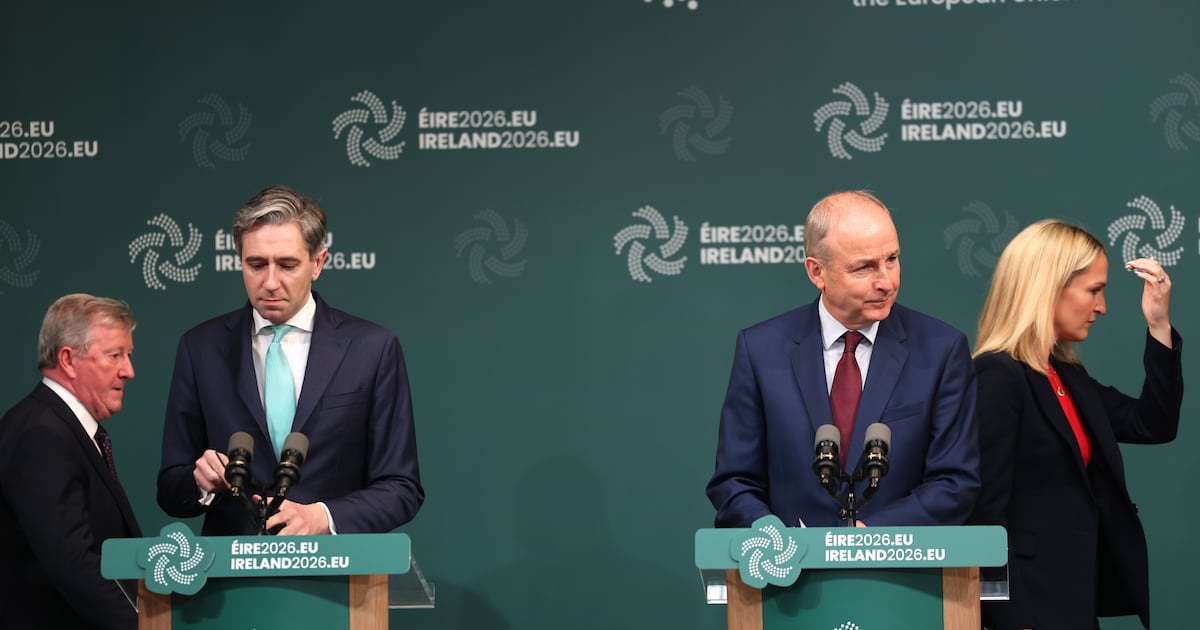
Of all the “isms” that preoccupy modern politics, nothing rattles the cage of the establishment more than populism. And it’s not hard to see why. Populism, in its various forms, has chewed through political establishments around the world. Skilled practitioners have proved the most adept at surfing the disruption that has followed the financial crisis. The fact that Ireland hasn’t had an electoral surge installing a populist government soothes mainstream politicians to an extent, but it shouldn’t blind them to the fact that our politics has changed profoundly in the last 15-20 years. It’s just that the establishment has shape-shifted too, with Fine Gael and Fianna Fáil’s formal Coalition the ultimate evidence of that. That transformation is one reason populism has struggled to break through in Ireland. But if that realignment is to endure, voters need to feel its benefits. Can the current configuration deliver them?The excellent History of Ideas podcast, hosted by academic and author David Runciman, devoted a recent episode to another “ism” that has sprung up in opposition to populism – deliverism. This has a particular relevance for Irish politics, and for the people at the top of government in Dublin. READ MOREDeliverism is an electoral strategy that believes serving up good outcomes for voters will lead to success at the ballot box. So far, so not-very-groundbreaking. It also posits that establishment parties are uniquely placed to deliver these outcomes because of their understanding of the administrative state and all its complexities. The theory goes that its exponents can use these skills to create benefits for voters – or key groups of voters – and ride out the populist wave, reaping the rewards come election time. Crucially, it is also less concerned with the day-to-day selling of these policies because if they are well delivered, it holds that the voters will come. Keir Starmer and Joe Biden are examples.Micheál Martin is constantly asserting that the Coalition is a government of “substance”, and indeed of delivery. It’s a core part of his political brand. It is reflected in Government – see the choices it made on housing in the first year of its term – deregulation of rent controls, tax breaks for landlords, smaller apartments. These things are hardly vote winners, but are anchored in the belief they will improve housing output and be rewarded in the final reckoning by voters. The infrastructure reform agenda, meanwhile, is the essence of political jam tomorrow but nothing tangible today. The problem is that to make it to the sunlit uplands of delivery you have to get through the troublesome business of day-to-day politics. Starmer was a deliverist to the point of absurdity. In May, as the clock ticked down on his political career, he was insisting that his government was a “10-year project”. That the timeline was so shockingly unmoored from the electoral cycle tells you everything you need to know. Martin is no Starmer – he has better instincts and more money, for starters. But Fianna Fáil’s polling numbers suggest he may have made a damaging miscalculation about how patient voters will be.One of the things that clearly gets under Martin’s skin is what he describes as the opposition “playing politics” or “political point scoring”. As an elected politician for the past four decades, he is hardly naive when it comes to playing politics, nor averse to it. He is more likely annoyed because criticism of today’s problems can undermine a strategy built on improvements being just around the corner. [ New Northern Secretary ‘deliberately’ avoids answering united Ireland questionOpens in new window ]Speaking of corners, Martin has been claiming the State has “turned a corner” on housing since at least March of 2023. At some point, people have to feel it to believe it. Anchoring your approach on convincing voters it’ll all come good eventually is a risky conceit.If Martin believes governing well will be recognised, the Tánaiste believes it needs to be advertised. Simon Harris practises a politics of visible action rather than deferred reward. That’s not to say Harris doesn’t care about delivery, but he is a politician who is instinctively, compulsively driven to do things, to tell people about them, to show he is doing them – and to repeat. Runciman’s podcast describes another “ism” that emerges to counter populism – popularism. This last (I promise) “ism” seeks to shift mainstream parties to policies that are demonstrably popular with the public – and to tell them about it; it is much more absorbed with the minute-to-minute currency fluctuations of politics. Early signs are that Andy Burnham is more like this. You can see it in Harris, whose native instinct to communicate turbocharged his ascent, but has at times damaged him too – recall his promises on scoliosis.More recently we’ve seen Harris rushing out a plan for a State-backed savings scheme; and look at the promises on personal tax for the forthcoming budget (although Fianna Fáil are no slouches here, either). There are other contrasts with Martin – the trajectory of planning for a united Ireland, for example, or how they describe plans to put manners on social media giants. The record shows the differing instincts of the two Coalition leaders can cause friction. In the run-in to the last election, Martin dismissed Fine Gael briefings portraying him as a cranky auld fella, asserting he was a “person of substance” and “not a person of soundbites” – denying this was a dig at Harris. Sure it wasn’t. This is not a government-threatening fault line right now, but the question for this Coalition is whether two competing theories of centrist survival can coexist: one that bets results eventually speak for themselves, and another that assumes they never do.
Jack Horgan-Jones: Michéal Martin thinks voters reward delivery. Simon Harris is not convinced
Full Article
Original Source
Read the full article at Irishtimes →KhanList aggregates and links to publicly available news content. We do not host full articles from third-party sources. Always verify important information with original sources.