
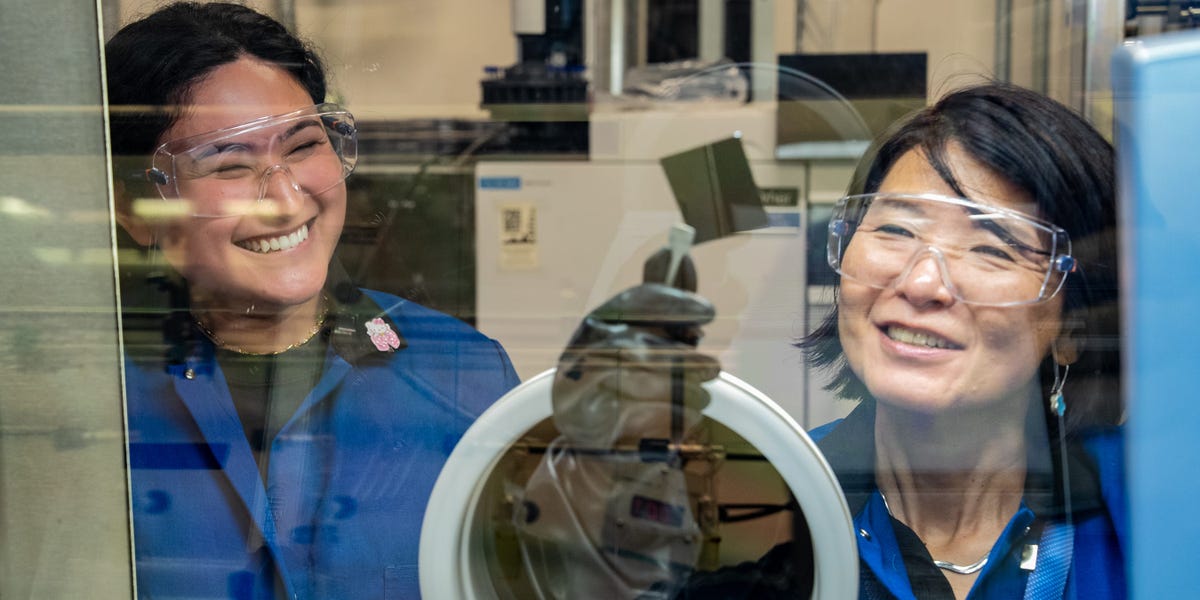
I've worked in the US, Europe, and Korea. The biggest difference is how people approach innovation. This as-told-to essay is based on a conversation with Myung-hee Na, an engineer with more than two decades of experience in the semiconductor industry who leads technology research at Intel Foundry. At Intel, she focuses on developing next-generation technology in semiconductor chips. The conversation has been edited for length and clarity.I've worked in the US, Europe, and Korea, and across all those places, the technology itself was the same. Device physics is device physics, no matter where you are.The culture around that technology, however, can be very different.There is the culture of the country, the company, and the technology sector itself. When those three things come together, they create very different working environments.Today, I lead technology research at Intel Foundry, where my team works years ahead of manufacturing. We explore new materials, test new concepts, and try to determine what future semiconductor technologies should look like before they ever reach production.US culture is prime for innovation Myung-hee Na (on right) is the vice president and general manager of technology research at Intel. Intel Foundry I spent 18 years at IBM in New York and Vermont, followed by two years working in Belgium and three years at SK Hynix in South Korea, before returning to the US.What stands out to me most about the US is how strongly it emphasizes innovation and independent thinking. From what I've seen, the US education system encourages people to develop their own ideas and challenge assumptions: People are often rewarded for thinking differently rather than following a single standard path, and that creates an environment where new ideas can emerge from many directions.That mindset is especially important in my current work. At Intel, our research organization is trying to solve problems that may not affect products for another five to 10 years. We often know what performance improvements we want to achieve, but we don't yet know how to get there.Our day-to-day work involves reading research papers, designing experiments, testing new materials, and evaluating millions of possible combinations. We start with ideas in the lab, narrow them down, and eventually move the most promising candidates into larger-scale testing.What worked before does not always work for the next generation of technology. We have to think differently, invent together, and approach problems from new angles.Korea taught me the value of discipline and execution Myung-hee Na's goal is to develop the semiconductor technologies that will power chips five to 10 years from now. Intel Foundry In many parts of Asia, including Korea, I have seen a different strength. There is often a strong focus on discipline, standardization, and execution.Teams can move with remarkable precision. Once a direction is established, people work together to execute it efficiently and consistently.Those qualities are incredibly valuable in semiconductors, where success depends on thousands of manufacturing steps working exactly as intended.I see that challenge every day. Research is only one part of the process. At Intel, we work closely with manufacturing teams because a promising idea in a laboratory is not enough. It has to be reliable, scalable, and practical enough to become a product.I don't see the approach in the US and Korea as better than another. I see strengths and weaknesses in both, and the semiconductor industry needs both innovation and execution.New ideas only matter if you can turn them into products that work reliably.The best ideas come from people who think differently Intel lead researcher Myung-hee Na (middle) stands next to Business Insider producer Olivia Nemec for an inside look at Intel's cutting-edge semiconductor research. Business Insider One lesson I've learned from working across different regions is that innovation becomes stronger when people with different backgrounds come together.You cannot underestimate diversity. If everyone in a room thinks the same way, you can often predict the outcome of the discussion before it starts.The moments that truly move technology forward are usually the moments when someone says, "I never thought about it that way." Those insights often come from people with different experiences, cultures, and perspectives.That is one of the greatest strengths of US culture. It brings together people with different ideas and different ways of solving problems.I see that every day in research. Some of the most valuable discussions happen when engineers, scientists, and researchers approach the same problem from different perspectives. Those debates often lead to solutions none of us would have found on our own.The industry is moving faster than ever, especially with the rise of AI. Solving future challenges will require new ways of thinking.Innovation doesn't happen because everyone agrees. It happens because people bring different perspectives to the same problem and work together to find an answer. Read next Jessica Orwig is a senior editor at Business Insider, where she collaborates with reporters, editors, and producers across teams to shape, write, edit, and publish stories that connect with a global audience. While her roots are in science and technology journalism, her work today spans business, careers, culture, and the big ideas shaping the future.She earned her Master’s in Science & Technology Journalism from Texas A&M University and holds a Bachelor’s in Astronomy & Physics from The Ohio State University. Throughout her career, she’s helped lead coverage on everything from space exploration and climate change to innovation, the future of work, and evolving cultural trends.Career HighlightsLed coverage on scientific milestones, including:Blue Origin's inaugural New Glenn launchIntuitive Machine's groundbreaking moon landing for the USSpaceX’s Polaris Dawn historic spaceflight NASA’s Parker Solar Probe Historic FlybyJapan’s SLIM lunar landingThe first image of a black holeIndia’s historic Moon landingSpaceX’s inaugural Starship-Super Heavy launchDiscovery of gravitational wavesNASA’s Pluto flybyReported on breaking news and scientific discoveries, including:Microplastics in the human brainPeregrine Mission One’s failed flightThe Palisades firesSpaceX Starship explosionsDark Energy Spectroscopic Instrument’s 3D map of the universe and what it revealsA local cosmic void that shouldn’t existThe Boeing Starliner missionMexico City’s water crisisEarth’s mysterious inner core behaviorPopular stories she’s edited on science and health:What it will take to modernize the American grid and usher in the clean-energy revolutionI study toxic microplastics. Here's how I protect myself and my kids at home.A mega-earthquake could strike the Pacific Northwest any day — and we're not preparedFlying is about to become even more miserableWhy the US can’t send humans to MarsThe world's most popular banana faces extinction but scientists' new creation could help save itScientists finally think they know where the most dangerous part of this US earthquake zone is and it's bad news for WashingtonOne of Mt. Everest's deadliest passages is growing even more treacherousJupiter's moon Europa generates enough oxygen to keep a million people alive for a day, NASA saysPopular stories she’s written and/or edited on careers, culture, life, and business:He weighed over 400 pounds as an FBI undercover agent — and it became his best disguiseA former FBI Special Agent who infiltrated the Italian Mafia, Mexican cartels, and Russian and Asian organized crime groups says he fears 1 group above the restHe was diagnosed with colon cancer at 31 in prison, and his survival odds weren't great. Now 59, he says spiraling is pointless.I stopped bartending full-time to sell ice. My company now makes nearly $3 million a year, catering to Michelin-starred restaurants in New York City.My dad ran a food cart and called it the 'worst business.' I decided to follow in his footsteps anyway.I moved from the US to Rome for a slower pace of life, but after 7 years I've realized I'll never fully adjust to some Italian waysAfter losing too many bidding wars for a home in LA, I bought a 5-bedroom house in the suburbs. I quickly realized it was a mistake.We bought our dream home in Colorado, but wildfires and home insurance trends had us selling 1.5 years laterA woman who retired early at 58 thought she was ready with over $500,000 in savings. A few years later, it was gone.I've made over $40,000 selling plush dolls I scoop from claw machines. Here's how I learned to beat the game and turn my hobby into a profitable side hustle.A 17-year-old designed a cheaper, more efficient drone. The Department of Defense just awarded him $23,000 for it.Yukon gold miners are unearthing mummified ancient creatures and truckloads of fossils from the Ice Age. Take a look.Archaeologists are finding mysterious ancient objects on Norway's melting glaciers. Take a look.I'm an American mom in Italy. When I couldn't help my daughter with her homework, I realized how isolated I felt. Olivia Nemec is a senior producer on the News & Documentary team at Business Insider.She joined the company in June 2021 after spending time anchoring and producing the evening news at an NBC affiliate in Nebraska. She graduated from Columbia University in 2020 with a master's degree in journalism and a focus on covering politics. Entrepreneurship Tech Innovation More
I've worked in the US, Europe, and Korea. The biggest difference is how people approach innovation.
Full Article
Original Source
Read the full article at Businessinsider →KhanList aggregates and links to publicly available news content. We do not host full articles from third-party sources. Always verify important information with original sources.