
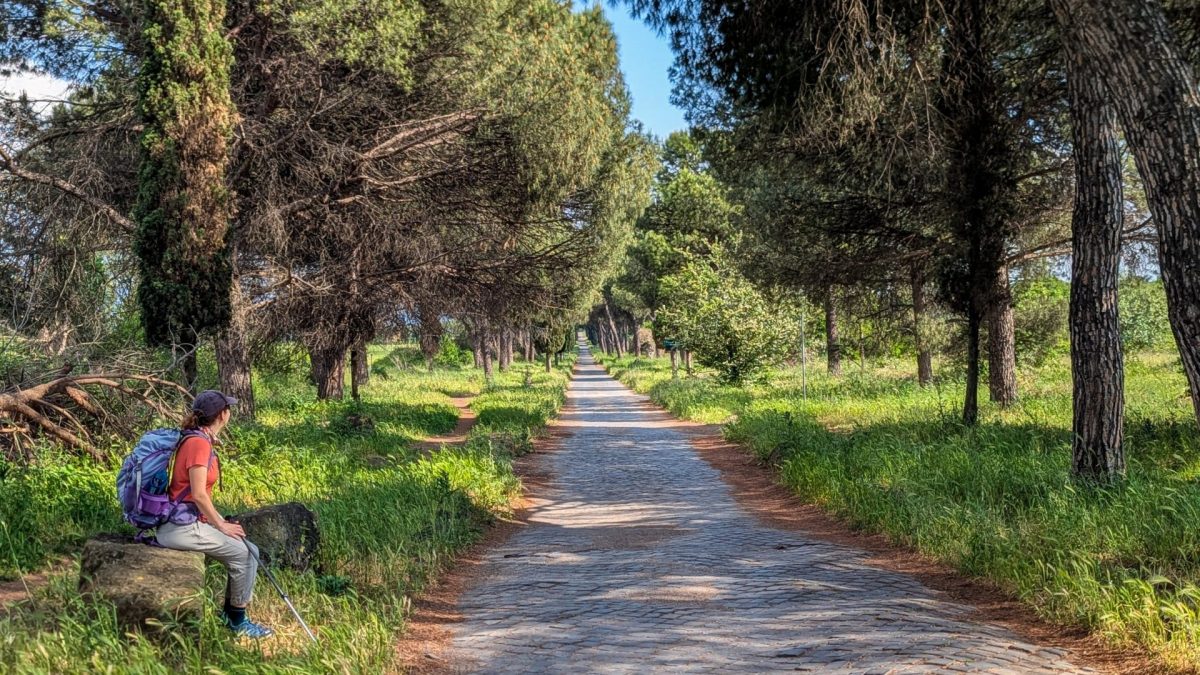
All roads lead to Rome, they say. That certainly felt true when I last stood here, on the steps of St Peter’s Basilica, having hiked all the way from Canterbury. But this time I’ll be walking away from the Italian capital. Having followed 2,000km of the Via Francigena – a quieter cousin of Spain’s Camino de Santiago – two years ago, I’ve returned with my wife, Jess, to experience 200km of the Via Francigena nel Sud (VFS). This official extension to the pilgrimage leads south from Rome to the heel of Italy, finishing at the Basilica Santuario di Santa Maria de Finibus Terrae in Santa Maria di Leuca, Puglia, the traditional “end of land” for pilgrims heading east. “The horizon, not the tomb” is how Giuseppe Pucci compares the VFS to Spain’s enormously popular Camino – suggesting pilgrims are drawn onward by the landscape, not the single shrine destination. I presume, as vice chair of the Gruppo dei Dodici (“group of 12”), the volunteer organisation promoting the route, he would want to emulate its success. “No,” he insists. He tells us to expect warmer encounters with locals and places less shaped by tourism into standardised “stage sets”. Shorts Intrigued, we set off on a 10-day journey along the first section, through Lazio. Against the grain, we slip out past the Roman Forum and Colosseum, smudging our fingers over centuries-old pilgrim graffiti at the Porta San Sebastiano. The city – and the tourist tide – loosens. Soon we amble beneath Roman pines, pass crumbling mausoleums, our feet tracing chariot grooves worn deep into the paving stones. Navigating the site of Jesus’ fabled encounter with St Peter, marked by the Church of Domine Quo Vadis, just beyond the old Roman city walls, we find the catacombs of some of the earliest Christians and popes. We sense deep-time in the slow descent from road to path, mire to meadow. We’re on the 2,000-year-old Via Appia Antica, the “Queen of Roads”, once the great southern artery of the Roman Empire. Pilgrims passed this way centuries before Santiago de Compostela on their way to the Holy Land. One was the anonymous “Bordeaux Pilgrim”, whose journey in AD 333-334 inspired the revival of the VFS in 2019 by the European Association of the Via Francigena Ways. Leaving the crowds of Rome behind (Photo: Ben Eley) The scenes feel drawn from Homeric myth. The town of Castel Gandolfo clings to the forested rim of an extinct volcano, its bowl filled with the glistening Lake Albano. Here, opposite Pope Leo XIV’s palatial summer retreat, we sit down for a cappuccino and cornetto al cioccolato – a chocolate-filled pastry – with local Fabio Casentini. “Lazio has a big problem: Roma,” he tells us. We are a stone’s throw from crowded Rome, but visitors tend to overlook the less prosperous wider region, which misses out on vital tourist income, he laments. As we walk on, forest trails frame volcanic lakes scented with pine and wild fennel, and we pause in pastel-coloured Nemi for wild strawberries and cream, sharing terraces with modern Romans escaping the heat. Beyond the Alban Hills, the land opens out: the Lepini Mountains, the vast Pontine Plain and, in the distance, Mount Circeo – the mythical lair of Circe, Odysseus’ enchantress. The town of Gaeta on the coast of Lazio, where Ben and Jess’s journey ended (Photo: Ben Eley) The towns of Cori and Sermoneta feel like vestiges of medieval pilgrimage. Threaded through hillsides of vines, olives, kiwi and apricot trees, they display what locals call stratificazione – layers of the archaic, Roman, Renaissance and modern, like a delectable lasagne of history. In Cori, Lucia Millone – part of the Gruppo dei Dodici – spots us arriving with our backpacks a mile off. We meet her for an auburn sunset at the temple of Hercules, where she gathers the few other pilgrims passing through – a handful of Belgians celebrating a 50th birthday – for a supper of pinsa (a local style of pizza), cold meats and cheeses at her favourite trattoria. “Ten years ago, I met pilgrims twice a year,” she tells me. They come more frequently now, with Lucia hosting when she can, and she’s hoping the route can help revive left-behind Lazio. “In little Cori, meeting people from all over the world is an infinite resource,” she says. A VFS mural near Terracina (Photo: Ben Eley) Her passion for the VFS is uplifting, carrying our tired legs through the mindful rhythm of the hills four days in, which gradually quietens everything else and draws us closer. We hit the coast at Terracina, overlooked by its Temple of Apollo, with traces of the Via Appia running through the old forum, and join the locals in passeggiata – an evening stroll along the seaside promenade. Unlike the Camino’s vast albergue network, accommodation here is simpler: affordable homestays with shared kitchens. Yet, dangling my undies from a perilously placed clothesline above the bustle of the old town feels strangely immersive in a way I’ve never experienced on the Camino. In the solitude of myrtle forest and limestone shelves overlooking Lago di Fondi, the silence is broken only by a solitary “Buon Cammino” from a local farmer. It lands with an authenticity that’s sometimes diluted on the crowded Spanish trails. During our final stages, the mountains close in as we trace remains of Roman, Renaissance and Napoleonic roads, passing sanctuaries of the classical gods and the fortress of Itri guarding the penultimate mountain pass. From here, we reach a coastal crescendo at Gaeta, where we’re joined by veteran Canadian pilgrims Dan and Lea (aged 70 and 69, respectively), who have now walked 10 Caminos de Santiago. Dan and Lea approaching Abbazia di Fossanova (Photo: Ben Eley) “The massification of the Camino is pushing people to look for alternatives”, reflects Lea. As an introvert, she appreciates the lack of crowds on the VFS – even if she misses the sense of community – and believes its history and culture set it apart. The descent into Gaeta is dramatic. Karst scree cascades into the Bay of Formia and the old maritime citadel stands sentinel over the Tyrrhenian Sea. On the boardwalk, we help ourselves to a tiella – a fisherman’s pastry of tomato, olive oil and octopus – as the light dies over the old town. Reflecting on our journey, part of me hopes the Via Francigena nel Sud remains just rough enough around the edges. Better infrastructure would help the route grow, but it’s the solitude and authenticity that make it special. Where to stay Aura Medieval House in Sermoneta is a typical homestay along the route; shared and private rooms with communal kitchen and living space; private rooms from £85. In Gaeta, Altavilla has private doubles with a view from £94. More information Gruppo dei Dodici offers assistance and accommodation bookings along the VFS in Lazio. UK-based Pilgrims to Rome offers planning assistance and “pilgrim passport” stamp books. “Testimonium” certificates are available at Monte Sant’Angelo, Brindisi, Santa Maria di Leuca and Rome for those who have walked a minimum of 100km. Ciccerone’s Walking the Via Francigena Pilgrim Route – Part 4 (2025) is the first dedicated English-language guide to the VFS.
I’ve walked the Camino – a quiet alternative near Rome was a revelation
Full Article
Original Source
Read the full article at Inews →KhanList aggregates and links to publicly available news content. We do not host full articles from third-party sources. Always verify important information with original sources.