
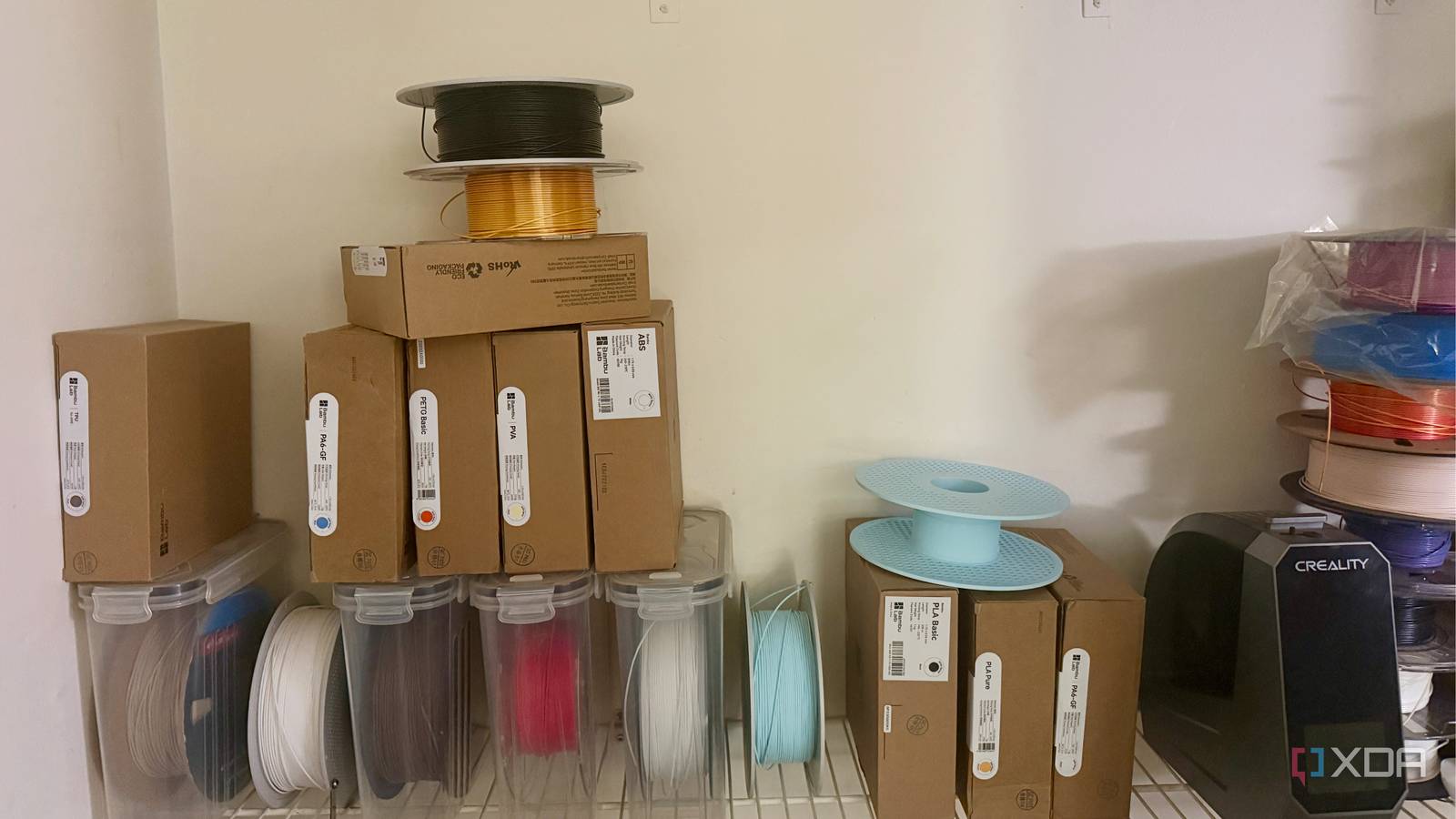
Published Aug 27, 2026, 11:00 AM EDT Jeff's been involved in the IT industry since before the Internet and spent more than 20 years working in technical support, system administration, network administration, and consulting roles. He holds an undergraduate degree in English, a Master's degree in English with a focus on professional writing and editing, and another Master's degree in Computing & Information Systems. After teaching university English and computer science for a few years, Jeff launched his writing career. He's written for Macworld, Tom's Hardware, groovyPost, The Mac Observer, and more before beginning here at XDA. PETG is still the filament I reach for first when I need a printed part that actually does something. It’s tougher than PLA, handles more heat, and usually doesn’t make me rethink the entire print just because I changed materials. That covers a lot of brackets, holders, replacement parts, organizers, and other functional pieces around the house. But “default” has gradually stopped meaning “use it for everything,” because there are a few jobs where PETG is clearly the wrong choice once I look at what the part actually needs to do. Flexible parts are where PETG stops making sense TPU handles movement without forcing rigid parts to compromise PETG has a little give, but that’s not the same as useful flexibility. If I need something to bend repeatedly, compress around another object, or provide grip instead of simply staying rigid, I start looking at TPU. I’ve found that trying to make PETG behave that way usually pushes me toward awkward design changes that exist only to work around the material. At some point, it’s easier to admit the filament is the problem. Using TPU, PA6-GF, and PCTG has made it clearer why PETG works so well for most of what I print. TPU made a lot more sense to me once I stopped looking for things specifically labeled “TPU projects.” The better approach was to notice where rigid plastic was just slightly annoying. Feet, bumpers, grips, protective pieces, and parts that need to stretch around something all fall into that category. PETG might technically work for some of them, but “technically works” and “behaves the way I want” aren’t the same thing. That doesn’t mean I enjoy using TPU for everything that could flex. It can be fussier to feed, especially when the filament path gets complicated, and its softness changes how I think about the part before I even slice it. I’m not swapping materials for a simple bracket just because TPU exists. But if movement is part of the job description, I’d rather use a material that naturally does it than keep trying to make PETG pretend to do it. Heat and load can push me toward nylon PA6-GF earns the trouble when stiffness really matters most There are also prints where PETG starts to feel a little too middle-of-the-road. If I’m dealing with more heat, heavier loads, or a part where stiffness matters more than convenience, PA6-GF becomes much more interesting. The glass-fiber reinforcement gives it a much more serious mechanical focus than the general-purpose toughness I get from PETG. That’s exactly why I keep it in mind for parts where failure would be more than a minor annoyance. I’ve used light blue and white PA6-GF, and I definitely don’t treat either as an everyday filament. It requires more preparation; moisture matters more, and the abrasive reinforcement means I have to think about the hardware the filament passes through. None of that is especially appealing when I’m printing something simple. For a cable holder or small organizer, the extra work would be ridiculous. That’s also why I don’t think of PA6-GF as an upgrade from PETG in the normal sense. It’s better at some things, but those things have to matter for the actual print. If a part is going to live indoors and hold very little weight, I’m not gaining much by turning the whole job into a more demanding material exercise. Once heat, stiffness, or sustained mechanical stress becomes a real concern, though, the extra effort stops feeling unnecessary. PCTG is my choice when PETG feels limiting It keeps familiar handling while improving the finished part PCTG falls into a much less dramatic category for me. When I tried it, I was surprised by how easy it was to print and by the finish I got. It didn’t feel like I had jumped into an entirely different kind of filament with a completely new set of rules. Instead, it felt closer to PETG territory, which is exactly why I found it useful. That makes the decision less obvious than with TPU or PA6-GF. Those two usually make their case: the job calls for flexibility, greater heat resistance, or greater rigidity. PCTG overlaps with PETG much more closely, so I usually consider it when PETG would probably be fine but I want something slightly different in the finished part. That’s a much narrower distinction, but it still matters once I’ve seen what both can do. I haven’t reached the point where I automatically choose PCTG whenever I’m printing something functional. PETG is familiar, easy to find, and predictable enough that I don’t have to think much before using it. PCTG has to earn the switch on a particular project rather than being picked just because it’s sitting there. But after using it, I no longer assume PETG is automatically the final answer whenever I need a durable part. PETG already covers most functional printing surprisingly well Its broad usefulness makes specialty filaments harder to justify There’s a pretty strong argument for ignoring all of this and just printing most functional parts in PETG. For normal household use, its compromises are easy to live with. It’s strong enough for plenty of jobs, handles heat better than PLA, and doesn’t require the same level of preparation as some engineering materials. If I had to narrow my practical filament shelf to one choice, PETG would still win. What I notice more now is how much extra mental overhead there is in keeping so many specialized materials around. Different filament types can mean different temperatures, drying needs, cooling behavior, hardware considerations, and slicer adjustments. None of those things are impossible, but they all add friction to a print that might have been perfectly fine in PETG. For brackets, organizers, holders, and replacement bits, that extra work can be hard to justify very quickly. It’s also easy to get carried away with material selection. There’s always another formulation promising more strength, more heat resistance, more flexibility, a nicer finish, or some combination of those things. I’ve gotten better at asking whether the part actually needs any of that before I start changing materials. A plain spool of PETG that produces a reliable part is often the smarter choice, even if it’s not the most interesting one. Default filament does not have to mean only filament The right material solves problems before design changes begin I still keep those alternatives around because the right material can spare me the need to design around the wrong one. If I need flexibility, TPU is a better starting point than trying to fake it with thin PETG sections. If heat or stiffness is the real concern, PA6-GF offers properties PETG doesn’t. And if PETG is close but I want a different balance of performance and finish, PCTG gives me another option without completely changing how I approach the print. That shift has changed how I think about functional prints in general. I used to put more weight on whether I could get a part to print successfully, which is understandable because failed prints are hard to ignore. But getting a clean print is only part of the job. The more useful question is whether the finished part behaves properly once I put it to work. Thinking that way also stops me from overcomplicating projects that don’t deserve it. PETG stays the default until the requirements give me a reason to move away from it. I’m not pulling out PA6-GF because it sounds more capable on paper, and I’m not choosing TPU because a model happens to have a curve. The alternate material needs to solve a problem I can point to. Don’t choose a filament because it’s stronger on a spec sheet. Start with what the finished part actually needs to do. PETG is usually the easiest answer for general-purpose functional prints, while TPU, PA6-GF, and PCTG make more sense when flexibility, stiffness, heat resistance, or a different finish actually matter. PETG stays loaded because it still earns that spot PETG hasn’t lost its place as my default functional filament. If anything, spending more time with TPU, PA6-GF, and PCTG has made it clearer why PETG works so well for most of what I print. It strikes a useful middle ground in toughness, heat resistance, printability, and convenience. Most days, that’s exactly what I need. The difference now is that I don’t expect one filament to cover every functional print just because it covers most of them. TPU gets the jobs that need movement, PA6-GF gets the more demanding mechanical and thermal work, and PCTG gives me another option when PETG is close but not quite what I want. PETG is still the spool I start with. I’m much more willing to put it back on the shelf when the part gives me a good reason. Bambu Lab X2D Build Volume 256 x 256 x 256 mm Printing Speed 1000 mm/s Materials Used PLA, PETG, ABS, ASA, TPU, Support for PLA, Support for PLA/PETG, Support for ABS, Support for PA/PET, PET, PA, PC, PVA; Carbon/Glass Fiber Reinforced PLA, PETG, ABS, ASA, PA6, PAHT, PPA, PET Brand Bambu Lab Extruder Quantity 2 Extruder Direct Drive (Primary), Bowden (Auxiliary) Bambu Lab's X2D can print with PETG, sure, but it can also print with a number of other materials that might be better suited to the job.
I've tried every functional filament, but PETG is still my first choice for a reason
Full Article
Original Source
Read the full article at Xda-developers →KhanList aggregates and links to publicly available news content. We do not host full articles from third-party sources. Always verify important information with original sources.