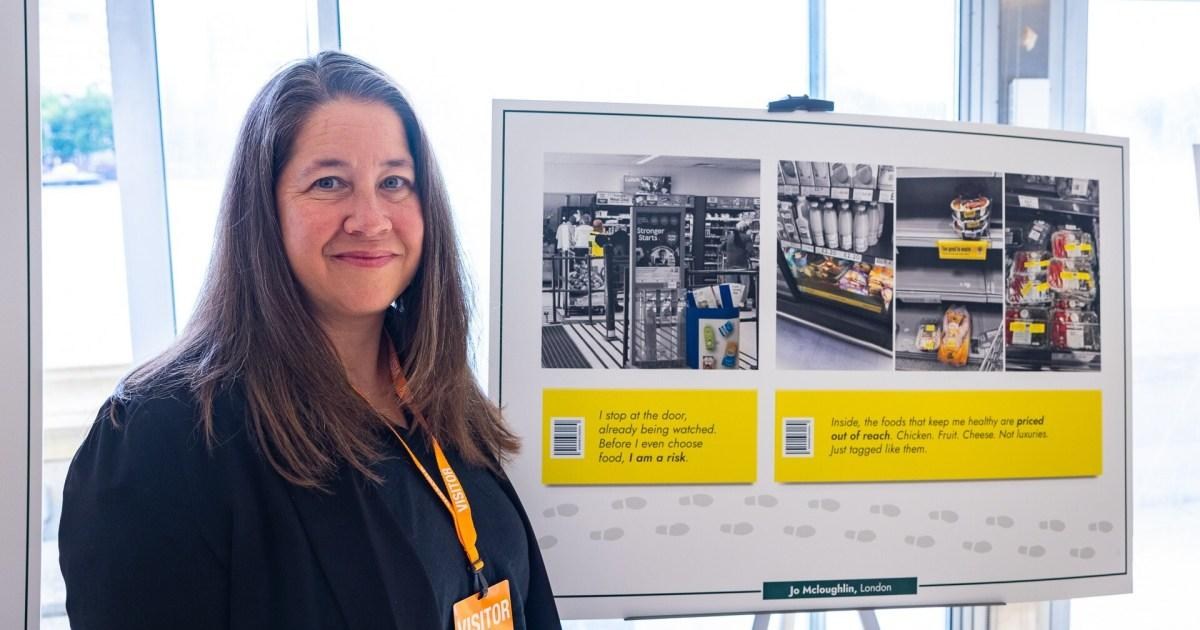
Yellow sticker foods give Jo a way to stay eating healthily (Picture: The Food Foundation) The cost of living crisis can be felt in every aspect of life – from the soaring price of concert tickets to prices at the till of your local supermarket. But one woman has found a clever way to keep her food budget low. ‘I have a £40 weekly budget for my food. I go to various supermarkets along my high street and I look for those yellow stickers – they’re a lifeline,’Jo McLoughlin tells Metro. Jo, also known as Yellow Sticker Girl, grew up in Cornwall but moved to London seven years ago. There, she noticed supermarket prices were much higher than those back home – and they have only increased since. Sign up for all of the latest stories Start your day informed with Metro's News Updates newsletter or get Breaking News alerts the moment it happens. Not wanting to sacrifice her health, Jo started scouring the reduced section for fresh produce. Soon, she was turning to yellow stickers for everything. This is the first photo in Jo’s visual poem (Picture: Jo McLoughlin) ‘With the cost of living and the massive upping of food prices, buying yellow sticker foods is a necessity to ensure that I get healthy, nutritional food into my diet,’ Jo says. To stick to her strict weekly budget, Jo sets aside a ‘pot’ each month and only uses a specific card when buying food. The bargain-hunter, who shops only for herself, said she is ‘constantly planning’ around whatever deals she can get her hands on. ‘If a product which is normally high value, for example chicken, is on a remarkably reduced offer, I might buy a few packets, separate them and freeze them, helping me for the week after,’ she says. ‘Some weeks I do a bulk buy, which can last me over a week and a half. Other times I’ll go to the shops every day of the week to see how I can create healthy meals. ‘I’m always really pleased to see a yellow sticker on soft fruit – raspberries and strawberries are especially rare.’ She wanted to show how the rest of the supermarket is void of hope through the lack of colour, except for the foods with yellow stickers (Picture: Jo McLoughlin) Going from supermarket to supermarket, including M&S and Waitrose, has enabled Jo to keep her shopping bill down. But more recently, her bargain-hunting has gone digital. She says: ‘Through [the app] Too Good to Go, I got a delivery of yellow sticker foods. It had a purchase price of £6.66, and upon getting it home I tallied up the original prices. I had saved around £30. ‘There were groceries I could freeze and make juices from, and plenty I could batch cook. ‘I can use yellow sticker foods pretty much straight away. It’s within my affordable budget, and also it makes me feel good that I’m buying food that would otherwise go to waste.’ Jo became a member of The Food Foundation’s Ambassador Programme in April 2025 and has been campaigning for food equality since. She even took a photo poem about her experience to Parliament last month, and displayed it to MPs. Jo says it was a chance to show policymakers what so many peoples’ lived epxerience is (Picture: The Food Foundation) She is clear that the issue is much broader than her own dependence on yellow stickers to maintain a healthy diet – and says people shouldn’t have to depend on discounts to access the food they need. ‘The lowest fifth percentile of earners have to spend 85% of their disposable income on their food shopping to be able to afford healthy products,’ she explains, referencing The Food Foundation’s Broken Plate Report, released this year. This figure is up from 70% in 2024, showing that a healthy lifestyle is growing less achievable for the poorest families. ‘There’s a lot of blame on lower-income individuals for buying less healthy or sugary foods, but that’s shockingly the only food group that has got cheaper in the past year.’ In fact, the report shows that healthier foods are nearly twice as expensive per calorie than foods that are high in sugar, fat and salt. Fast food outlets make up a quarter of places to buy food in England, increasing to a third in the country’s most deprived areas. The lowest fifth percentile of earners have to spend 85% of disposable income on food shopping, a new report finds (Picture: Jo McLoughlin) Despite the positive impact yellow stickers have had on her life, Jo hopes that one day people won’t need them. ‘My poem highlights to governments that yellow stickers are a visual representation of what’s happening,’ she says. ‘Why are these healthy food products having to be reduced at the end of the day for people to be able to buy them, when actually they could have been better priced, and then we wouldn’t be in this situation?’ As things stand, however, Jo encourages everyone to look in the yellow sticker bays at their local supermarket. ‘Check the end gondolas weekly for specific rotations of healthy food. Pre-plan and take shopping lists before you go and use methods like freezing and bulk cooking to make healthy food stretch. ‘And importantly, don’t be ashamed to buy yellow sticker products. There’s so much healthy food waiting to be bought.’ Arrow MORE: Schools warned about unknown dangers of learning devices taking over classrooms Arrow MORE: Highly contagious virus not seen in the UK for decades kills 35 ponies in the New Forest Arrow MORE: This is what sleeping with a fan on all night does to your body News Updates Stay on top of the headlines with daily email updates.
‘I’ve lived off yellow sticker deals for five years – it shouldn’t be this way’
Full Article
Original Source
Read the full article at Metro →KhanList aggregates and links to publicly available news content. We do not host full articles from third-party sources. Always verify important information with original sources.