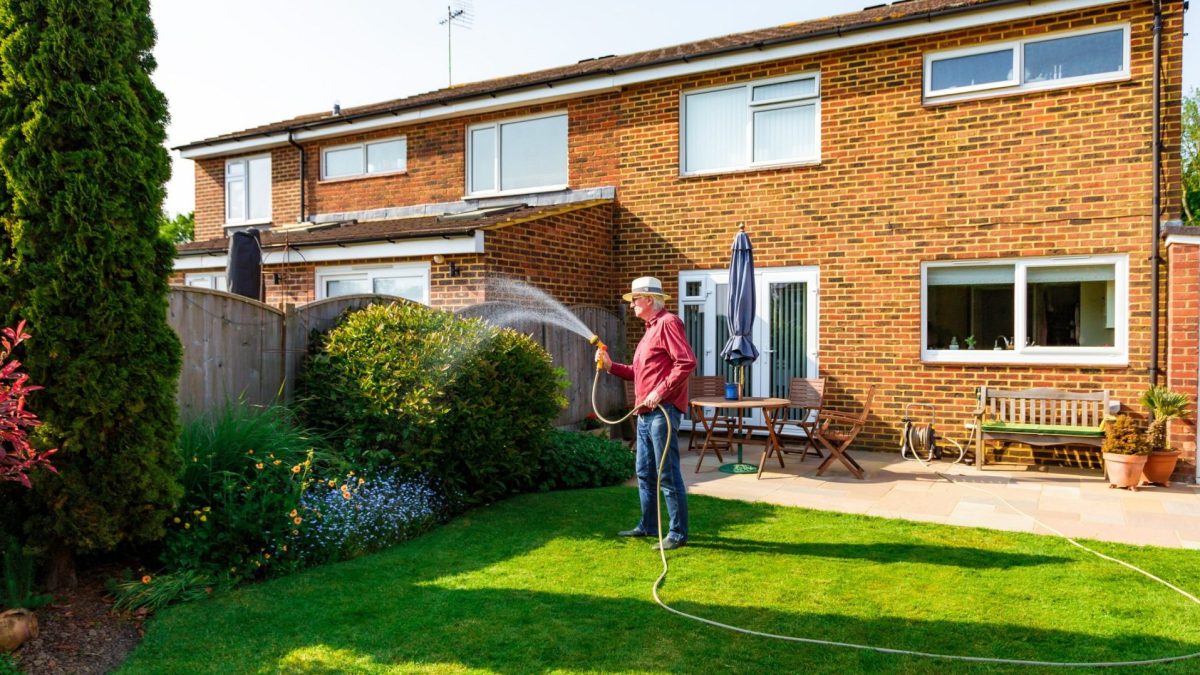
Sarah in Uxbridge, West London was watering her garden in the last week of July, when her neighbour popped her head over the garden fence and asked to see proof that she was exempt from the hosepipe ban. “I was using my hose,” she says, “but I genuinely hadn’t realised it had come into force in our area, as this was the first or second day. “I’m embarrassed that I didn’t know – I’m not sure how I missed it – and I’ve stopped using it since. I know it’s the right thing to do. But I was also quite shocked that she asked me for proof, and then was really stern with me. She could have just let me know, in a normal way? We’ve not lived here long and I sensed she was a busy body – now I know for sure. She’ll probably turn the whole road against me!” Hosepipe bans have long caused tongues to wag, and curtains to twitch, as they stoke division across Britain. Yet this year, with widespread public anger at the behaviour of water companies, neighbourly tension in some areas has reached boiling point. In a leafy village in East Anglia, Jaz, 38, says that his neighbour announced to the road WhatsApp group that if she saw anyone flouting the ban, she’d be “straight onto the police”. Jaz has a beautiful garden which is “almost as important to my wife as our kids are”, he jokes, but he won’t be flouting the ban, so is safe from his neighbour’s wrath. “Our plants aren’t doing well, but our garden isn’t more important than everyone’s wellbeing. I also get that we do need to do a bit of social shaming for people to do the right thing, and neighbours can do that… but calling the police seems insane. Aren’t the police famously quite busy with other things?” Shorts Jaz’s sharp-eyed informant next door isn’t the only one threatening to dial 999. Thames Water have, in fact, had to officially urge people not to ring the emergency services if they spot someone with a hosepipe. “Breaking a hosepipe ban is not a police matter and you should not call the police,” they have reminded the nation. Instead, repeat offenders could face a potential £1,000 fine from the water providers, although it is not currently known whether anyone has ever actually been fined. Yorkshire Water told the BBC, however, that it has had at least 100 reports of people who have kept using hosepipes since the ban came into effect for more than five million households on 11 July. Thames Water has said explicitly that people do not need to report their neighbours at all, because the company can track and enforce the ban on its own. Jane*, in Surrey, says her neighbour is not exempt but uses his oscillating sprinkler for four hours “every single day.” She says she’s not reporting him, though, because she knows for certain that his other neighbour already has. After the driest start to the year since 1976, with drought declared in half of England and record low rainfall, eight water companies across England and Wales have implemented temporary hosepipe bans. Some report that demand for water has increased by a third in the hot weather, and state that the measures are necessary to ensure adequate drinking water. Yet, not everyone believes in the ban. And some are actively sticking two fingers up to it. “The water companies are literally pumping sh*it into our rivers and seas constantly and taking no responsibility for it,” says Carla, 63, from Barking, Essex. “They take months to fix leaks in the pipes down our road, which wastes a lot of water, and meanwhile the boss of Thames Water gets £1m salary, and the other bosses get a fortune too. And then I’m meant to listen to what they tell me to do?” Carla is not hiding her hosepipe use. “I couldn’t care less what those bastards say. And nobody is going to be fining me, are they? My husband has hosed down our car in the front drive this morning, and earlier in the week I watered the front garden with a hose, too. I’ve also filled up two paddling pools for our grandkids today, and I’ll be doing it again. Water companies are incompetent and greedy, and ordinary people like us are left to sort it out. The whole ban is an absolute joke.” The feeling from other Britons across the country is that two things can be true at once; it is possible to be furious with water companies about persistent sewage in rivers, and their wasting of water, at the same time as wanting to adhere to the ban for the sake of our communities. While a ban in and of itself won’t save the day, the facts are that nearly half of England’s reservoirs are at lower than normal water levels following four consecutive heatwaves. There are some exemptions such as gardens or private allotments where food crops are being grown and “a watering can isn’t a practical option”, and where the welfare of livestock is at stake. But there are also some more divisive carve-outs such as cleaning a private boat if needed for health and safety purposes, or to “clean a leisure boat which has an enclosed space”. Water companies allow exemptions for newly-built private swimming pools if the water is used while it is being constructed, and hosepipes can be used for watering sports pitches. Some schools in London, including St Paul’s School and Dulwich College, have used this loophole to keep their playing fields watered despite both schools being currently closed for the summer holidays. In an online forum discussing the ban, a resident living near a reservoir in North Derbyshire says: “If all of you had seen the reservoir today you might judge water wasters more harshly. We are currently keeping a washing up bowl in the sink to tip water on the garden, and using water from our water butts to water the tomatoes.” One respondent says: “I’m not cutting back on my water, we pay enough for it, I’m carrying on as normal.” Lorraine, 68, in Haringay, North London, says she’s sticking to it, even though her husband has a blue badge. “My husband’s disability means he’s exempt from the ban, but a ban doesn’t affect him adversely, so we’re using watering cans for our garden instead. Why? Because we aren’t selfish, entitled tw*ts. It’s exactly the people ignoring the ban who will be the ones panicking the most when the drinking water runs out.” Hose pipe bans have hit a nerve, but they go back further than we might think. Although they were only explicitly mentioned in law in the 1945 Water Act, during the drought of 1895 in East London, hosepipes and sprinklers were banned and water was supplied intermittently to people’s homes. According to The Garden Museum’s archives, the first formal “hosepipe ban” was implemented in London in 1929, and other cities including Leicester and Liverpool also brought in similar restrictions. Trade body Water UK has said it is not aware of anyone having ever been fined for using a hosepipe, though it did not hold data. Yet, this could be the year that this changes. More than one in 10 householders who are currently living with a hosepipe ban do not intend to abide by it, according to a survey, which showed that 11 per cent of households said they did not intend to fully abide – while five per cent said they did not yet know, the YouGov poll of more than 4,200 adults commissioned by the Press Association found. It seems as though people’s likelihood to report each other, to some extent depends on how much they like their neighbours. One respondent said they’d be more likely to report their neighbour on “the side I don’t like” for flouting the ban, whereas if it was the “nice, helpful” neighbour, then she’d leave them to their hoses and sprinklers. Alan, 73, in Bedfordshire, says; “I’d probably have a word with someone if they were using their hoses for hours, because I wouldn’t want to go back to the summer of 1976, when I had to queue to fill buckets of water at a stand pipe a couple of streets away. That’s the sort of thing people forget, when they take water for granted. It’s not an endless resource.”
‘I’ve filled two paddling pools today’: The neighbours at war over hosepipe bans
Full Article
Original Source
Read the full article at Inews →KhanList aggregates and links to publicly available news content. We do not host full articles from third-party sources. Always verify important information with original sources.