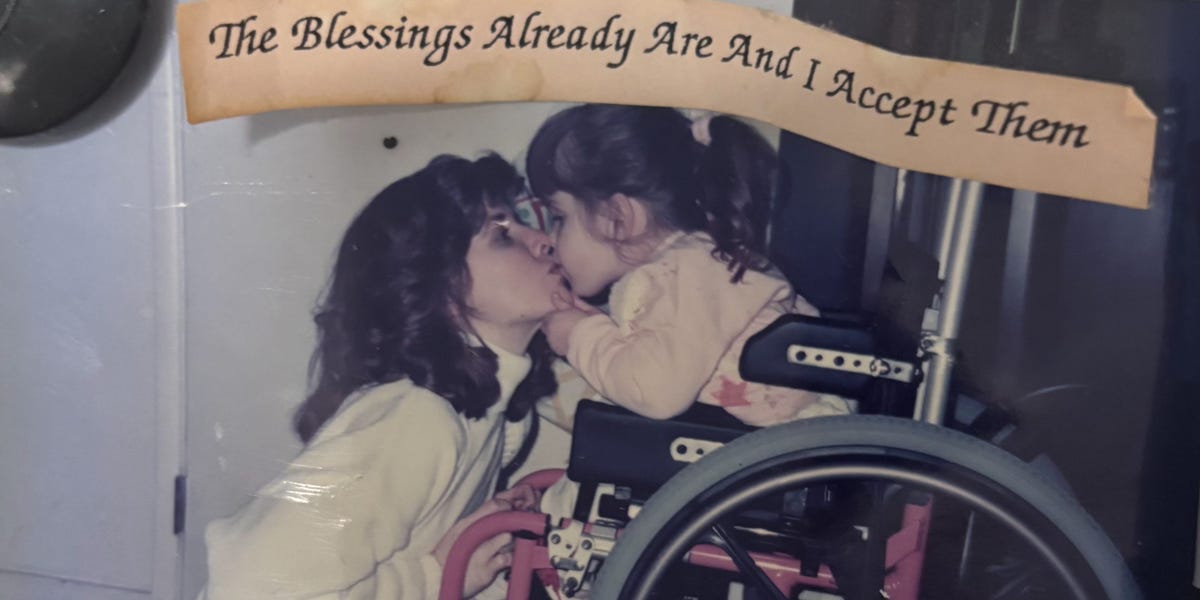
I've cared for my daughter for 39 years. Retirement wasn't the break I imagined. Tama Phelps has cared for her daughter with spina bifida for almost 40 years. Tama Phelps This as-told-to essay is based on a conversation with Tama Phelps, 64, who lives in Ann Arbor, Michigan, and has cared for her adult daughter with physical disabilities since she was born 39 years ago. Phelps retired early to care for her full-time but said doing so has been a financial hit. This interview has been edited for length and clarity.I was raised in Ann Arbor by two fabulous parents. I married my high school sweetheart. I worked for the University of Michigan. I was 25 when my daughter was born with spina bifida. She just turned 39. I have a son who is 33, and he's able-bodied and married on his own.I had to maintain my daughter's insurance eligibility by keeping a job at the University of Michigan. I worked as an equipment manager at a recreational sports facility. As long as I was able to show that she had a disability, I was still able to cover her under my insurance. When she turned 18, I made sure she signed up for government aid. She is a college graduate with a psychology and communications degreeMy husband and I worked split shifts so someone could be with her at all times. For about 15 years, I worked five days a week, four hours a day. My husband works as a manager for a company sharpening blades for print services and hockey arenas. My daughter is now bedridden and has breathing issues.My daughter had been having issues with headaches. She's also shunted because she was hydrocephalic, which comes with spina bifida. She ended up having two vertebrae removed from the back of her neck. Since then, she has had no speech, hearing, or vision. She is a wheelchair user. She also had to have a new bladder reconstructed due to cancer, and she has severe tremors.She had a G-tube put in that goes into her stomach. She is extremely unhappy now. The only way we can communicate is via text, and she has a hard time seeing her phone. Her quality of life is zero.She still has a sense of pride, and her mind is totally fine. However, she's in a body that does not function. It sucks to be in that position, and that's one of the reasons I keep trying to help her. I take care of my dad, too.My mom died about 16 years ago from a glioblastoma. It took a hit on my dad's financials. He realized the need for getting insurance for hospice or palliative care, so he's picked up that cost for himself, looking forward. He dealt with some heart issues and had a TAVR procedure done. He fell and broke a cheekbone a few years ago. Otherwise, he's been healthy.He's 89, and I've been taking care of him. I'm his only daughter, and he pays for his own care. He fell and broke a hip back in December, but he lives less than five miles away. He walks with a cane and has two bad knees, but he still drives, and his mind is good. I spend time with him while my husband cares for our daughter, but when he goes to work, I come back here. I go back and forth, and it feels like a tidal wave.I've also started the legal procedure to get a divorce filed, though I put that on hold. My husband would have gotten the house, and I would have needed to get another place within the city because there would have been transportation issues getting her to and from the hospital.I ended up working for the university for 40 years before retiring at 60 to care for my daughter full time. My insurance covers her over $1,000 monthly cost for her catheterization. I would guess, though, that I've paid hundreds of thousands of dollars caring for her due to her therapies and a new wheelchair, which cost as much as a car. Tama Phelps raised her son and daughter while working for the University of Michigan. Tama Phelps I talked to her social worker, who said that if we were able to find a facility that would take her, they would take the money that she gets from the state and put it toward her cost of living.However, we'd have to pay out of pocket for the rest, and she was quick to tell us that we would get what we paid for. I don't have that kind of money. $7,000 a month is not something I can afford, especially for a place that won't address her needs.My daughter does not want to go into a facility.I know the responsibility will continue to fall on us, but you do what you have to for your kids. However, it's getting to the point where I can't physically lift her anymore. She weighs more than I do, so it's going to come down to us eventually not being able to provide care.My family, who all live nearby, tries to keep pushing me to put her in a home, but they don't have as much of an idea about the cost or psychological issues it involves. My daughter has alienated most of her family because she doesn't want them to see who she's become.I'm mentally overwhelmed.I only stay home and take care of her. I have no life. I've been a gym rat since I was 18, but I haven't been to the gym in over two years. My social circle is very small. My husband still plays golf and keeps up his life. He does take care of some things for her, but I'm her primary caregiver. I can't be bitter about anything because it's just a matter of fact.I'm very fortunate that my brother is a financial advisor, so he's helped me through the years. He makes suggestions and moves my money around to make sure I have enough. I'm sitting on a pretty nice nest egg. I have not signed up for Social Security yet because I'm not 65 yet. I also have a full pension from the university. Whatever my daughter needs, I pay for it.I want my life back. I did not retire in order to take care of people, but you man up and take care of what needs to be taken care of. People don't realize it's not just baby boomers who require care. I wish there were some kind of facility that would help families get a reprieve. I'd be a much better parent if I could come home at night knowing she's cared for toward the end of her life. Read next Noah Sheidlower is a senior economy reporter with Business Insider. He covers retirement, aging, age tech, and employment trends.Noah reported a monthslong, award-winning series called 80 Over 80 about what working at 80 and older looks like. The 300-interview series includes over a dozen features and chronicles the lives of people like an 81-year-old Home Depot worker battling heart failure, a 93-year-old woman searching for a job, and an 85-year-old bus driver who died at work.In 2024, Noah led a 17-story retirement series on the regrets older Americans have about their lives. He has also reported on how Americans have navigated unemployment, what compels Americans to move, and how mass deportations could impact the economy. He has appeared on SiriusXM Business Radio, Vox, and CBS News to discuss his reporting.Noah received his Bachelor's in Sociology and English from Columbia University. Noah has covered the restaurant industry, transportation, retail, and markets for CNBC, NBC News, CNN, and The Atlanta Journal-Constitution.Contact: nsheidlower@businessinsider.com or 516-304-1352.Awards:National Headliner Award, New York Press Club Award, Excellence in Financial Journalism Award, Deadline Club AwardPopular articles:Some of America's oldest workers hold jobs while battling major health issues81 and working to surviveThey died 'doing what they loved': The stories of workers in their 80s who died on the jobThey're in their 80s, still working, and living paycheck to paycheckWhat work looks like in your 80s for half a million AmericansWhat an extra $500 to $1,000 a month did for 8 familiesA medical crisis derailed their retirement plans. Here's what they wish they'd done differently. Family
I've cared for my daughter for 39 years. Retirement wasn't the break I imagined.
Full Article
Original Source
Read the full article at Businessinsider →KhanList aggregates and links to publicly available news content. We do not host full articles from third-party sources. Always verify important information with original sources.