
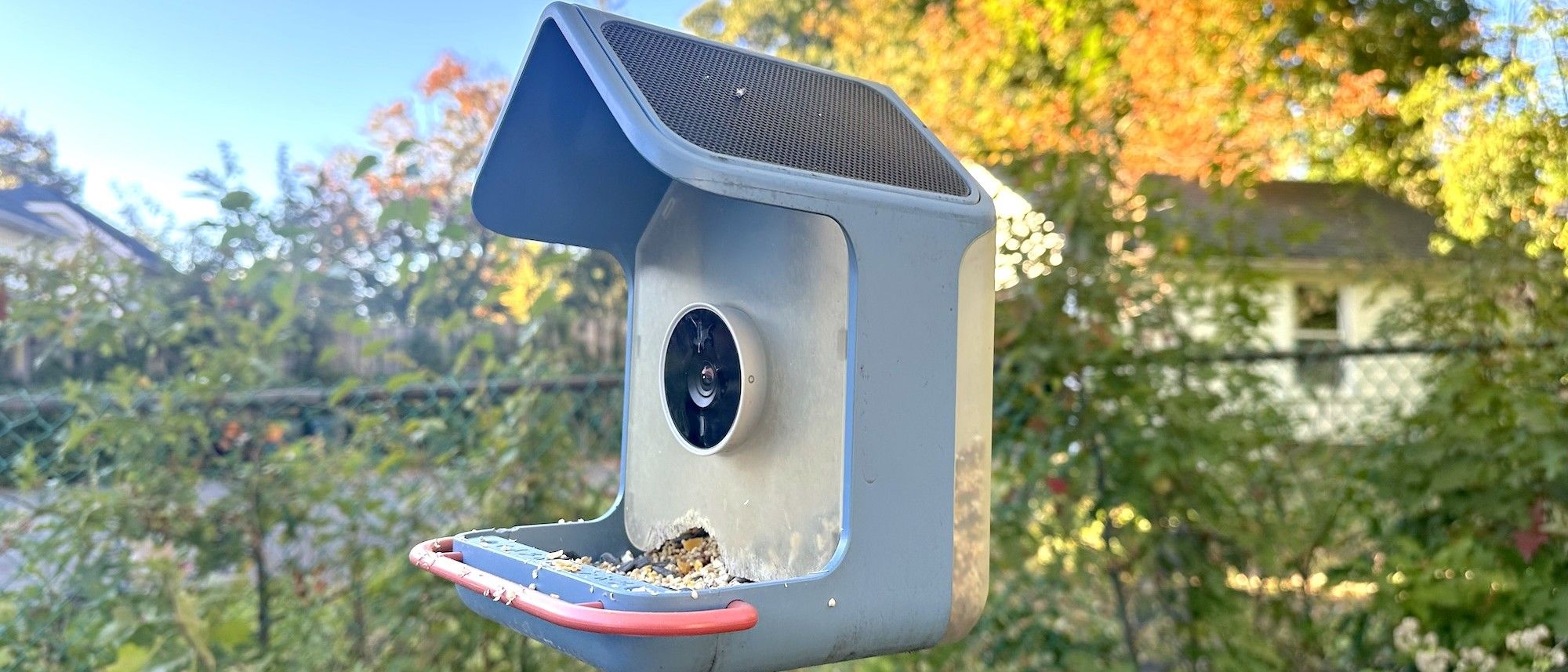
Tom's Guide Verdict The BirdBuddy Home is a modest improvement over the previous generation. It's easier to clean, and you can rotate the camera to record landscape or horizontal video. However, video quality is only marginally better, and the all-plastic housing is easily chewed by squirrels. Reasons to buy +Easier to fill and clean +Camera can rotate between landscape and portrait +App is very intuitive Reasons to avoid -Lens distortion around edges of video -Feeder’s plastic parts can be easily chewed by squirrels Why you can trust Tom's Guide Our writers and editors spend hours analyzing and reviewing products, services, and apps to help find what's best for you. Find out more about how we test, analyze, and rate. I’ve been waiting for the Bird Buddy Home to make its debut longer than the swallows to come back to Capistrano.The original Bird Buddy ushered in the age of the smart bird feeder, which not only gave you an up-close-and-personal look at the visitors to your feeder, but could also record photos and video and, thanks to AI, even identify your feathered or furred friends.At CES 2026, the company introduced what was then called the BirdBuddy 2, its second generation feeder that uses the same camera as its Petal Smart Nature Camera. Initially, the feeder was supposed to ship in February (I received my review unit in January), but it was delayed a number of times; only now — in October — is it finally going on sale to the public.So, I’ve had a lot of time to test this thing out. Now called the BirdBuddy Home, this feeder has a new 2K HDR camera module that lets you rotate it to capture horizontal or vertical photos and videos. The feeder itself has also been modified to fit more feed, and to make it easier to load in seed and clean everything.So, after nearly 10 months sitting in my backyard, how does the BirdBuddy Home compare with the original?BirdBuddy Home: Price and availability (Image credit: Future)The BirdBuddy Home is available starting today (Oct. 22) at BirdBuddy’s website for $219, and will be available at other retailers shortly after.BirdBuddy is also launching a smaller version, the BirdBuddy Nook, which will cost $99 for the non-solar model, and $159 for the solar version. The nonsolar model will only be available at mybirdbuddy.com, while the solar model will be sold at most major retailers.Tom's Guide: Direct to Your InboxGet instant access to breaking news, the hottest reviews, great deals and helpful tips.The original Birdbuddy Pro will be phased out, with remaining inventory available on Amazon through the end of 2026.BirdBuddy Home: What I likedThe camera can rotate (Image credit: Future)With the original BirdBuddy, you were locked into a portrait-oriented video, which gave you a nice vertical view, but not so great side-to-side. It reminded me of the early days of video doorbells, where companies took off-the-shelf cameras that either gave you a narrow vertical view or a narrow horizontal view.The BirdBuddy Home’s camera doesn’t solve that issue exactly, but it at least gives you the option of whether you want your videos in portrait or landscape orientation. All you have to do is rotate the camera in the feeder’s housing.Hopefully, smart bird feeders will take a cue from the best video doorbells, and start using cameras that can take square videos.The app has been improvedWhile not directly hardware-related, the BirdBuddy app has improved over time. One of the most recent additions has been a weekly recap of all your visitors, which makes it easy to see in one place who’s dropped by, stats on how many birds have visited, and more.The app also makes it a cinch to scroll through videos and photos of all the birds, and seems to be fairly accurate when it comes to identifying species. I only get cardinals, blue jays, sparrows and wrens; it sometimes confuses the latter two, but you can change the identification with just a few taps.There's also a host of other fun features, such as information on bird species, and the ability to check out feeds from other BirdBuddy feeders around the world.It’s easier to fill and clean (Image credit: Future)I have my Bird Buddy mounted on a six-foot pole, so it’s somewhat easy to reach without me having to haul a ladder out every time I need to refill it. Like the original, there’s a triangular door at the top of the back of the feeder that swings open; on the newer model, the door is a bit larger, which makes it a lot easier to fill without spilling lots of seeds all over the ground. However, the company no longer ships the little filling cup that came with the original.Also, all of the pieces pop off somewhat easily, so it’s much quicker to clean the inside of the feeder — an essential task to prevent diseases from spreading. However, as I found out, this leads to other issues…BirdBuddy Home: What I didn’t likeIt’s been chewed up by squirrels (Image credit: Future)One of the best attributes of the BirdBuddy Home is also its worst. It’s very easy to disassemble to clean, but the large opening in the bottom of the feeder makes it a lot easier for squirrels to empty it out quickly. Once those furry-tailed rodents found the feeder, they would drain it in a day or two. By comparison, the metal grate on the front of the BirdFy 2 Metal 4K feeder prevented the squirrels from eating all the seeds as quickly.One other disadvantage of the BirdBuddy Home’s all-plastic design: When the squirrels couldn’t easily reach the seeds, they started chewing the front plastic section of the feeder.It’s expensiveThe BirdBuddy Home is available at Amazon for $219. That’s a lot to pay for a smart bird feeder. I can’t vouch for the competition, but you can find plenty of other models with higher-resolution cameras for less than $200. Currently, you can get the original BirdBuddy Pro Solar for $169 at BirdBuddy’s site; I recommend picking up that deal if you like what the company is offering.There’s also the BirdBuddy Nook ($99/$159 for solar), which has the same camera, but a smaller reservoir, so you’ll be refilling it more often.If you don’t want to pay a monthly subscription, you can record video at up to 2K resolution. If you want 2K Ultra (which records HDR content) or slow-motion (which captures video at 90 fps) you’ll need to pony up for a Premium subscription, which costs $69/year for an individual membership and $89/year for a family membership, which lets up to 10 invited members look at the feed from the camera.Regardless of whether you have the free or paid tier, BirdBuddy only saves videos on its servers for seven days; if you want to save anything for posterity, you’ll need to download it.One I dunnoUpgraded, but distorted visuals Image 1 of 8 (Image credit: Future) I suspect the reason for the BirdBuddy Home’s delay was that the company was working on improving its camera quality. When I first received the device, it could only record in resolutions up to 1080p. A few months later, and it was upgraded to 2K. When that switch occurred, I was able to see much more detailed images, such as individual feathers on the birds, and strands of fur from the squirrels who regularly raided the feeder.Compared to the BirdFy Metal 2K, the BirdBuddy’s video was better — not only was more of the frame in focus, but the camera did a better job at accounting for differing levels of brightness in the background. For example, it was able to capture the clouds in the sky more accurately.However, images and videos are more distorted around the edges than they are with the original BirdBuddy. While birds and objects in the center look accurate, things such as seeds at the bottom in the foreground were stretched out so much they looked like grains of wild rice. (Image credit: Future)Within the last week, I’ve also noticed some water between the lens cover and the camera itself; while it doesn’t seem to have affected the quality of the video itself, it’s a little concerning.I suspect the issue I experienced could be due to the fact that I had an early model. I reached out to BirdBuddy, and the company is sending me a new unit to test.BirdBuddy Home: Verdict (Image credit: Future)I’ve had a BirdBuddy in my yard for more than three years at this point, and it’s been a real treat to see all the critters that come to the feeder. The BirdBuddy Home is a modest improvement on the previous generation, but not such a great leap that you should toss the model you have.It’s nice that you can now pick between portrait or landscape videos, but I hope that the company can fix the lens distortion. And, a little bar of metal along the bottom of the feeder would probably help keep hungry squirrels at bay, if just for a little longer. Follow Tom's Guide on Google News and add us as a preferred source to get our up-to-date news, analysis, and reviews in your feeds. U.S. Editor-in-Chief, Tom's Guide Michael A. Prospero is the U.S. Editor-in-Chief for Tom’s Guide. In his spare time, he also tests out the latest drones, electric scooters, and smart home gadgets, such as video doorbells. Before his tenure at Tom's Guide, he was the Reviews Editor for Laptop Magazine, a reporter at Fast Company, the Times of Trenton, and, many eons back, an intern at George magazine. He received his undergraduate degree from Boston College, where he worked on the campus newspaper The Heights, and then attended the Columbia University school of Journalism. When he’s not testing out the latest running watch, electric scooter, or skiing or training for a marathon, he’s probably using the latest sous vide machine, smoker, or pizza oven, to the delight — or chagrin — of his family. You must confirm your public display name before commenting Please logout and then login again, you will then be prompted to enter your display name.
I’ve been using the BirdBuddy Home for nearly a year — 3 things I love about this smart bird feeder, and 2 I don’t
Full Article
Original Source
Read the full article at Tomsguide →KhanList aggregates and links to publicly available news content. We do not host full articles from third-party sources. Always verify important information with original sources.