
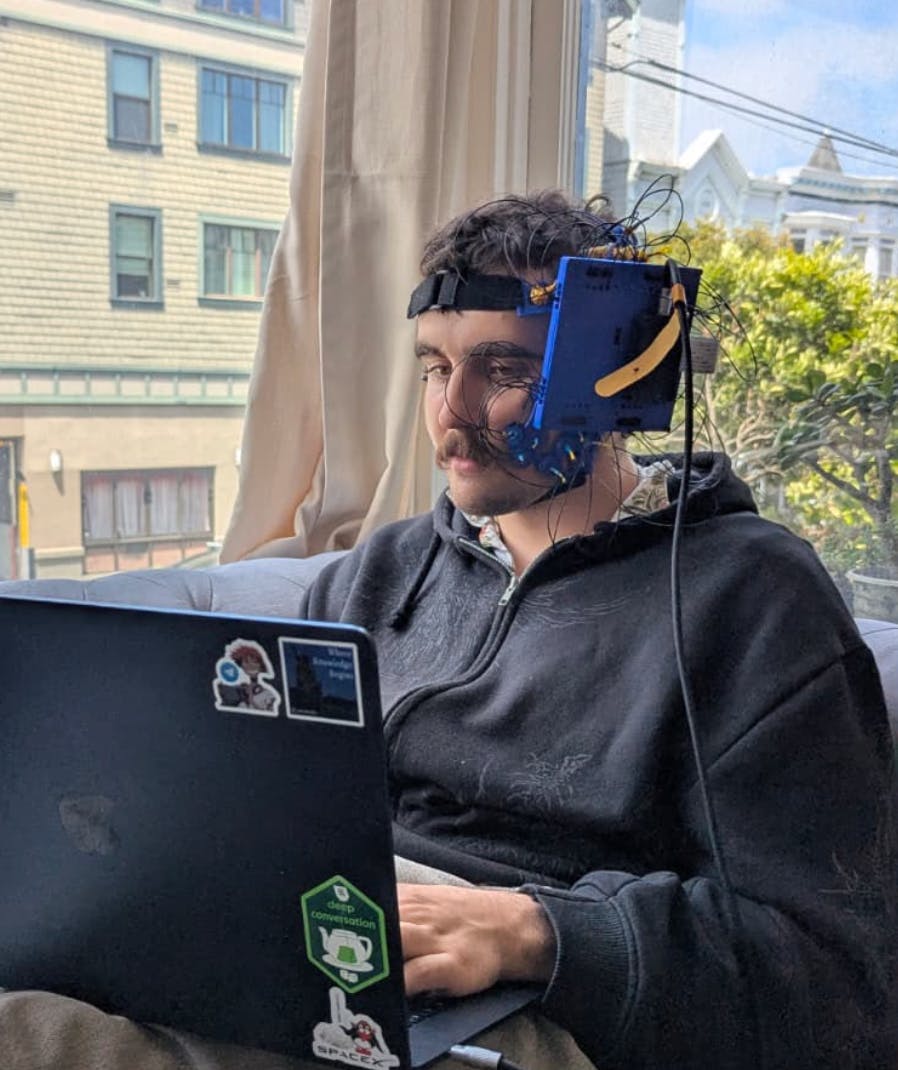
The Voyage Interfaces CTO is developing a silent-speech system by working backward from a central question: what kind of interface can keep pace with increasingly capable computers? Two years ago, Ivan Bokarev was couch-surfing through Europe and eating leftovers scavenged from a KFC. He spent his last $200 on a flight to the United Kingdom to meet a possible collaborator. Today the company he helped start is backed by Draper Associates and is building a device that lets people speak to computers without making a sound.The direction didn't start with silent speech, however. It started years earlier, sideways. "I started playing around with machine learning quite early, after I gave up my dream of becoming an esports player," he says. One day, riding a train, he noticed a stranger using Google Colab and struck up a conversation. The stranger, an ex-lawyer working in artificial intelligence, introduced him a week later to two people in his network. The group co-founded a company building large-language-model automations for local governments and corporations. "Someone took a bet on me. I kept figuring things out, and at some point I was magically able to pay rent." After finishing high school, he left the company to look for work that felt more consequential. Neurotechnology held his attention because it tied together ideas he had been circling for years: "The AI we have today can already be turned into extremely powerful cognitive tools — someone who's hyperaware of how thinking works just has to lay out the process and interaction correctly." He began experimenting independently, building the skills he lacked and finding the people he needed. A trusted friend eventually introduced him to the CEO of Voyage Interfaces, and a week later he joined as CTO. "I had realized that first, we needed to fix the problems of communication between human and computer throughout the day." The goal became to develop a non-invasive wearable that recognizes words a person forms without speaking them aloud. "We're making something that replaces voice as the input modality you can use on the go," Bokarev says. "I don't want everyone to hear what I'm saying as I take notes, or talk with people or AI." The device draws on activity associated with the brain's speech and motor regions, along with downstream signals from the small muscle activations involved in articulation — without any sound being produced. Getting there means working across machine learning, neuroscience, hardware, and design at once. "It's fun. I have no specialized background in many of these things, so the first few sprints all started with 'I don't know what I'm doing, but we need to solve this' — and there's always something that goes wrong," he says. "You have to reason in the unknown, then work back toward the knowledge and decisions you need to build a primitive test off your hypothesis" That comfort with open problems is not incidental. Bokarev was looking for fields where the standard approaches had not yet hardened — where being early to fundamentals matters more than years inside a discipline's conventions. "When there are hundreds of known things to do, experience helps you avoid getting them wrong," he says. "When the problem is still open, it can be baggage. I would rather have strong, clear fundamentals." Silent speech qualified. The field has produced decades of research but nothing that worked in its entirety. Not even the high-level question of which signals to use was answered."In essence, we're solving a cryptanalysis problem," Bokarev says. "We use speech pathology to lay out all the sources of information, phonetics to define what we need to decode, and physics to see which proxies to that information exist and can actually be read out." By benchmarking each informational pattern separately, we can engineer direction instead of betting." "Let's see where all of this brings us," he says. "Reading out language won't be an end-goal in itself. It's a bridge to all the other interesting data streams running in the brain." How far that bridge extends depends on a question Bokarev admits he can't settle: how much of cognition stays human at all. "In theory we should be able to model, or at least approximate, any part of cognition — but some things may stay farther away in practice. Whether it's control, actual value, or just fun, humans will stay in the loop for quite a while. At least I want to. I can't imagine a more interesting game than creating things — products, companies, art." "I think preservation isn't god-given. It's a question of whether tools that extend people develop as fast as the automation that replaces them." This story was distributed as a release by Jon Stojan under HackerNoon’s Business Blogging Program.
Ivan Bokarev Is Building a Voice You Don’t Speak
Full Article
Original Source
Read the full article at Hackernoon →KhanList aggregates and links to publicly available news content. We do not host full articles from third-party sources. Always verify important information with original sources.