
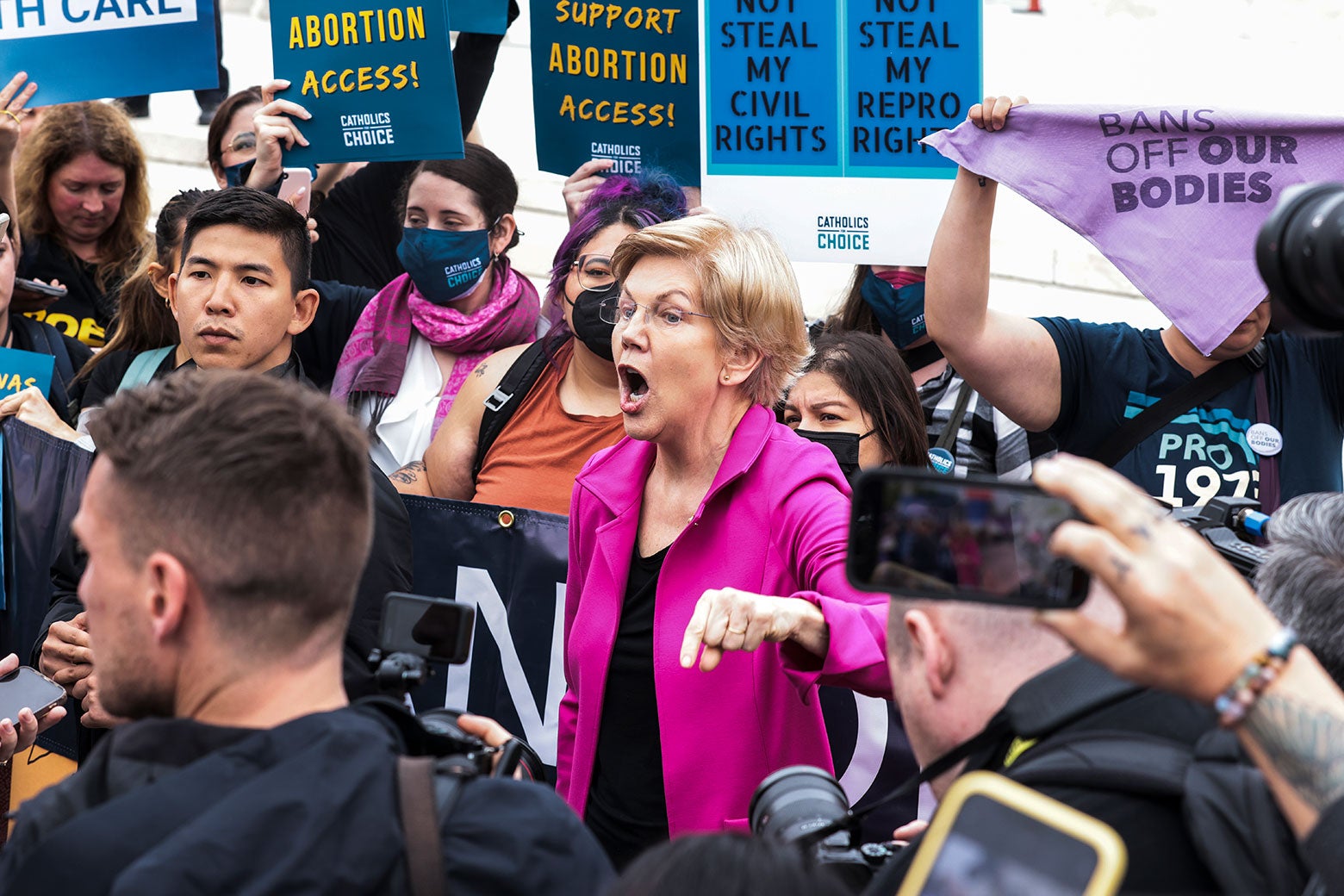
Jurisprudence Sen. Elizabeth Warren. Oliver Contreras for The Washington Post via Getty Images Sign up for the Slatest to get the most insightful analysis, criticism, and advice out there, delivered to your inbox daily. A historic blue wave has raised questions about what Democrats will do with their majority in both houses of Congress. With a Republican president in office, there will be limits on what the new congressional majority can accomplish, not least on reproductive rights. But there are opportunities for the party to make progress before 2029 if Democrats use their power with purpose. Pundits sometimes suggest that voters have moved past the abortion issue, even though data suggest that reproductive rights were a key issue for some voters. The truth is far more complicated. A network of shield laws ensures that abortion remains broadly available, even in states that criminalize it. Voters perhaps paid less attention to abortion this cycle because no major policy change was making headlines, but ballot initiatives protecting abortion rights—three of four of which were successful this fall—show voters still care. And reproductive rights remain under threat. The Trump administration may act to end telehealth access to medication abortion by March 2027; federal lawsuits filed by the attorneys general of Louisiana, Idaho and Missouri, and Texas and Florida seek to take abortion pills off the market or reimpose restrictions that the Food and Drug Administration lifted. Other challenges to shield laws are in the pipeline, some of them predicated on the Comstock Act, a 19th-century obscenity law that some conservatives interpret as a de facto national abortion ban. Reproductive-rights policies have featured prominently in Democrats’ plans for the first 100 days of a new Congress, and if the party doesn’t act on that agenda, Democrats could fall into a familiar trap: waiting to act until there’s a conservative victory in the federal courts or anti-abortion action by the executive branch. Democrats have done this in the past, missing opportunities to pass landmark legislation in the Clinton and Obama administrations. With the dust settling on the midterm, Democrats should ensure that history does not repeat itself. Skeptics will stress that Donald Trump is still in the White House. The president will likely veto most bills passed by the Democratic majority, which will fall well short of the two-thirds needed to override. But Trump hardly seems passionate about reproductive issues, and it’s possible to imagine him signing a bill that goes some way to loosen abortion restrictions. Last year, for example, he suggested that the party should be open to changing the Hyde Amendment, which bars most Medicaid reimbursement for abortion—a statement that has increasingly worried abortion opponents. And Medicaid coverage matters a great deal. Sixteen states where abortion is legal prohibit most Medicaid reimbursement, and groups offering private alternatives, like abortion funds, have struggled to fundraise in recent years. Cost is a major barrier for abortion-seekers, most of whom are low-income. The Hyde Amendment is part of appropriation riders for the Department of Health and Human Services; Democrats could remove it without repealing or amending an existing law. Democrats also could wield the appropriations power to attack the Comstock Act, seeking to prohibit the Department of Justice from using funds to enforce it against those mailing or receiving abortion-related items. It could cost Trump politically for refusing to sign must-pass legislation because of an abortion-related provision, and thus shutting down the government. Nevertheless, Trump could block most bills passed by the Democratic Congress. But a veto has consequences for Republicans. Each one will put Trump and congressional Republicans on record in rejecting a position that voters keep backing at the ballot box. Trump has successfully finessed the abortion issue since the start of the 2024 campaign, postponing federal action and avoiding discussion of his own views on the issue. Forcing a veto of a popular bill would remind voters of what the president’s party thinks—especially as the GOP begins to imagine a future after Trump leaves office. The leading candidates to top the ticket for the party in 2028, J.D. Vance and Marco Rubio, are far more conservative than Trump on abortion, and drawing out their views on reproductive health as part of a national conversation could be politically damaging in the future. Republicans who vote against these bills, or who defend current restrictions, will have to own that choice going into 2028. A bill that fails now, moreover, is still worth writing because it will become a template for the moment when passage is possible. Democrats could propose legislation that includes and goes beyond restoring a federal right to abortion. Such a bill might face a filibuster since Democrats likely will not have 60 votes in the Senate, or the desire to end the filibuster altogether. But that shouldn’t change the imperative of drafting a compelling bill for future Congresses. In the past, Democrats with control of Congress and the White House have struggled to come together around a bill that is both pragmatic and principled. Advancing legislation of this kind could build coalitions among providers, advocates, labor, faith groups, and state officials, among others. A bill would also give members a record to run on, and gives voters a concrete sense of what could happen if Democrats win again in 2028. When Joe Biden and then Kamala Harris ran on reproductive rights in 2024, they struggled because the Democrats did not have a clear enough answer about what they could change if they held power. The new Congress can avoid the same pitfall by outlining a bold vision of its own. That vision could go beyond a bill protecting abortion. Democrats could renew efforts to protect access to and reduce the costs of infertility treatments, like in vitro fertilization, and contraception. Democrats could try to preempt the weaponization of the Comstock Act by forcing a vote to repeal its provisions on abortion. The new congressional majority could help blue states in the interstate conflict over shield laws and mailed-medication abortion. State shield laws sometimes contain provisions establishing that the “site” of care is where the provider operates, not where the patient lives. A federal equivalent, potentially applying to telehealth care more broadly, could provide additional security and support for shield doctors serving patients in ban states. More broadly, Democrats can offer their perspective on what it means to be pro-family. Republicans increasingly equate being pro-life and pro-family with ratcheting up criminal and civil penalties for those seeking certain healthcare treatments. Democrats could present an alternative by using the budget reconciliation process to address issues from prenatal care and paid family leave to extending postpartum coverage under Medicaid and supporting childcare and early education. If Democrats want to avoid the threat of a filibuster, they may try to weave reproductive-rights measures into bills through appropriations or budget reconciliation, which allows Congress to pass spending, tax, and debt-limit legislation with a simple majority. The Senate’s Byrd Rule limits what can be accomplished through reconciliation, requiring that a bill have a direct, non-incidental impact on federal spending or revenues. That would likely rule out a bill creating a new federal right to abortion or even Comstock Act repeal. That said, there are clear steps Democrats could attempt through reconciliation, notwithstanding the chances of a veto. For example, Democrats could seek to change the Emergency Medical Treatment and Labor Act, originally passed through budget reconciliation, to withhold or reduce funding for hospitals that refuse to offer abortion as stabilizing treatment. Democrats also can vote down federal abortion restrictions, such as efforts to block funding for Planned Parenthood or Title X family planning. Perhaps most significantly, a Democratic House can refuse to pass bills with anti-abortion riders such as the Hyde Amendment. At the agency level, even though Congress cannot dictate the outcome, a Democratic majority can assess the FDA’s review of mifepristone, one of the two pills used in a majority of abortions nationwide, and one of the most studied drugs in the nation, with a safety record established since FDA approval in 2000. Under pressure from abortion opponents, the FDA launched its own new safety study and will issue a report no later than March 2027, after which it will decide on any changes. Democrats can intervene in several ways. First, committees can evaluate the review’s protocol, data, and communications with outside groups. They can ask who designed it and whether anti-abortion advocates influenced it. Such scrutiny might make it harder for the agency to publish a report that looks predetermined. The Trump administration may ignore these requests unless a court forces compliance, but committees can take important steps toward understanding the process that might lead to new FDA restrictions. Second, Democrats control the spending bills that fund the FDA. They can attach riders or reporting requirements to the FDA’s budget, or limit funds for changing mifepristone’s regulatory status if change is contrary to established evidence on safety. A caveat: Any such rider would have to survive negotiations with a president who can veto the bill. But taking both actions could matter in court and inform the current litigation asking courts to reimpose restrictions on mifepristone. Finally, there’s Congressional approval of presidential nominations. Whether for the bench or for federal agencies, confirmation hearings can spotlight candidates’ views on reproductive rights. And a Democratic Senate can block or stall judicial nominees that committee members believe are unqualified for the position. It may be tempting to believe that Democrats are better off focusing exclusively on issues like the cost of living and corruption that were also salient for voters. Democrats would be foolish not to try to deliver on those priorities. But there is no reason that the party cannot tackle reproductive rights at the same time, as they’ve outlined in their own health plans. Democrats have signaled to U.S. women that their health is a legislative priority, not just a talking point. Now that Roe v. Wade is gone and shield laws are at risk, it is time for the party to show that it meant what it said. Abortion Congress Department of Justice Donald Trump Jurisprudence Senate Supreme Court Judiciary
It’s Time for Democrats to Put Up or Shut Up on Abortion Rights
Full Article
Original Source
Read the full article at Slate →KhanList aggregates and links to publicly available news content. We do not host full articles from third-party sources. Always verify important information with original sources.