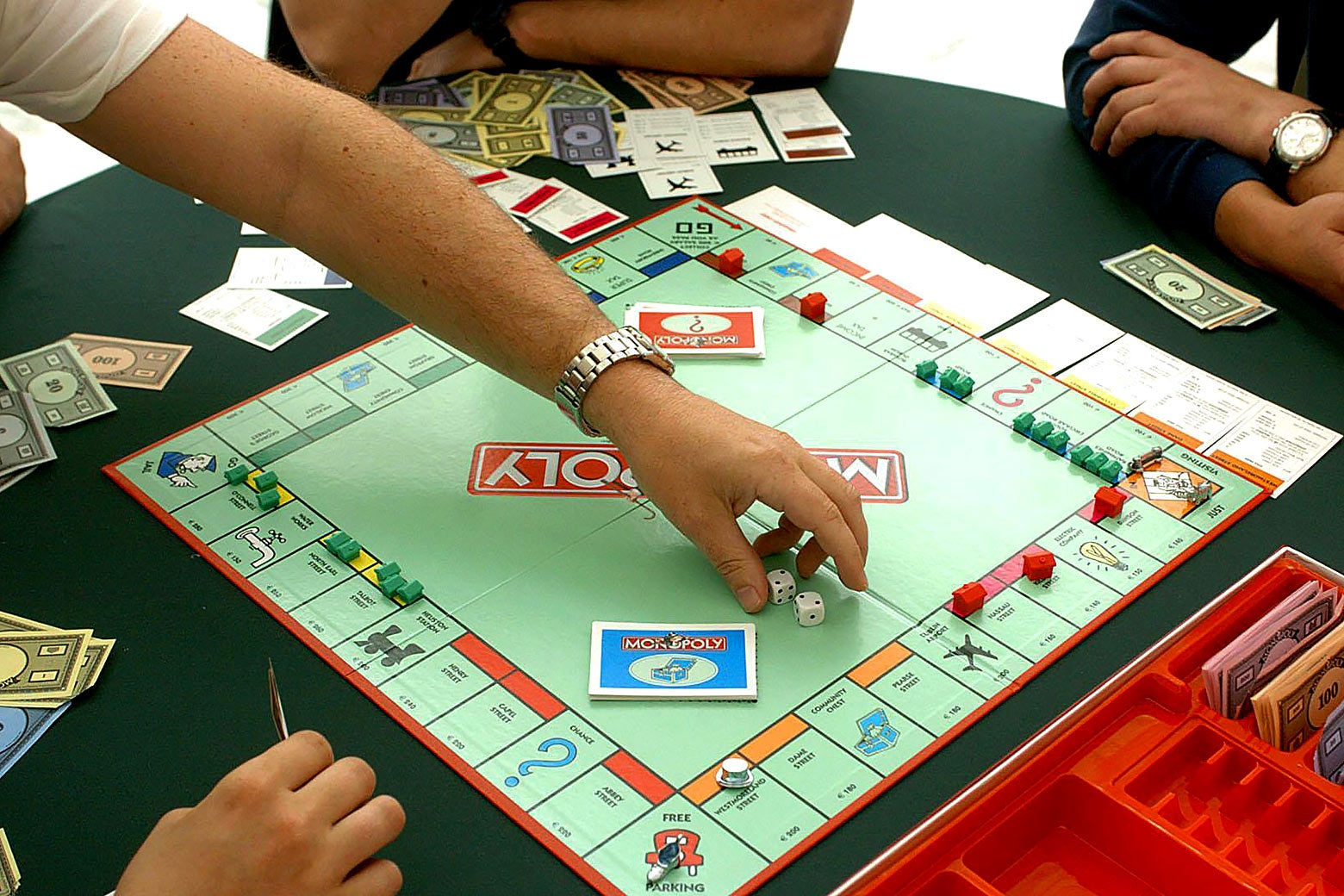
Downtime Have We Been Playing Monopoly Wrong All Along? The board game everyone loves to hate has some staunch defenders. They say the game isn’t the problem—we are. By Enter your email to receive alerts for this author. Sign in or create an account to better manage your email preferences. Unsubscribe from email alerts Are you sure you want to unsubscribe from email alerts for Luke Winkie? July 26, 20265:40 AM Haydn West/PA Images via Reuters Connect Sign up for the Slatest to get the most insightful analysis, criticism, and advice out there, delivered to your inbox daily. According to an old bromide, nobody has ever finished a game of Monopoly—every session drags on into eternity until it is mercifully abandoned, perhaps right after your father installs a hotel on Connecticut Avenue. And as someone who can recall innumerable rainy weekends spent glumly traversing Monopoly’s gauntlet of scams, I have always considered this correct. The game has ghastly built-in qualities that make it at once indeterminably long and terminally random, more than earning its deplorable reputation among gamers, teachers, and parents alike. In 2018 Slate even named Monopoly one of the 10 worst family games on the market, putting it in the same tarnished league as Candy Land and Tic-tac-toe, a consensus that has been echoed by pretty much everyone else. (“Happenstance quickly separates contenders from also-rans, leaving one player gleefully collecting rents while the others wait sullenly to be finished off,” surmised Slate alum Noel Murray.) And yet, there is a quiet constituency out there who believe that we’ve got it all wrong. They maintain that Monopoly is strategically dynamic and richly marbled with clever counterplay opportunities—and, more controversially, that it’s actually good. If, that is, you play by Monopoly’s official rules. Which almost nobody does. These rules come packaged inside every Monopoly box and are written on a pamphlet that urges players to remember certain core principles that are always, always forgotten. These protocols differ from the ancestral precepts of Monopoly, passed down from generation to generation through oral tradition. And if you are one of the 275 million people who have purchased a copy of Monopoly since Parker Brothers first published it in 1935, the ramifications of these rules might sound paradigm-shifting—perhaps even a tad sacrilegious. For one, nobody is supposed to collect money by landing on Free Parking. It’s meant to be an ordinary blank space, offering reprieve from the vultures waiting around the corner. Similarly, nowhere in the rulebook does it tell you to pile cash on the center of the board. Any money lost from ill-fated draws of the Chance or Community Chest deck go back to the bank. Also, if a player chooses not to buy an available property after landing on it, that card immediately goes up for auction, with a starting bid of $1—allowing for massive swings of fate, like scoring a huge discount on Park Place. There are no loans to be taken, no debts to be offered. Money can’t be donated to unlucky players. And you should not, under any circumstances, collect $400 for landing on Go. All of these rules are clearly printed in the manual, but the problem is that no one—and I do mean no one—ever reads it. Instead, we learn an inaccurate version of the game from a parent or an uncle and pass it down the chain, further metastasizing the distortions across the country. This is what frustrates Monopoly die-hards most of all. They are of the opinion that the most famous board game in the world has been unfairly stigmatized essentially due to user error. And if we purged those faulty instincts—if we played by the book—something unprecedented would happen: Monopoly would become fun. “The game is fun if you actually play by the rules,” bemoans the headline of one post made on the r/UnpopularOpinion subreddit. Elsewhere, board-gaming YouTubers have pleaded that, contrary to what the haters might say, a proper game of Monopoly is a worthy and unembarrassing way to spend an evening with adults. (“Why Monopoly Doesn’t Suck with Official Rules!” reads one characteristically exasperated title.) And I think that’s because most tabletop-gaming hobbyists—the folks playing Wingspan at your local coffee shop—tend to speak about Monopoly as if it is essentially demonic. Across 40,000 user reviews of the game submitted to the tabletop community nexus BoardGameGeek, Monopoly holds an abysmal average score: 4.4 out of 10. The central idea articulated in those reviews isn’t so much that Monopoly is a bad game—that part goes without saying. Instead, it’s that due to Monopoly’s exhausting ubiquity, a huge swath of Americans has been indoctrinated to believe that every other board game is bad too. “When all you know is Monopoly, trying other board gaming feels foreign and strange,” said Tom Vasel, a veteran board game critic, in a video titled “Five Things I Hate About Monopoly,” uploaded two months ago to his YouTube channel. Vasel cites the game’s punitive nature, arbitrary swings of luck, and fiddly mental arithmetic—how the players around the table are constantly being asked to calculate the sum of, like, 37 and 68, a hell I wouldn’t wish on my worst enemy. “So many people I want to introduce board games to have had a miserable time with Monopoly,” continued Vasel. “And it turns them away.” Here is where I must admit my biases. Much like Vasel, I have also harbored a lifelong distaste for Monopoly. I entered the board gaming hobby in college and am writing this article from a home office, surrounded by several Ikea bookshelves filled to the brim with tabletop games that have been accumulated, piece by piece, through decades of collecting. I would ballpark that I inventory more than 200 board games in total, a fact that fills me with either beaming pride or wretched shame depending on the day. But that’s exactly why I’m fascinated by the select few who assert that Monopoly has gotten a bad rap. Because like countless other Americans, I’ve never played Monopoly by its stated rules. And maybe that means I’ve been missing out. The thinking goes like this: If you play Monopoly while adhering to the overlooked rules outlined above, the game’s most glaring problem—its length—is solved. Two of those rules are especially important. By removing the Free Parking jackpot, and all the cash that piles in the middle of the board, players dramatically curtail Monopoly’s overall money supply and deflate its economy. Similarly, by auctioning off unsold properties, the game’s safe harbors effectively disappear by the second lap around Go, rendering the board a hostile trap of steadily ratcheting rents. When those restrictions are working in parallel, players around the table are bankrupted with bloodless efficiency. Monopoly becomes crueler, yes, but also leaner and speedier. “The object of Monopoly is to bankrupt everyone but yourself. So any house rule that works against that premise is going to artificially make the game longer,” Brian Valentine, a Washington high school vice principal who finished third in the 2015 Monopoly World Championship, hosted in Macau, told me. “When you play by the rules as printed, the game takes two hours tops,” he continued. “And most tournament games are limited to 90 minutes.” That’s the paradox of Monopoly: Despite the fact that the solution to the game’s most commonly perceived design flaw has existed in its rulebook for nearly a century, those mandates have never been internalized en masse—and they probably never will. Brian Baker, head of Hasbro’s board game division, which has operated the Monopoly IP since its purchase of Parker Brothers in 1991, has a few theories about why that is. He reminded me that Monopoly first entered the national market during the Great Depression, when it functioned as a trenchant bit of political commentary: a tabletop experience where the rich get richer—an articulation of class consciousness through board and dice. (It is telling, after all, that Monopoly’s original name was “The Landlord’s Game.”) The game’s hard edges were meant to simulate the rapacious nature of capital, but as every parent knows, gouging grade schoolers of their life savings after a bad roll of dice can lead to a lot of hurt feelings. This is why so many of Monopoly’s fugazi house rules are explicitly designed to neutralize the game’s dizzying financial punishment, manifesting a social safety net in this nasty realm of commerce. And that’s the thing that puts Monopoly true believers in a bind. Baker would like it if more people understood that they had the wrong ideas about Monopoly, and unfortunately that means that he—and the rest of Hasbro—is standing against generations of inherited knowledge. “We’ve made a deliberate commitment to making sure that we debunked some of those house rules,” he said. “One thing we hear over and over again is that Monopoly takes too long, and our top priority is that our players have the best possible experience. The reason it’s taking so long is because you’re actually not playing the way the game was designed.” With all that said, even when accounting for those original rules, I still wasn’t convinced Monopoly would be much fun. The best tabletop games, in my opinion, are the ones encumbered with hundreds of tiny decisions that nudge you toward victory. Every quarter, a few friends and I hold an eight-hour session of Twilight Imperium—a space-empire building simulator in which participants must account for weapons manufacturing, trade deficits, diplomatic initiatives, scientific research and so on. Compare that to Monopoly, for which strategic thinking is limited to the entropy of two dice rolls, and you can start to see where I’m coming from. This is the premise I put to Valentine: How could Monopoly ever be played with any real skill? Why wouldn’t he instead take his prodigious tactical acumen to poker or Scrabble or, I don’t know, Jeopardy? But Valentine was steadfast in his belief that immense cerebral depth can, indeed, be found on the corner of Marvin Gardens and Pacific Avenue—so long as you’re willing to look for it. “Yes, you’re working with those two dice and the 36 outcomes of those dice. But understanding those outcomes helps you determine when to build houses and when to attempt trades,” he told me. “A game like chess is all about moves and countermoves. In Monopoly, you are dealing with the built-in element of chance and interacting with the other players. On some level, this is a game about trying to get someone to do something that isn’t in their best interest, and that’s the challenge.” And so, armed with Valentine’s encouragement and a copy of Monopoly sent to my apartment from Hasbro, I convened a handful of the most dedicated board-gamers I know to my dinner table on a vacant Monday night, in hopes of uncovering that magic for ourselves. A shoe, a top hat, a thimble, and a terrier made their first intrepid steps out of Go and traipsed down the piddly brown and turquoise properties. The four of us hadn’t played Monopoly in years, but at last, for the first time in our lives, we intended to play it correctly. I wish I could tell you that we solved the mystery, and that Monopoly proved to be a weighty puzzle box of intrigue, full of intricate gambits and savvy maneuvers. But here is what happened instead. Four of my first five rolls landed me on low-value Chance and Community Chest spaces, awarding me minor bonuses and a Get Out of Jail Free card. By the time I finished my second lap around the board, I had been able to purchase only two properties, putting me hopelessly behind the pace of my friends, who by that point had already opened ominous green-shingled subdivisions on their blocks. I had no real trade capital and—thanks to the fact that we weren’t playing with the Free Parking jackpot—extremely limited leverage to make a comeback. I can confirm that the original Monopoly rules do make the game move considerably faster, because I had been taken out of the running in under an hour. But everything else? The wild swings of luck, the utter lack of balance, the nonsensical stratagems—like how, in the late game, you’re actually better off sitting in jail than touring the board—well, all of that felt just like good old-fashioned Monopoly to me, which is to say, it felt exactly like the game I had learned to hate a very long time ago. Some of the ancient rules we introduced to spruce up the experience barely came into play, which also wasn’t terribly surprising. We auctioned off just one unsold property because, quite frankly, why would you ever not purchase a property you land on? In typical Monopoly fashion, our night ended after the player far and away in first place made two unlucky rolls in a row, landing them on the four neatly manicured houses on Boardwalk. They went bankrupt; everyone left unsatisfied. Hey, at least it didn’t take all night. The hidden skill ceiling that Valentine spoke of never did come into view, but perhaps that’s just because I do not possess the brainpower to successfully detect the virtuosic plays that separate a high-level Monopoly player from the chaff. I am sure there were a few sophisticated trades I left on the table or mathematical optimizations I failed to consider. But again, that’s a level of thinking thrust upon a board game that was never built to support it. At least, that’s the way Baker sees it. “The hardcore hobby gamers will always criticize how much chance is involved in the game,” he said. “But remember, Monopoly was designed for kids 8 and above.” Hasbro was kind enough to send along a handful of Monopoly expansions, all released last year to celebrate the game’s 90th anniversary. One of them greatly amplifies a player’s options when they’re sent to jail, another reintroduces the Free Parking lottery with more regulation, and the third breaks the game wide open, allowing players to do some truly wild stuff—like charging rent on the Go space. All of these expansions appear to be an attempt to bolt some modern game-design precepts onto a lumbering, outmoded beast. (It’s notable that each of them is inscribed with the phrase Makes the Game Faster!) But we didn’t end up playing with any of these modules. We all witnessed the soul of Monopoly—trimmed of its fat, refined to its purest form—and collectively decided that we had seen enough. Ultimately, that’s what I found myself thinking about after my few grim marches around the board, watching the variegated denominations in front of me dwindle to nothing. I wonder if Monopoly’s sheer cultural ubiquity might be coming to a close. I have to imagine that the entry point into tabletop gaming for anyone under the age of 20 is far more likely to be Dominion or Carcassonne or any of the other esteemed European classics that have slowly infiltrated our Barnes & Nobles. The same goes for the graying millennials, weaned on dormitory rounds of Magic: The Gathering, who will surely be raising their children in households absent of shopworn boxes of Risk. Modern tabletop gaming is so distantly removed from the Parker Brothers canon that the two catalogs might as well exist in different universes. How would you even explain to a child socialized in a Catan environment that when they play Monopoly, they can move only in one direction—as determined by the value of the dice? Maybe we really are coming to the end of an era. Perhaps all of us will live to see the day when Monopoly fades off into the horizon, perhaps taking Sorry! and Cluedo with it—remembered, exclusively, by the aging generations who were forced to play them, often against their will. I guess you could call that a tragedy. You know, if Monopoly were any good. Get the best of news and politics Sign up for Slate's evening newsletter. Family Kids Family Games Games
It’s the Most Popular—and Most Hated—Board Game in the World. Maybe You’ve Been Playing It All Wrong.
Full Article
Original Source
Read the full article at Slate →KhanList aggregates and links to publicly available news content. We do not host full articles from third-party sources. Always verify important information with original sources.