
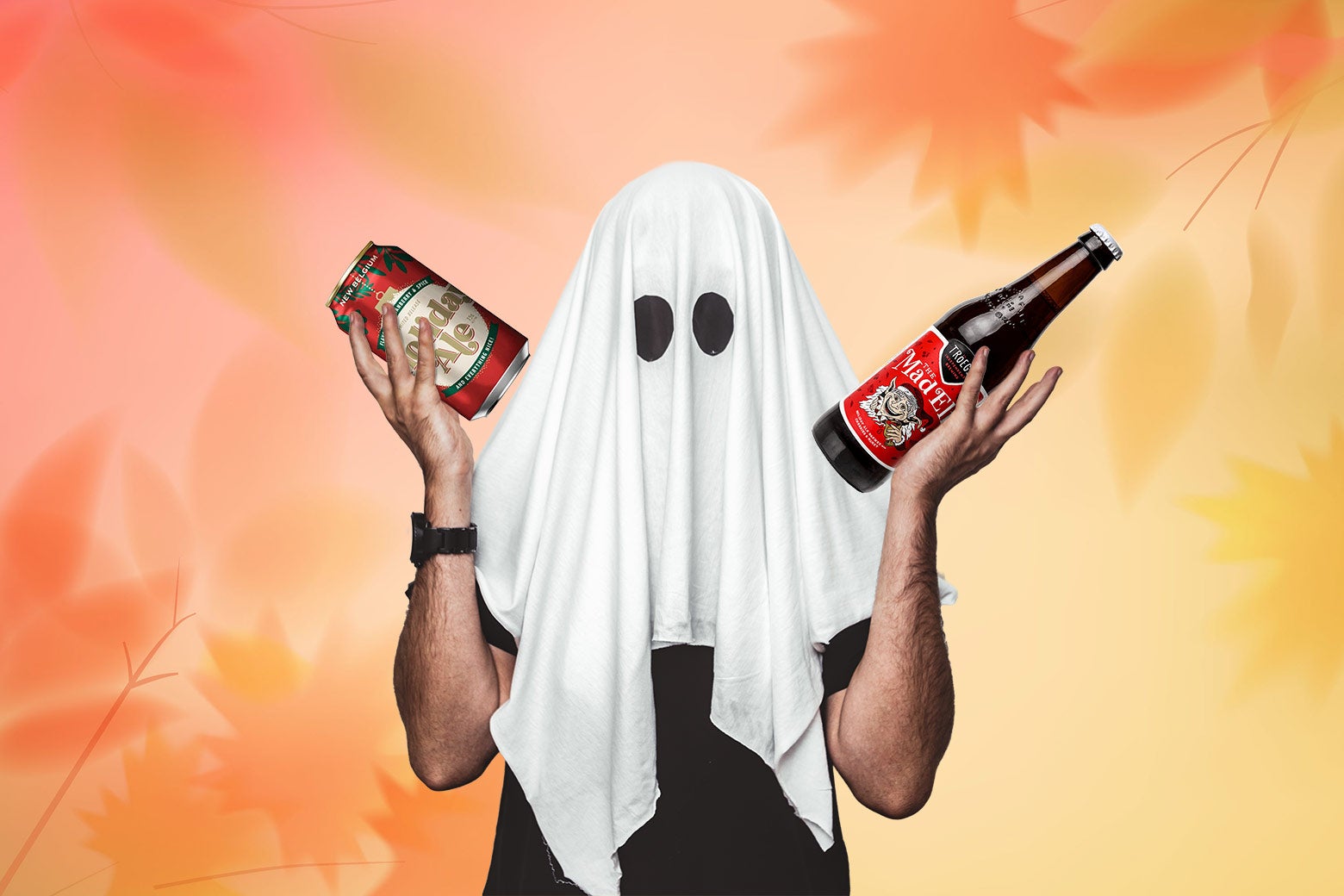
Drink Stop Complaining About “Season Creep” in Craft Beer If you want the industry to keep pouring out interesting flavors and styles, you shouldn’t be mad about Christmas Ale during Oktoberfest. Photo illustration by Slate. Photos by New Belgium, Troegs, and Getty Images Plus. Sign up for the Slatest to get the most insightful analysis, criticism, and advice out there, delivered to your inbox daily. Seasonal creep can suck. No argument there. You walk into your local chain drugstore on Jan. 2, frazzled from the endurance test that is Christmas, in search of meds for the cold you picked up hosting dozens of relatives, and you see red. Literally. You’re barraged with Valentine’s Day candy, cards, and all manner of crap. It feels like you can’t catch your breath on this year-round rat race of holiday commercialization; far be it from me to deny you the right to bemoan this on social media or to friends. But Oktoberfest beers on shelves in late July? Pumpkin beer in August? Christmas beer in October? You might think it’s part of the same corporate cynicism, but if you really love beer and appreciate craft breweries embracing variety through flavors and styles, I’ve got news for you: This is not a “problem.” Seasonal-creep complaints have long been as common among craft-beer fans as neckbeards and dust-accumulating homebrew setups. Often, it’s the same people who shake their fists at the sky about lactose in IPAs or doughnuts in stouts, but not always. Plenty of people don’t like to be rushed through their year with the crushing pressure of Halloween decorations in June, and plenty of beer drinkers don’t love seeing elf-branded beers when they’re just getting their giant skeletons erected in October. A brewery pushing a seasonal beer before its own season underlines the relentless onward march of time—summer shandy in March is a reminder of our mortality. I get it. At the same time, it’s just beer. While, admittedly, seasonal-beer-creep kvetches have cooled somewhat simply as a result of craft beer losing its cool factor, it undeniably still gets its fair share of grumbles. It’s time to put this conversation to bed once and for all, for a few reasons. For one thing, breweries are struggling due to that flagging demand for craft beer. Thanks to its shiny-new factor fading, the growth of wellness trends mitigating drinking habits, and competition from other categories like canned cocktails, beer volumes are down and brewery closings are up. If you care about craft beer at all, letting them brew whatever sells, when it sells, is the way to go. “Criticizing breweries for releasing beers any time they think consumers will buy them has always been insane to me,” says Ryan Pachmayer, a beer writer, beer judge, and former brewer. “Breweries have chased hop water, nonalcoholic beer, and every flavor under the sun to try to capture the next big thing. Releasing a ‘fall’ beer a month before fall hardly seems like the hill to die on in 2026, and it never really should have been in the first place.” For another, climate change is real. Breweries must plan their production schedules months in advance. Do they stick to the strict Oktoberfest window and risk 90-degree days in late September sabotaging the appeal of those beers? Put them out later when it should be cooler, but people are already thinking about Thanksgiving? Instead, why not put them out earlier to pad the selling window a bit so bouts of unseasonable weather don’t make such an impact? There’s also the factor of plain and simple demand. It seems that for every seasonal-creep skeptic, there are about a thousand eager seasonal-beer buyers. “We typically launch our whole fall line-up the first week of August,” says Jon London, senior director and head of beer for Samuel Adams owner Boston Beer Company. “By early August, we’re already seeing that shift in consumer mindset. People are thinking about fall, planning tailgates … their palates are shifting.” Production and logistics play a part, too, since the brewery naturally needs time to brew, package, and distribute. But London reasons they wouldn’t aim for that perhaps seemingly early release if the math didn’t math. “The data tells the real story here: People love these beers, and they want them on shelves when they’re ready to start celebrating the season,” he says. “If people really hated ‘seasonal creep,’ we’d see it in the numbers. We don’t. We see the opposite. People actually stockpile Octoberfest and save it for when it’s not in stock.” Sam Adams Octoberfest is the top-selling Oktoberfest beer in the United States, and Sam Adams overall is the No. 1 seasonal-beer brand, London notes. “Seasonals certainly move the needle in terms of sales,” he says. These beers are big business for a lot of breweries, and they’re going to make the most of the time windows, like mid-October through January for holiday beers—which are still short even with a couple of extra weeks squeezed in at the top. It’s primarily larger breweries like Sam Adams that drive this seasonal conversation, says Julie Rhodes, founder of beverage industry consultancy Not Your Hobby Marketing Solutions. “Large regional and national brands are still very much dependent on big seasonal periods and they’re usually the ones that come out first. They’re the ones that push back and make things earlier and earlier.” These are the breweries who have been around long enough, and have been available in a far-reaching enough region, that people know to look for their seasonals each year. They snatch them up, telling the brewery there’s enough demand to push back the release date a bit, and the cycle continues. These breweries are able to make the season about the beer more than the beer about the season, too. They feed into the anticipation with events like their own Oktoberfest parties and variety packs combining different summer, fall, or winter offerings. This year, Sam Adams debuted a nonalcoholic Octoberfest so more consumers could be part of the action, and also introduced the “Front Yard Beer Hall,” an actual inflatable beer hall that sold out in one day. In Cleveland, Great Lakes Brewing Company is well known for its Oktoberfest; its holiday beers, Christmas Ale and Cookie Exchange Milk Stout; and its St. Patrick’s Day styles, Conway’s Irish Red Ale, Conway’s Irish Stout, and Irish Lager. They generate buzz for the latter with a “Halfway to St. Paddy’s Day” party in September and release the beers in January. The holiday ales drop in October and have their own festivities. “We have the First Pour Party at the brewpub the Thursday before market release in mid-October,” says Great Lakes brand development manager Michael Williams. “We get people who line up around the block, starting at 6 or 7 a.m. And it’s a Thursday, so they’re taking Thursday off, and they’re probably taking Friday off, too. The events definitely have a big part to play feeding into the local excitement for the seasonals.” To even further build seasons around beer and not the other way around, a growing number of breweries are tying their beers more to occasion, mood, and experience rather than specific weather or calendar dates. This conveniently helps with the whole changing-climate thing. Instead of Mexican-style lager only for Cinco de Mayo, which could still fall on a chilly day, May to September is Mexican-style-lager season. It’s a style you want to crush on a hot day, even if that hot day comes unusually early or late. Despite the popularity of its Oktoberfest beer, Great Lakes calls the variety pack built around it the “Biergarten Pack” rather than the “Oktoberfest Pack.” “That was a very intentional choice to use those words,” Williams says. “It’s like, OK, it’s not fall, it’s late August or early September, but I would drink in a beer garden right now.” Similarly, the Great Lakes summer variety pack is called the Sunshine Pack, communicating that it doesn’t have to be between June 21 and Sept. 21 to be enjoyed; and while Christmas Ale and Cookie Exchange Milk Stout are about as December-coded as it gets, the simply branded “Holiday Pack” feels just as suitable for the November run-up to Thanksgiving, too. There’s an overall blurring of the seasonal lines, Rhodes points out. Because of changes in weather and consumer flavor and beverage preferences, it’s unrealistic now to structure seasonal beer-release calendars into the four literal seasons. “It’s becoming more like two seasons per year, a spring/summer release for warmer weather then a couple of fall/winter releases for cold,” she says. That means styles might indeed pop up sooner than some drinkers are used to, but they’re also probably around for a longer time, too, which doesn’t seem to bother anyone. Seasonals are in fact worthy of excitement, and not deserving of irritation when they show up. It’s good, old-fashioned fun to have beer seasons to look forward to. Who isn’t excited about the weather warming up for the first time of the year, and marking that with a crisp lager? Or hoisting steins of festbier to oompah music for Oktoberfest, the OG seasonal-creep perpetrator, considering it’s been held in September for over 150 years? Or feeling toasty and festive with pumpkin ale? Or enjoying spiced, boozy winter offerings around the holidays? All of these styles have their fans—that’s why they continue to exist—and those fans are likely just happy to have as long with these beers as possible. Variety is a core tenet of craft beer, and seasonal beers bolster it. The more time we have with more styles, the better. Beer Food Holidays Drink
It’s the Beer Drinker’s Favorite Complaint. Let Me Tell You Why It’s So Stupid.
Full Article
Original Source
Read the full article at Slate →KhanList aggregates and links to publicly available news content. We do not host full articles from third-party sources. Always verify important information with original sources.