
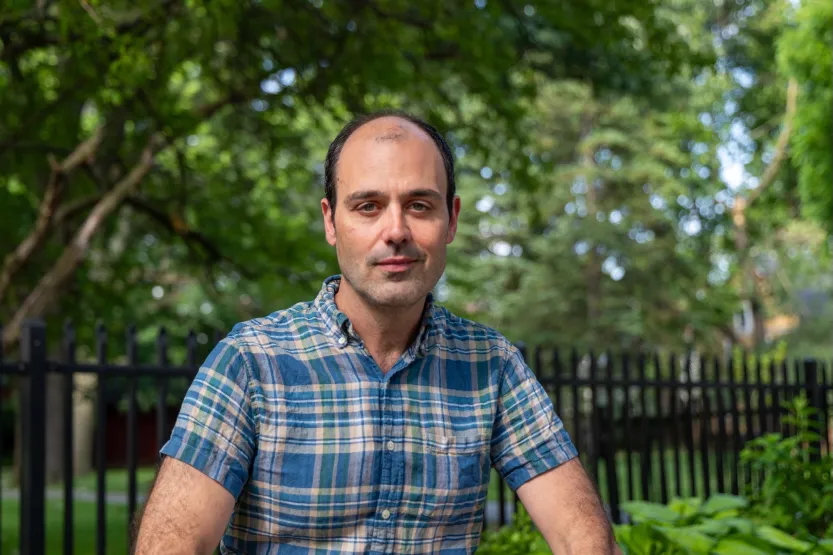
Man wins fight to block ICE threat over off-the-cuff angry email. Feds threatened to prosecute David Streever for sending a critical email to former ICE acting director Todd Lyons. Credit: via FIRE It’s not illegal to send an email telling Immigration and Customs Enforcement (ICE) officials that their actions will haunt them, a federal judge ruled Tuesday, granting a preliminary injunction that blocks ICE from threatening to prosecute a critic for protected speech. Back in January, David Streever sent a scathing three-paragraph email to then-acting director of ICE, Todd Lyons. Outraged by the killings of two Minnesota protestors against ICE, Renee Good and Alex Pretti, Streever told Lyons that he was a “monstrous human being” who will eat himself “alive with shame” for defending officers who shot people who posed no threat and had no weapons. Comparing Lyons to an infamous high-ranking Nazi cop, Streever predicted that “even Trump” would one day turn on Lyons for defending the “obvious” slayings of Americans. David Streever’s email to ICE. Credit: via FIRE David Streever’s email to ICE. Credit: via FIRE “You are a monstrous human being and will go down in history as America’s Reinhard Heydrich, the butcher,” Streever wrote. “You will never know peace. You will seek to lose yourself, to escape the burden of knowing the truth about yourself. But wherever you go, you will find yourself. You will torment yourself until your last day on Earth.” ICE did nothing when the email was received, but five months later, the agency served a warning notice at Streever’s home that claimed his note may have constituted a criminal threat of violence. Those warnings are normally issued to people threatening to assault, kidnap, or murder officials, not morally condemn their actions. But ICE held Streever’s email to the same bar, warning that if he did not “discontinue” speaking critically of ICE leadership, he risked state and federal prosecution. Because Streever wasn’t there at the time of their visit, agents took the extra step of tracking him down at a hotel. That “greatly alarmed” him, his lawyers at the Foundation for Individual Rights and Expression (FIRE) said in a press release. And he’s been self-censoring ever since, fearful of government retaliation. “I’m deeply relieved” At least for now, ICE apparently has conceded that Streever’s email was protected speech, US District Judge Rudolph Contreras wrote in his opinion. Notably, ICE confirmed that the agency supposedly dropped the investigation within a month of sending the warning, but it never told Streever that his case was closed. Rather, an official Department of Homeland Security (DHS) account made a “somewhat contradictory statement” in an X post that Streever reasonably understood as confirming that the probe was still underway, Contreras said. Moving forward, ICE still has to prove that the case was actually closed. Either way, though, the agency’s warning—which Contreras said “practically shouts” that Streever could be prosecuted for future political speech—remained in effect. That allowed the government to continue censoring Streever in likely violation of his First Amendment rights, Contreras wrote. To avoid irreparable harm to Streever, Contreras ordered ICE to temporarily stop enforcing the warning notice, making good on the threats, or issuing similar threats while the case proceeds. Otherwise, Contreras found that Streever “faces a distinct possibility of prosecution for future speech,” especially since a DHS spokesperson has warned that “ANYONE who assaults or threatens our law enforcement officers will face the consequences.” “I’m deeply relieved that the court affirmed what I knew all along: that I am permitted to speak my conscience in the United States of America, including when I criticize government officials,” Streever said. “While I wish this ordeal hadn’t happened, hopefully this incident will serve as a reminder that the First Amendment protects us all.” ICE doesn’t contest email is protected speech Ars could not immediately reach ICE for comment or to confirm if it plans to appeal the injunction. During litigation, ICE wouldn’t explain who made the determination that Streever was potentially illegally threatening violence. Instead, ICE noted that the email came amid a reported “946 percent increase in threats against ICE officials” between 2024 and 2025. Ultimately, it was decided that “the email had potential threatening undertones to ICE personnel, potentially presenting a safety concern,” ICE claimed. As the case moves forward, ICE will likely continue to argue that it needs to police critical emails like Streever’s “to protect the ability of law enforcement to investigate and deter criminal threats or crimes that follow less-than-criminal threats.” However, Contreras emphasized that ICE’s lawyers “wisely do not contest that Mr. Streever’s January email constitutes protected expression or that similar speech would be protected.” As Contreras explained: Streever’s email addressed salient political decisions to a government official, an arena where the First Amendment’s speech protections reach their “zenith.” More importantly, the email does not contain a physical threat. The email registered displeasure with Acting Director Lyons’s official conduct, forecasted that the Acting Director will lose favor with the President, and warned that the moral weight of the Acting Director’s actions will haunt him in the future. Although Mr. Streever’s email was not kind, and may not have been particularly productive, it was a far cry from a “[t]rue threat[ ] of violence” sufficient for the email to shed its First Amendment protections. As it stands, the agency must defend against both First Amendment coercion and retaliation claims. ICE critic likely to win Contreras found that Streever is likely “to succeed in proving that Defendants either tried to coerce him into abandoning his First Amendment rights or retaliated against him for his exercise of those rights.” Until that’s decided, the injunction ensures no further censorship can occur stemming from the ICE threat, the judge said, no matter how cutting Striver’s criticism may be. “Streever’s injury is the loss of his freedom to engage in political speech now because the threat of such an investigation or prosecution looms over him like the sword of Damocles, and he is forced to self-censor under that threat,” Contreras wrote. Later on, he stressed that “Streever has a right to express his political views through non-threatening speech, however degrading the speech might be.” For Streever, the injunction means he’s free to once again “engage in speech through off-the-cuff emails and comments on social media” that ICE may have previously tried to use against him, Contreras wrote. However, ICE could still potentially target him in a future investigation, as the injunction doesn’t cover all possible future probes into his protected speech. That’s likely troubling since Contreras noted that ICE had fought to substantially narrow the injunction in a way that might have allowed the agency to continue pursuing Streever by simply assigning another agent. FIRE senior attorney Adam Steinbaugh told Ars there’s no indication yet that the government will appeal the injunction, which takes effect after 14 days. He celebrated his client’s win, saying that Contreras’ “decision is a strong protection for the First Amendment” and confirming that “we are confident the court’s careful analysis will hold up on appeal or after summary judgment.” “Ominous letters warning people their speech might land them in prison are meant to coerce people into silence, and that’s not how the First Amendment works,” Steinbaugh said in a press release. Streever has been clear that his hope is that his ICE fight will put an end to intimidation tactics that he believes are intended to silence protestors. “I cherish our right to speak openly about issues of public concern,” Streever said in July as his free speech fight intensified and he felt forced to explain to his daughter that ICE might try to forcibly detain him. “I hope others will not be discouraged from peacefully expressing their views, even when those views are critical of the government.” Ashley is a senior policy reporter for Ars Technica, dedicated to tracking social impacts of emerging policies and new technologies. She is a Chicago-based journalist with 20 years of experience. 22 Comments
It’s OK to tell ICE their actions will haunt them, judge rules in speech fight
Full Article
Original Source
Read the full article at Arstechnica →KhanList aggregates and links to publicly available news content. We do not host full articles from third-party sources. Always verify important information with original sources.