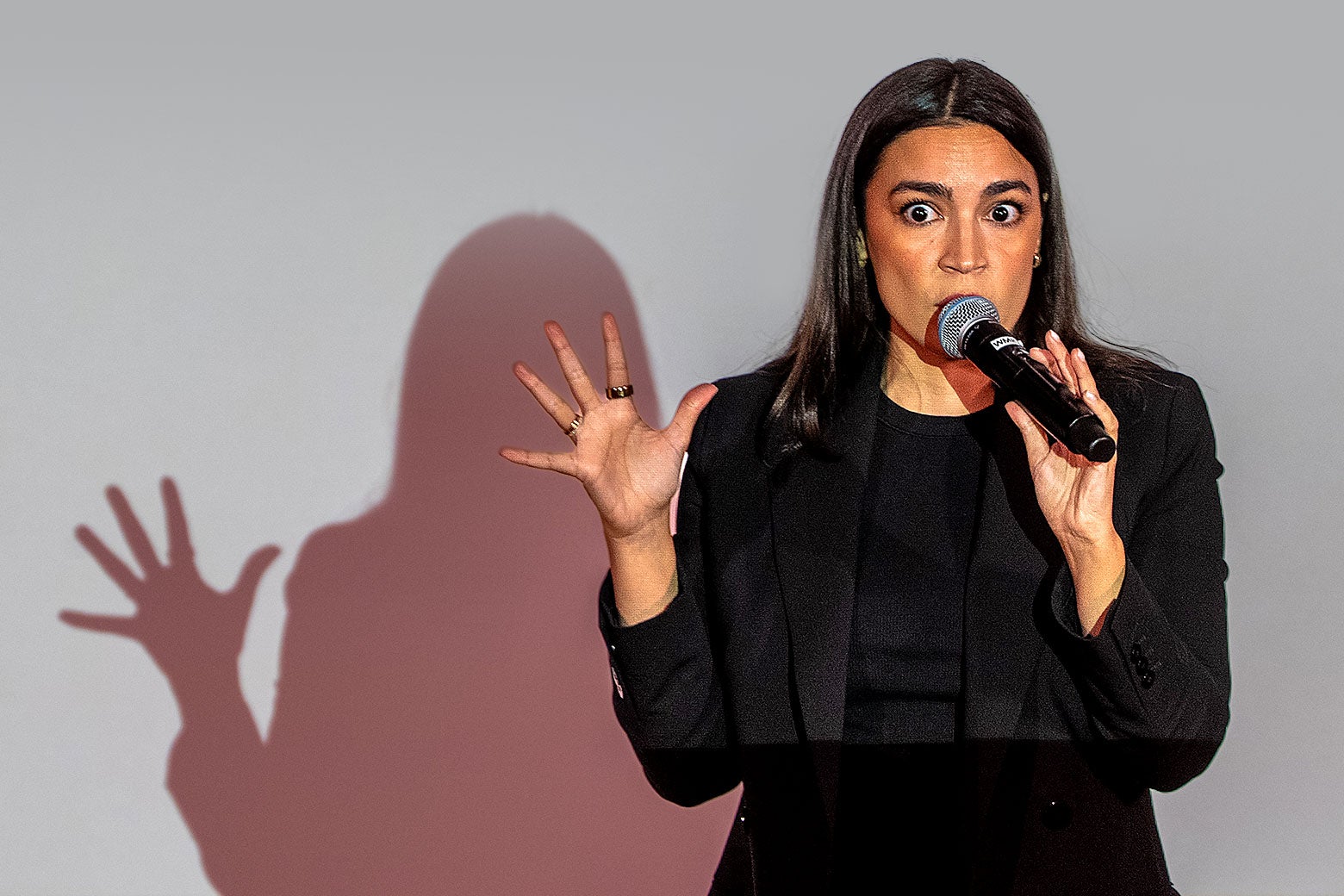
Politics AOC has a point—that era sure was crazy. But what went wrong is also a fixable problem. By Enter your email to receive alerts for this author. Sign in or create an account to better manage your email preferences. Unsubscribe from email alerts Are you sure you want to unsubscribe from email alerts for Luke Winkie? Aug 17, 20265:40 AM David Dee Delgado/Getty Images Sign up for the Slatest to get the most insightful analysis, criticism, and advice out there, delivered to your inbox daily. I need to acknowledge up front that it is unwise for anybody—including me—to deduce any comprehensive conclusions about the Democratic Party and where it’s headed from Wisconsin’s gubernatorial primary last week. That was a really weird race, and it only got weirder as Election Day drew nearer. The front-runner was Francesca Hong, a State Assemblywoman and DSA member who, according to the scant few surveys conducted, held a dominant lead over the moderate candidates in the field. Hong maintained that momentum throughout the spring and summer, as several establishment hands dropped out. The party searched far and wide to find a conventional Democrat to coalesce around, but the right person never surfaced. Then, in a last-ditch effort to fend off Hong’s insurgency, Milwaukee County Executive David Crowley, who had previously suspended his campaign, reentered the race less than a month before polls opened. This looked like a humiliation ritual to me: Crowley wasn’t polling competitively even when he was actively campaigning, and it seemed unlikely that his brand could be rehabilitated with such little time left. But then Crowley … won. Sure, Hong massively underperformed her benchmarks—posting an abysmal 7-point margin of victory even in the cobalt-blue Dane County—and, yes, we must note that Crowley eked out a razor-thin plurality. There are plenty of ways to account for this upset, from polling errors to the musical chairs at the ballot box to Hong’s failure to spend basically any money on TV ads. But, really, much of the postmortem has focused on Hong’s association with what we’re now all calling “Woke 1.” It’s hard to articulate exactly what Woke 1 is or, I suppose, was. But like pornography, you know it when you see it. Here are a few examples that come to mind. Woke 1 is a podcaster in Brooklyn listing their Twitter location as “unceded Lenape territory.” Woke 1 is a colleague at a public-relations firm starting a GoFundMe to escape a “toxic roommate situation.” Woke 1 is a 5,000-word article probing the crisis of bi erasure, a 34-year-old YouTuber canceled for dating a 25-year-old TikTokker, or perhaps a “gay immigrant Muslim furry romance” pitched as a weapon to resist Donald Trump. If you were to ask me, I might describe Woke 1 as a highly codified set of language principles that participants in left-wing causes were expected to internalize and wield with fluency because if they didn’t, they risked punishment, ostracization, or harassment. But even that doesn’t really get to the heart of the matter. I think when we derisively say Woke 1 now, what we are gesturing at is the shudderingly visceral feeling of the whole thing—the distinct haughty tang, the way-too-online insularity, and, most important, the telos that amounted to little more than inflicting guilt and experiencing guilt, in perpetuity. It was difficult to determine what that guilt could ever produce. After all, Lenape territory remains unceded, no matter how many times it is acknowledged. This is the stench that hampered Hong’s campaign. I wrote about all of this earlier this month, when it seemed she would be the nominee for Wisconsin’s governorship, but to quickly bring you up to speed: In 2020—the pinnacle of wokeness, when you could say just about anything and be taken seriously—Hong posted a good-natured but prototypically annoying tweet. The subject was Thanksgiving. Hong insisted that we ought to “cancel” the holiday because it celebrates “colonialism” that “killed Indigenous folx and women.” (As for what the x affixed to the word folk is supposed to mean, I still don’t know—and neither do you.) Like a lot of people in circa-2020 left-wing activism, Hong was correct on the merits. The genocide of Native Americans does, indeed, heinously clash with the new-world facade imagined by the Thanksgiving tradition. But if we’re being honest, that wasn’t the argument she was making in her tweet. Instead, she was asking Americans to embrace the ascetic, self-flagellating, and eternally anxious lifestyle of Woke 1. Did ordinary people really want to interrogate Thanksgiving like this? Especially knowing full well that all that interrogation could ever reveal was a bottomless shame that nobody—and certainly not themselves—could atone for? The answer to that question was no, which seems obvious now. But there was, indeed, a brief aperture of time in the pressure cooker of 2020 when it all seemed possible. Here’s the thing: Looking back, I do understand the utopian vision that captivated Hong and her fellow partisans. I think we all liked the idea of wreathing the long days of COVID with the possibility of rebirth. But you know what happened afterward. Trump got reelected on a tide of score-settling revanchism. Woke culture, at least in its original incarnation, was summarily defeated. Its most extreme positions—like prison abolition and police defunding—did not challenge conventions or prompt change; instead, they were easily reforged into right-wing cudgels. We sifted through the rubble, and it was clear to just about everyone that the left needed to retool to get its point across. But Hong didn’t get that memo and has lost her primary, and frankly, that’s for the best. A number of prominent leftists have started to back away from the tenets of Woke 1 in the blistering clarity of Hong’s defeat. The most prominent among them is Alexandria Ocasio-Cortez, who, during an appearance on ABC on Aug. 9, was asked about Hong’s Thanksgiving comments. In her response, she quoted a post made by New York City Councilman Chi Ossé, who himself had made some overheated posts in the early 2020s and recently corrected the record with “Woke 1 was crazyyyy,” a phrase AOC deployed on TV as well. A lot of dyed-in-the-wool activists were turned off by the flippancy of AOC’s riposte, and even with my own recent grappling over the problematic emotional landscape of the movement, I can understand why. The apotheosis of Woke 1 was triggered by the brutal murder of George Floyd by a police officer. Characterizing the outrage that followed as a strategic error feels a little mercenary. But with respect to those concerns, I don’t think that’s exactly what Ocasio-Cortez was saying. The underlying injustices animating wokeness are real, and the opposition to them is righteous. But the challenge, for AOC and anyone else dreaming up Woke 2, is to bring the cause to scale—for the folks, rather than the folx. Is there room for a positive wokeness? One that does not commit so much time and energy to go-nowhere debates? I am far from the first person to make this point, but one of the great failures of Woke 1 was how insistent it was to remind everyone of their sins, ancestral or otherwise. How, by existing on that unceded Lenape territory, they are living cruelly and thoughtlessly. But ordinary Americans do not like to think of themselves as unforgivably bigoted, because—generally speaking—ordinary Americans think that being bigoted is bad. And there is untapped power in that consensus. Perhaps, someday in the future, the spirit of 2020 will be revived with a new galvanizing philosophy: Most of our fellow citizens might actually be good people. Because the American people are angry. That’s the great irony of the Woke Reckoning; in many ways, the Democratic electorate is fully radicalized, perhaps more so than ever. The wine moms will happily endorse mass tribunals for aberrant Immigration and Customs Enforcement agents; they want to see the oligarchy toppled and the data centers razed to the ground. Entrenched institutions of U.S. statecraft—like our Israel policy—are suddenly, miraculously up for debate. Wokeness can still reign, but if it does, it will be an earthier wokeness. A more practical, forward-looking wokeness. A more joyful wokeness. Maybe you could call it a tea party wokeness, purged of pedants and scolds. A better world is still possible, so long as we’re not too annoying about it. Democrats Elections Internet Social Media Alexandria Ocasio-Cortez Wisconsin 2026 Midterms
It’s Obvious Now Why “Woke 1” Failed. I Have an Idea for How Progressives Can Be Less Annoying Next Time.
Full Article
Original Source
Read the full article at Slate →KhanList aggregates and links to publicly available news content. We do not host full articles from third-party sources. Always verify important information with original sources.