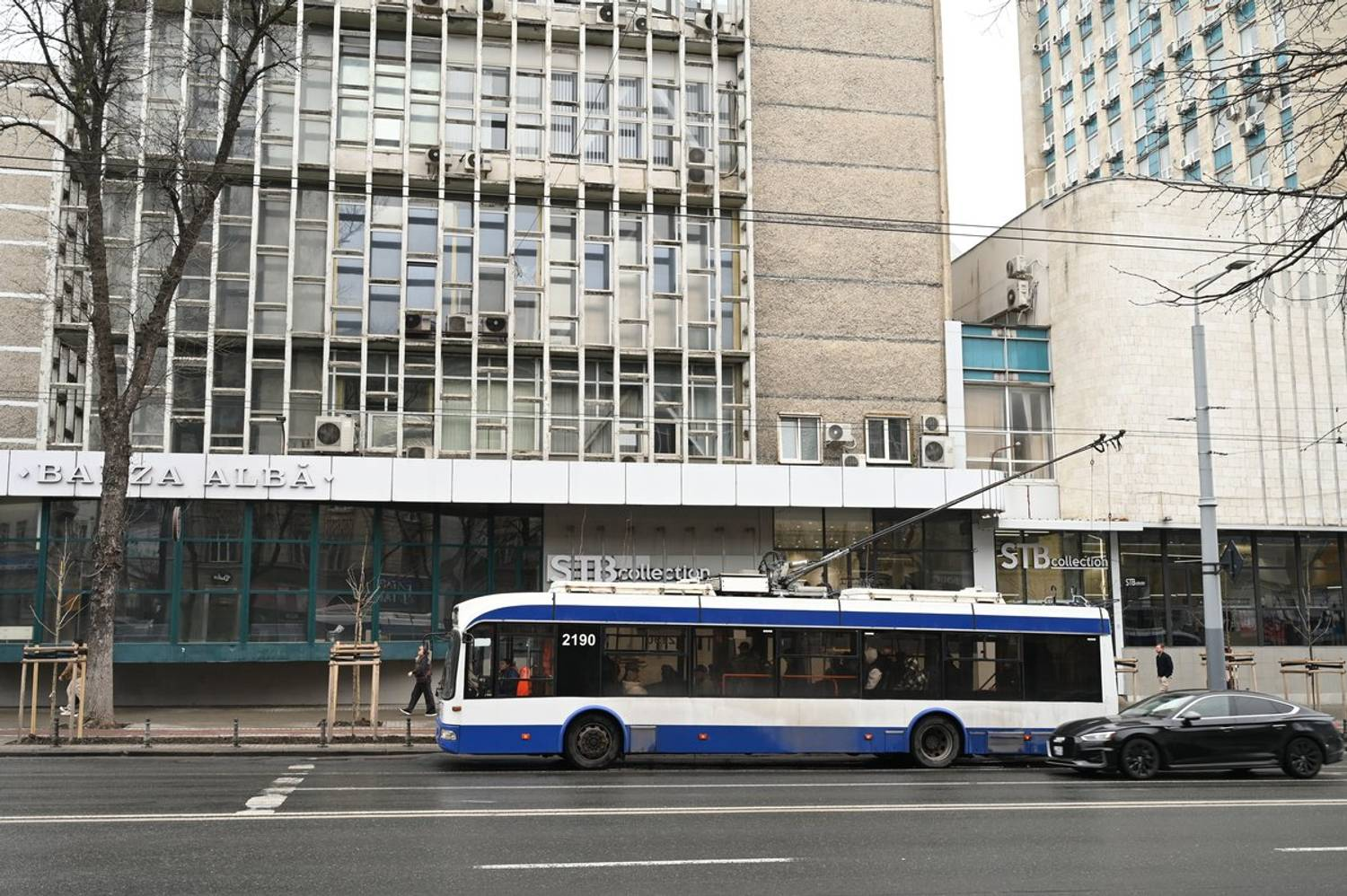
As a result of mass emigration, Moldova is among the fastest-depopulating countries in the world. One in four Moldovans lives abroad. But now, the state is trying to entice its citizens back. “Chisinau is a city of contrasts,” says Sasha, a young man in a baseball cap and beige jacket, with whom I chat over cigarettes and decaf coffee at the Casa Zemstvei community centre. His sentence sounds like a cliché, but as I stroll through the Moldovan capital of nearly three-quarters of a million people, I am reminded of it more than once. Even in the city centre, low houses with wooden beams stand, often with handymen kneeling in front of them, hammer or paintbrush in hand. Wide avenues, where columns of cars and blue-and-white trolleybuses crawl, are lined with majestic Brutalist concrete structures and white limestone buildings adorned with Neoclassical reliefs. Yet, just a few blocks away, the grand boulevards are replaced by torn-up roads where, despite their dismal state, more cars are stubbornly parked. “Does Chisinau feel like a European or a Soviet city to you? Last year, friends visited me here and said it felt European. It filled me with pride,” I heard in several variations during my stay. Between war and European integration Since the Russian invasion of Ukraine in 2022, the geopolitical situation has dominated Moldovan public debate. Many feared that if Ukraine fell, the next in line would be neighbouring Moldova. The war next door affects the country directly: in mid-March, the government declared an emergency due to fuel contamination of the Dniester River following a Russian attack on a Ukrainian hydroelectric plant, and Moldova suffers power outages as a result of Russian strikes on Ukrainian electrical infrastructure. The European Union opened accession negotiations with Moldova in December 2023, and the Moldovan government is hastily adopting EU-required reforms, hoping to conclude an accession treaty by 2030. Moldova is among the world's fastest-depopulating countries. Source: Petra Dvořáková/DR. The continuation of European integration was narrowly but ultimately confirmed in 2024 by two concurrent elections: a referendum on enshrining the promise of EU integration into the Moldovan constitution, and presidential elections in which Maia Sandu, from the ruling centre-right liberal Party of Action and Solidarity (PAS), succeeded for a second consecutive term. It was confirmed again in 2025 when PAS won parliamentary elections. However, those elections would have turned out differently were it not for the votes of the Moldovan diaspora, which today numbers approximately one million people. Shortage of doctors and gravediggers Moldova is among the fastest-depopulating nations in the world. While in 1991 the population was nearly four and a half million, today fewer than three million people inhabit the country. Every fifth child in the country grows up with only one parent, or even without parents at all. "When someone dies, according to local tradition, eight men should dig the grave. But in some villages, you can hardly find eight adult men," says sociologist and journalist Vitalie Sprînceană, illustrating the situation with a bitter anecdote. There is a lack of gravediggers, a lack of doctors; the population is ageing, and in the future there might not be enough taxpayers to sustain low pensions and underfunded public services. Moldova, hit by a severe economic crisis shortly after independence, was long described as the poorest country in Europe. It remains among the poorest, although Ukraine and Kosovo currently fare worse in GDP per capita. Mass emigration for work began in the 1990s, initially with men heading to Russia for construction work. After the 1998 Russian financial crisis, emigration shifted westward, especially to Romania and Italy, where Moldovan women filled the growing demand for caregivers. This changed with Romania's EU entry in 2007, which triggered another wave: Romania grants citizenship to anyone who was a Romanian citizen before 1940, including descendants up to the third generation. Today, roughly one-third of Moldovans hold dual citizenship. 'The best have left' Another wave hit in 2014, fuelled by visa-free EU travel and a loss of faith following the "one billion" corruption scandal, in which one billion dollars was siphoned out of the Moldovan banking system by EU-sanctioned oligarchs Ilan Shor and Vladimir Plahotniuc, and former prime minister Vlad Filat. At that time, the children of earlier emigrants were leaving too — not just for economic reasons, but over thwarted political hopes and poor public services. "University education was a business at the time of my studies; diplomas were for sale. I had classmates who never showed up at school and yet achieved the best grades," explains Vlada Ciobanu in the austere white office of the Center for Policies and Reforms. Ciobanu completed her bachelor's degree in Moldova and went to the UK for her master's. "The question wasn't if I should do it, but when. If you finished a bachelor's in Moldova, it was almost essential to do a master's abroad," she adds. As sociologist Alexandr Makuhin confirms, emigrating was simply "normal": "If you wanted to build a specific career, succeed in science, or work for a multinational corporation, you had no choice but to emigrate." "If you finished a bachelor's in Moldova, it was almost essential to do a master's abroad," explains Vlada Ciobanu of the Center for Policy and Reforms. Source: Petra Dvořáková/DR. Sprînceană explains that as social networks grew, so did the influence of pro-EU parties, shifting the public debate. "One of the dominant narratives is the claim that 'the best have left.' There is a grain of truth in that: since the nineties, doctors, engineers, teachers, and scientists left to perform jobs in the West far below their qualifications. Until 2010, however, the word 'diaspora' wasn't used at all; people simply spoke of Moldovan Gastarbeiters," Sprînceană outlines. In the 2010s, part of the diaspora began participating in domestic politics from afar. "They started commenting on the domestic situation, expressing anger, sadness, and joy over what was happening here. And most importantly, they began participating in elections. The so-called pro-European forces realised that this was a huge electorate very loyal to parts of their program. And they began targeting the diaspora in their campaigns," Sprînceană continues.
‘It’s like returning to the Wild West’ – Moldova tries to lure back its lost citizens
Full Article
Original Source
Read the full article at Euobserver →KhanList aggregates and links to publicly available news content. We do not host full articles from third-party sources. Always verify important information with original sources.