
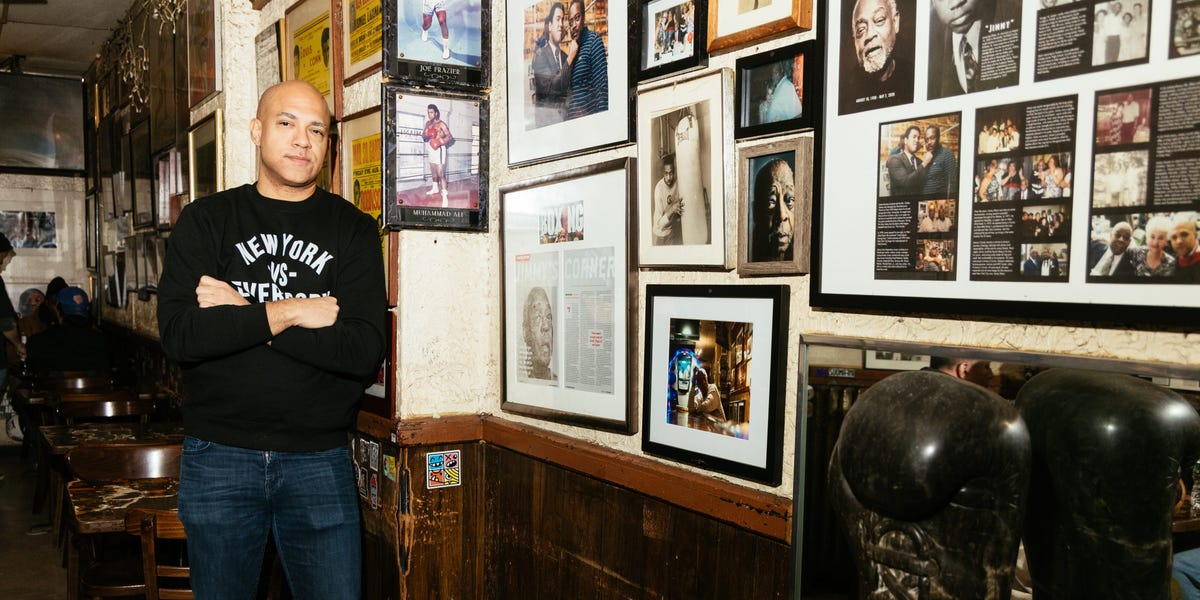
Rebecca Smeyne for BI Adam Glenn is fighting to save Jimmy's Corner, the Times Square bar his father opened 55 years ago. Last call for the great American dive bar Rising rents, increased costs, and less boozing: Why it's harder than ever to keep local bars afloat There are few things more magical than walking into a dive bar at 2 pm on a Tuesday. It's late enough in the day to provide some plausible deniability but early enough to avoid the happy hour crowd. In the air hangs the stench of stale beer and decades-old cigarettes and the ghosts of drunken decisions past.Jimmy's Corner, tucked under an unassuming blue awning steps from Times Square, is the type of place built for those kinds of afternoons. Its walls are lined with photos and memorabilia gathered by its late owner, Jimmy Glenn, a longtime boxing trainer. The bar is heavily shellacked, its edges intermittently covered in duct tape. Above the liquor shelf hangs a sign warning that political talk is prohibited. In the corner sits a Knicks-branded foam finger covered in dust bunnies, a reminder of how long fans waited for the NBA championship. Beer cases are stacked at the back of the narrow space on the walk to the bathroom, which is appropriately covered in graffiti, though not terrifyingly gross.The November afternoon I walk into the 55-year-old establishment, it feels like traveling back in time, minus the paper straws. The man next to me at the bar agrees to watch my water while I scoot away for a minute, and I agree to only lightly make fun of him for drinking his Heineken over ice. Someone stops in to leave a phone battery for a guy named Phil. Regulars buy drinks for a trio of young sailors in town for the week before shooing them away to bars where they're likelier to meet women. The bartender, John, has been a customer at Jimmy's for 30 years but only got behind the bar in 2021. Rebecca Smeyne for BI Looming over all of it is the fact that the existence of Jimmy's Corner is at risk — it's locked in an eviction battle with a landlord that wants it out.For years, New Yorkers have fretted over the death of the dive — these neighborhood homes away from home that still feel homey. They remain resilient, but rising rents, soaring costs, and shifting drinking habits have left them in an extra precarious position."New York needs but is in danger of losing authenticity and what really makes New York," says Jimmy's son, Adam Glenn, who now owns the bar. "I love this city, and part of it is why is anyone going to come if we just have the same stuff that every other place has?"Glenn always planned to return to Jimmy's Corner, despite his Harvard law education. He abandoned his corporate legal career to help run the bar in 2015, when his mother died of lung cancer, and fully took over when his father died of COVID complications in 2020 at the age of 89. In 2023, the building's owner — the Durst Organization — attempted to terminate the bar's lease, arguing that Jimmy Glenn's death voided it. Adam Glenn has sued to stop the eviction, alleging the clause allowing Durst to end the tenancy upon his father's death was slipped into a 2010 modification without his father's knowledge. He also points out that the landlord accepted his rent payments, which come out to about $5,000 a month, for years after his dad died — including during the 18 months the bar was closed due to the pandemic.Glenn isn't naive — he recognizes that keeping Jimmy's in its original location forever is not a realistic expectation. Durst sold the building this year, and the new owner appears to also want Jimmy's gone. For now, the best-case scenario is the bar makes it to the current lease's 2029 expiration date. Apart from running Jimmy's, Adam Glenn also managers boxers — just like his dad. Rebecca Smeyne for BI "I didn't ever tell them, 'I'll never leave, I refuse to go,'" Glenn says. "There's a right way to do it, but you're choosing to do this in the ugliest way possible."A spokesperson for the Durst Organization said in an email that the building was sold and that they are no longer the landlord. An attorney for the new owner, Ben-Josef Group Holdings, did not respond to a request for comment.One of modern New York's paradoxes is that in a city of 8 million people, storefronts can sit empty for months or years while longtime businesses struggle to stay put. Bars and nightclubs have a 10.9% vacancy rate, according to the city comptroller, and in some Manhattan neighborhoods, vacancies can be especially persistent.Once a gritty block becomes desirable, a bar built on cheap drinks and loyal customers can find itself unable to make the new market-rate rent. It then becomes dependent on a landlord's willingness to renew a lease rather than attract a tenant with deeper pockets."You're really at the mercy of the landlord," says Andrew Berman, the executive director of Village Preservation, a nonprofit advocacy group focused on Lower Manhattan. There are legal mechanisms for preserving buildings, he adds, but not for preserving a business. Jimmy's Corner's awning is so unassuming you almost miss it. Rebecca Smeyne for BI Of course, longtime establishments close for a multitude of reasons — their owners retire or sell, a new buyer decides to change the concept. But the losses become harder to write off as ordinary churn when a bar is still viable as a business, and the people running it are eager to keep going. A look at the 50 locations on Complex Magazine's 2011 list of New York City's best dive bars illustrates the evolving landscape. At least 10 have now closed, while others have moved, been renovated beyond recognition, or face their own lease and ownership threats. Plenty remain — dive bars are, indeed, stubborn institutions — but their endurance often depends on circumstances far beyond whether people still want to drink there.It's possible to come out on the other side of tumult. Take Neir's Tavern in Woodhaven, Queens. Loycent Gordon, a now-retired FDNY firefighter, bought Neir's in 2009 when it was on the brink of shuttering. The nearly 200-year-old neighborhood fixture had become a bit too divey for its changing surroundings — peeling paint, a crumbling tin ceiling, one draft beer on tap. "When I came in, I found that $200 for them on a Saturday night was a big deal," Gordon says. He made some adjustments, bringing in food and making the place more welcoming to a broader clientele, while maintaining the neighborhood vibe. The pivot worked until it didn't — a new landlord bought the building in 2018, and when the lease came up for renewal, they tried to jack up the rent. By early 2020, Neir's was once again on the brink of closing. As a Hail Mary, Gordon called into Mayor Bill de Blasio's weekly radio show to ask for help, and after some municipal cajoling, the parties were able to reach a deal that both the landlord and tenant could stomach. Still, staying afloat has become a war of attrition. "It's like death from a thousand cuts," Gordon says. Rent may be the most visible threat, but bars are being squeezed simultaneously from all sides. Wholesale prices for everything from liquor to frying oil are up, while labor costs are marching steadily higher. Few customers pay with cash anymore, meaning credit card swipe fees shave off the top of every tab. The real "sleeper," Gordon says, is liability insurance. His provider tried to cancel his relatively affordable policy a couple of months ago, and he had to "fight like hell" to keep it. If a big hike had happened, he would have had to fire some of his employees. Behind the bar at Jimmy's. Note the sign: No politics. Rebecca Smeyne for BI Gordon sees Neir's as a "beacon of hope and stability in an ever-changing world," but it's not stagnant, as Gordon sets out to diversify revenue streams. He has signed contracts with tourist companies to try to bring visitors in — one of the bar's claims to fame is that it was featured prominently in "Goodfellas." He is working on a plan to distribute one of its signature drinks at retail locations, and he's licensed two Neir's outposts at JFK Airport.The challenges keep on coming. The nightlife industry depends heavily on foreign workers, and the Trump administration's crackdown has spooked many immigrants. One of Gordon's longtime employees is Mexican, and while he's living and working fully legally in the US, he refused to go to the new JFK location to help with training out of fear he could be mistakenly detained by federal immigration authorities. "He was scared to death," Gordon says.The adversity dive bars are facing isn't confined to New York. John Bodnovich, the executive director of American Beverage Licensees, a trade association for alcohol retailers, says that while many locals across the country are hanging in there, the business remains a grind. Margins are razor-thin, and customers are increasingly selective about where they spend their money.Many Americans are drinking less, choosing to moderate for the sake of their health and their bank accounts. GLP-1s are curbing alcohol consumption, and THC drinks are eating into some market share. Gen Z is still figuring out bar culture. This environment requires owners to get creative and "give people a reason to show up," Bodnovich says. That might mean bingo, trivia, or karaoke, or hammering home for customers what makes the place unique. "Of local neighborhood bars that are successful, they have a personality, and they have a character — they develop that," he says.Even for local bars that have personality and character in spades, so much comes down to who controls the real estate.In the life of a city, there's always a balance to strike between nostalgia and progress, including back at Jimmy's Corner. "I grew up here in the 'bad old days' of Times Square," Glenn says. It's good that some of the city's roughest edges have been sanded down. Like many dives, Jimmy's Corner picks up quite a weekday afternoon crowd. Rebecca Smeyne for BI That's also what makes his situation so frustrating. "Part of what made it better was my parents being out here and protecting people and making sure that this little corner of Times Square was safer than it was before they got here," he says. But improving a neighborhood drives up property values and makes other, larger businesses more willing to come in. Jimmy's still manages to sell $3 beer, which Glenn prefers to think of not as cheap but accessible. "That's how New York's supposed to be," he says. "You're supposed to have rich, poor, black, white, local, tourists, all in the same place."Glenn has started scoping out other locations for a move, but he's found he doesn't have much leverage with landlords who seem content to let their properties sit empty. His real dream is to buy a space of his own, so that he, not a landlord, can control his own destiny.For all the uncertainty, Glenn's enjoyed running Jimmy's more this year than he has since his parents passed. You always appreciate things more when you might lose them, and even the little annoyances take on a certain charm. He plans to host a party at Jimmy's on December 4 to mark the one-year anniversary of his lawsuit, which is still making its way through the court."It's like getting another day with a family member or someone you love," Glenn says. "I get to be here."Emily Stewart is a senior correspondent at Business Insider, writing about business and the economy. Business Insider's Discourse stories provide perspectives on the day's most pressing issues, informed by analysis, reporting, and expertise. New York City Alcohol Small Business More Real Estate Discourse Most popular Business Insider tells the stories you want to know about the world of business, technology, and finance Business Insider tells the stories you want to know about the world of business, technology, and finance Business Insider tells the stories you want to know about the world of business, technology, and finance Business Insider tells the stories you want to know about the world of business, technology, and finance Business Insider tells the stories you want to know about the world of business, technology, and finance Business Insider tells the stories you want to know about the world of business, technology, and finance Emily Stewart is a senior correspondent on Business Insider’s Discourse team. She focuses on consumerism, culture, and the economy, among other topics. Some of her biggest stories have explored Red Lobster’s demise, middle-class shoplifting, convenience stores’ struggles, the rise of illicit drugs as work performance-enhancers, and generational finance trends, including Gen Z’s love for AmEx and the impending avalanche of baby boomers’ stuff. She also writes regularly about sports betting, event ticketing, the alcohol industry, work, millennials, and economic trends. Emily appears regularly on nationally syndicated radio shows and podcasts, including Marketplace, The Weekend Dive, and Today, Explained. She has guest hosted C-SPAN’s “After Words” and moderated multiple panels on economic policy and workplace dynamics.Before joining Business Insider, Emily was at Vox, where she covered business and the economy and wrote a newsletter, “The Big Squeeze,” about how people experience the forces of the economy and capitalism day to day. Prior to that, she worked at TheStreet.
It's last call to save America's dive bars
Full Article
Original Source
Read the full article at Businessinsider →KhanList aggregates and links to publicly available news content. We do not host full articles from third-party sources. Always verify important information with original sources.